Workshops Support Moroccan Olive Oil Sector
As part of the FAO’s and EBRD’s ongoing support to Morocco’s olive oil sector, a series of workshops were organized during the first quarter of 2017.
A series of workshops in Morocco aiming to strengthen the country’s olive oil sector were organized jointly by the European Bank for Reconstruction and Development (EBRD) and the Food and Agriculture Organization of the United Nations (FAO) during the first quarter of 2017.
We are focused on organizing ourselves better in terms of national representation of the industry.
On February 7, 2017, a workshop was held in cooperation with Interprolive, Morocco’s olive oil industry association, in Meknes, which is in the heart of one of the country’s olive growing regions.
Public and private stakeholders were invited to come together to discuss how to improve interprofessional organization and ensure a high quality of olive production in the region. At the same workshop, representatives of olive oil professional associations from Italy and Portugal were invited to share their experiences and insights with their counterparts working in the olive industry in Morocco.
In a press release by the FAO, Interprolive’s director, Ahmed Khannoufi shared details about the association’s recent activities: “Right now we are focused on organizing ourselves better in terms of national representation of the industry, and have signed a ‘contract programme’ with the government that has allowed us to start providing services to our members, such as technical assistance and communication strategies to increase consumer awareness.”
Specifically, the association has launched an advertising campaign encouraging Moroccan consumers to buy better quality olive oil packaged in bottles instead of in bulk and has been focusing on providing technical training to its member aiming to improve production.
Mohamed Sadiki, the secretary general of Morocco’s Ministry of Agriculture and Maritime Fisheries reiterated the importance of improving the quality of the country’s olive production: “By reinforcing olive oil sector institutions and focusing on the quality of production, Morocco will be able to strengthen the olive oil value chain at the national level, facilitate job creation and increase exports,” he was quoted as saying in the FAO press release.
As part of the FAO’s and EBRD’s ongoing support to Morocco’s olive oil sector, 12 training workshops in olive tree pruning were also organized from 12 to 18 March. Participants included students of agricultural science, members of economic interest groups working in the olive sector, as well as olive growers and producers from the provinces of Sefrou, Taza and Taounate.
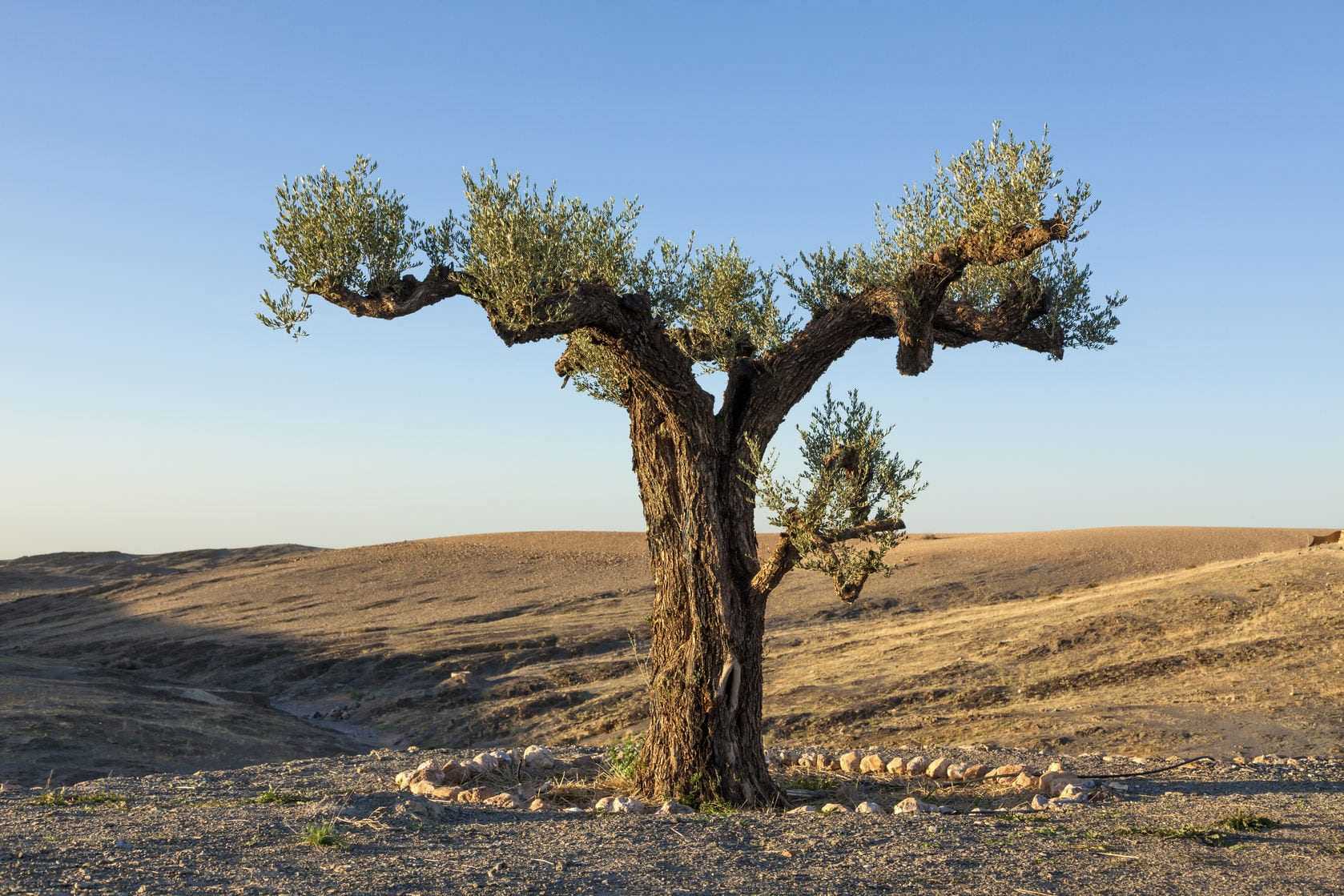
Olive tree in the Agafay Desert, Morocco
“The olive oil sector in Morocco has played a role of primary importance in the government’s (Green Morocco Plan),” said Michael Hage, the FAO representative in Morocco. “In this context, priorities for development of the sector have a specific focus on aggregation, improvement of quality and efficiency all along the value chain, development of the local olive oil market and support to exports of Made in Morocco products.”
Increasing olive production is one of the focal points of the government’s Green Morocco Plan, launched in 2008. Under the 15-year program, there have been significant investments in the olive sector with the aim to increase olive production to 2.5 million tons by 2020.