Report Finds Rising Interest in Olive Oil Tourism Amid Knowledge Gap in Italy
Olive oil tourism in Italy grew sharply between 2021 and 2024, but a new report shows most consumers still cannot name a single olive cultivar.
A significant expansion of olive oil-related tourism in Italy in recent years has coincided with a persistent cultural distance between consumers and the product itself.
According to the Second Report on Olive Oil Tourism, the number of people taking part in olive-themed experiences increased by 37.1 percent between 2021 and 2024, signaling strong growth in consumer interest.
The report reflects a broader transformation in Italian food travel, where gastronomy is increasingly shaping tourism choices and oleotourism is expanding its role.
“The olive oil tourism report again shows a growing interest in olive oil not only as an agricultural product but as an expression of territory, history and community,” Michele Sonnessa, president of the national association Città dell’Olio, said in introducing the report.
The study notes that Italy’s olive sector represents a unique global heritage, with about 619,000 olive-related enterprises and more than 500 recognized olive cultivars spread across the country. Still, only 47 percent of Italians are able to name at least one olive tree variety.
By contrast, 33 percent said they did not know any cultivar, while another 20 percent said they did not know how to answer, meaning a majority of respondents were unable to identify a single olive variety.
The report also found that when asked to name olive varieties, about eight percent of respondents cited commercial olive oil brands rather than botanical varieties.
For the authors, that gap underscores the importance of initiatives such as olive oil tourism, which can help consumers connect directly with producers, landscapes and the biodiversity behind extra virgin olive oil.
“Olive oil tourism has enormous potential, especially in our region, cradle of some of the most prized extra virgin olive oils in the world. Curiosity about this product, its characteristics and its properties is finally beginning to grow, but knowledge about it remains very limited,” Alberto Morettini, general director of the multi-awarded Frantoio di San Gimignano in Tuscany, recently told Olive Oil Times.

A learning experiences for children (Photo: Frantoio di San Gimignano)
Morettini’s company has expanded into several projects that combine culture and tourism around olive oil, including museum-style installations, interactive tours, and educational experiences.
The report noted that oleotourism is increasingly viewed as a strategic tool for rural development and territorial preservation, since it can generate additional income and help counter olive grove abandonment.
“Olive oil tourism experiences encourage more sustainable agricultural practices and support the conservation of olive biodiversity. Oleotourism represents a lever capable of strengthening the Italian olive sector, generating economic benefits that go beyond product sales and contributing to the protection of olive landscapes,” said Roberta Garibaldi, the report’s lead researcher.
The report shows that most olive oil tourism experiences are still centered on direct contact with producers and their products.
Among Italian travelers who have taken part in olive-related experiences, the most common activity is buying olive oil directly from a producer, cited by 20 percent of respondents. Guided tastings followed at 12 percent, while 11 percent said they had visited an olive farm or mill during their travels.
Other common experiences included visiting historic mills, attending olive oil festivals and tasting different oils in restaurants paired with local dishes, each mentioned by roughly 11 percent of respondents.
While traditional activities remain dominant, the report also identified growing interest in more immersive and creative formats. About nine percent of respondents said they had taken part in olive harvesting and made their own olive oil, while eight percent had joined walking itineraries through ancient olive groves.
More experimental offerings are also emerging. About five percent of respondents said they had participated in candlelight dinners in olive groves or booked multi-day tourism packages centered on olive oil.
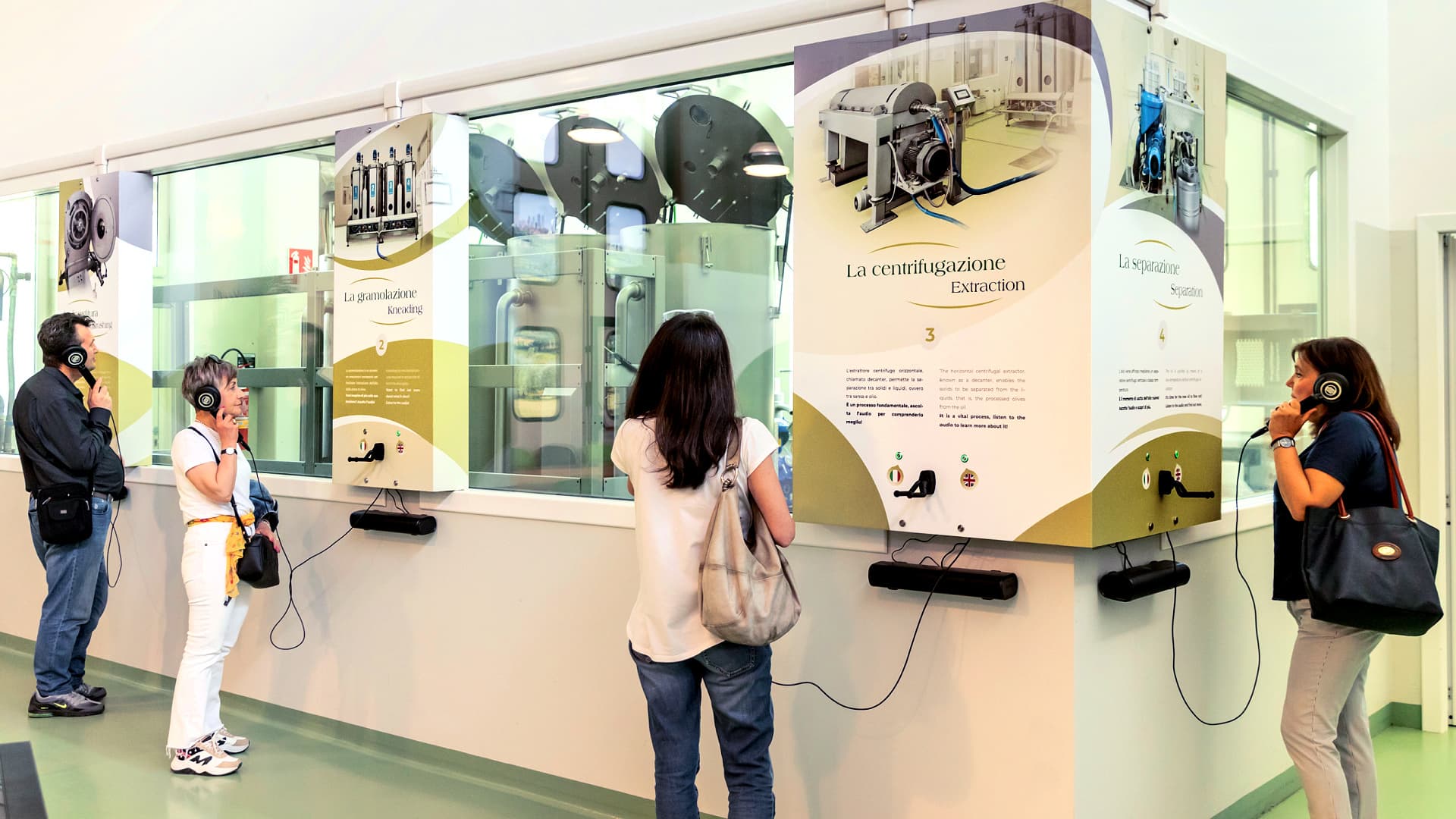
Interactive Olive Museum (Photo: Frantoio di San Gimignano)
The research extended beyond Italy to examine France, Germany, Austria, and Switzerland, which are considered the main nearby markets, and found that international tourists often approach olive oil tourism differently from domestic visitors.
According to the report, foreign travelers tend to focus more on tastings and direct product discovery, while Italian visitors are more often drawn to broader experiences combining olive oil with landscape, culture and wellness.
The results also showed notable differences in spending behavior. The report found that foreign visitors are often among the most valuable segments for olive tourism because they tend to spend more and prioritize premium food experiences.
In most European countries, the preferred price range for a guided visit to an olive farm with tasting is between €20 and €40 per person. U.S. tourists, however, show a significantly higher willingness to pay. About 23 percent said they would spend between €41 and €60, while roughly 15 percent were willing to pay between €61 and €100, bringing the share of U.S. travelers ready to spend more than €60 to about 30 percent.
More than half of international travelers, between 56 and 81 percent depending on the market, said they want to experience food and wine tourism in Italy over the next three years.
In a country grappling with over-tourism in some destinations, olive oil-related travel is helping redefine the identity and visibility of lesser-known rural areas.
Initiatives linking production zones with rural culture, museums and nature-based activities are increasingly attracting both domestic and international visitors.
“Each bottle contains the work of those who protect often difficult territories and preserve the beauty of rural landscapes,” David Granieri, president of the Italian olive oil producer association Unaprol, said in presenting the report.
Morettini said an olive mill is not only a workplace but also a place of meetings and exchanges among private producers, farmers, millers, and agronomists.
“Still, it is a place where the senses are awakened: the aroma of the crushing fills the air, the sound of the machinery can be heard, the color of each production is examined and, above all, the new oil is tasted,” he said. “We wanted, through the visitor path we developed inside our mill and through tastings, to make these emotions accessible to everyone throughout the year.”
The report suggests that olive oil wellness treatments and nutraceutical applications could emerge as new tourism niches that attract visitors year-round.
Despite its growth, the report emphasizes that oleotourism still requires stronger professionalization and organization to reach its full potential. Training programs for hospitality professionals, olive oil guides and tourism managers are seen as essential to turning many existing initiatives into sustainable business models.
“We must create new professional figures, from hospitality experts to olive guides and managers of mill tourism experiences,” the report says in its concluding recommendations.