Used Cooking Oil Finds New Life in Innovative Materials for Cars, Homes
New research led by the University of Pisa found that used cooking oil can be transformed into polyurethane foams, heat-storing materials and bio-lubricants for industrial use.
Used cooking oil can be transformed into innovative materials for the automotive and construction sectors, including polyurethane foams, phase-change materials capable of absorbing, storing and releasing heat, and bio-lubricants for industrial hydraulic systems.
That is the finding of a study coordinated by the University of Pisa within the MOST Sustainable Mobility National Center, funded under Italy’s National Recovery and Resilience Plan. Led by Maurizia Seggiani of the university’s Department of Civil and Industrial Engineering, the work was developed in the framework of Spoke 11, a program focused on sustainable, innovative materials and lightweight solutions.
“Basically, we used this waste – used cooking oil – as a precursor for polyols,” Seggiani told Olive Oil Times. “Polyols are one of the two main components of polyurethane foams, alongside isocyanates.”
She explained that the used cooking oil was subjected to chemical treatments to obtain polyols. The mixture of waste cooking oils consists of triglycerides whose fatty acid chains contain double bonds, making them unsaturated. This made it possible to exploit those double bonds to functionalize the chains with hydroxyl groups, which then react with isocyanates to form urethane bonds, giving the foams their characteristic reticular structure.
By adding suitable additives, including catalysts, surfactants and foaming agents in small quantities, researchers created open-cell structures that give polyurethane foams their flexibility.
“With this research, we aimed to develop flexible foams for use in the automotive industry, but we can also produce closed-cell foams to be used as insulating panels in the construction sector,” Seggiani said.
The used cooking oil was also repurposed for other applications. In particular, the derived polyols were tested as bio-lubricants to provide an alternative to conventional petroleum-based lubricants.

Professor Maurizia Seggiani, of the University of Pisa’s Department of Civil and Industrial Engineering, led the NRRP MOST‑funded research that developed innovative materials from waste cookin oils.
“In this case, the polyols underwent the standard tests used to validate lubricants, such as rheological and tribological analyses, friction coefficient measurements and viscosity index evaluation, to assess how their viscosity changes with temperature,” Seggiani said. “Some of these polyols successfully passed the tests and therefore show potential as bio-lubricants for tightening operations carried out at room temperature. So far, they have been tested specifically for this type of application.”
Another part of the research, conducted in collaboration with Maria Michela Dell’Anna of the Polytechnic University of Bari, focused on developing phase-change materials through a hydrogenation process.
“These materials undergo phase changes, from liquid to solid and back again, at temperatures between 30 and 35°C,” Seggiani said. “This allows them to be incorporated into polyurethane panels, giving them the ability to absorb, store and release heat in response to temperature changes. These panels can be used in vehicles or integrated into building walls. This is one of several strategies to improve energy efficiency, reducing the energy required to heat or cool indoor environments.”
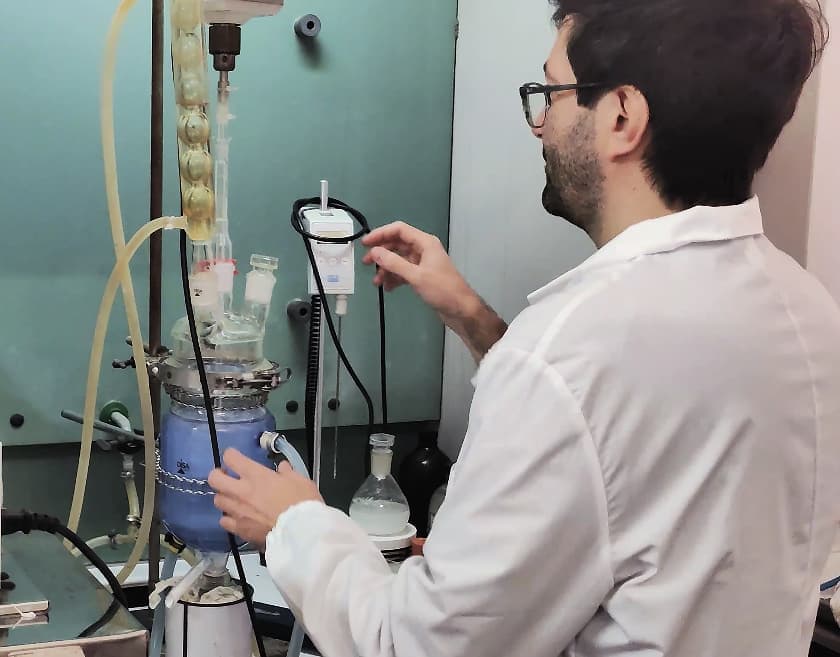
Damiano Rossi, of the University of Pisa’s Department of Civil and Industrial Engineering, during laboratory activities for the research that turned waste cooking oil into innovative materials.
The waste cooking oil used in the research was supplied by Physis Srl, a Tuscany-based company that collects it from large retail chains and catering facilities. Analyses carried out during the study showed that the oil contained about 45 percent oleic acid by weight, indicating a significant presence of virgin and extra virgin olive oils.
“The oil we used was collected in Tuscany, where extra virgin olive oil is widely used, even for frying,” Seggiani noted. “The composition of the oil mix can vary depending on the region where it is collected.”
Seggiani said there is extensive literature on the use of virgin oils, such as soybean and castor oil, to produce polyols for polyurethane foams. Because their compositions are known in advance, including the percentage of double bonds available for functionalization, they allow for more standardized production processes.
“Working with mixtures of used oils introduces additional complexity because the degree of unsaturation varies from batch to batch, requiring the additives to be recalibrated each time,” she said. “Nevertheless, this is the more sustainable approach, since using virgin oils competes with food production and land use, and we cannot divert edible resources to produce industrial materials.”
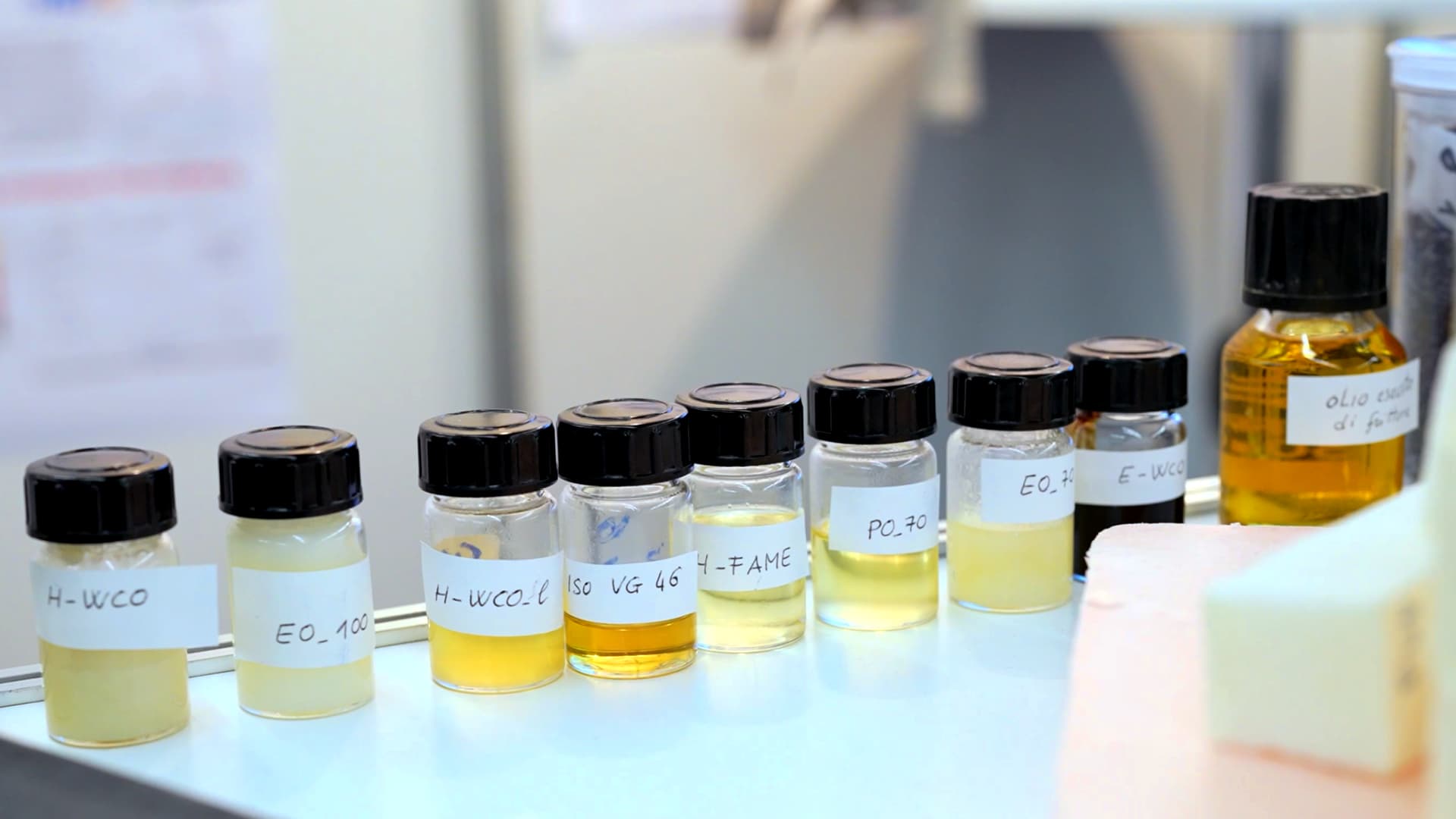
Tests conducted by researchers at the University of Pisa showed that polyols derived by waste cooking oil can function as bio-lubricants, offering a viable alternative to conventional petroleum-based formulations.
Seggiani said that while an effective collection system exists for large-scale facilities, household waste oil still lacks one, despite the potential benefits.
“The company from which we sourced the waste cooking oil, Physis, collects it from large retail chains and canteens that can guarantee a steady supply,” she said. “In Italy and across Europe, only a small fraction of household waste cooking oil is collected. Estimates suggest that between 0.6 and 1 million tons are collected annually in Europe, compared to a potential of around 4 million tons. Much of what is collected is currently used for biodiesel production. We hope that developing alternative applications for this waste, as demonstrated in our research, will help encourage a more effective collection of household used cooking oil.”
Seggiani emphasized that the key value of the research lies in transforming a waste material destined for disposal into durable, high-value products, bringing additional environmental benefits.
“In an unstable geopolitical landscape, where access to energy and chemical raw materials is increasingly subject to tensions and strategic dependencies, investing in alternatives to fossil-derived oil is not only an environmental choice, but also an industrial and political one,” she said. “Research must anticipate these changes by developing complementary solutions that reduce the vulnerability of supply chains. In this context, valorizing a local waste product such as used cooking oil represents one possible strategy to reduce reliance on fossil resources. Turning it into high-value materials means strengthening technological autonomy, diversifying sources and building more resilient production systems capable of addressing future global challenges.”