Literature, Science and Olive Oil Take Center Stage at Rome Awards Ceremony
The ninth Ranieri Filo della Torre Award brought together researchers, writers, educators and olive oil professionals in Rome to celebrate excellence in science, culture and the growing recognition of women’s contributions to agriculture.
The ninth edition of the Ranieri Filo della Torre Award concluded on May 25 with a well-attended ceremony at Palazzo della Valle, headquarters of Confagricoltura in Rome.
Promoted by Pandolea, a non-profit association of women olive oil professionals, and supported by leading industry organizations, the unique competition honors Ranieri Filo della Torre, a prominent figure in the sector. The award celebrates the olive tree and olive oil through literature, art and science.
The event was moderated by archaeologist Laura Pinelli and featured remarks from Roberto Caponi, director general of Confagricoltura; Rosa Giovanna Castagna, president of Donne in Campo of CIA Agricoltori Italiani; Desiree Nieves, president of Confagricoltura Donna of Viterbo–Rieti; Elia Pellegrino, vice president of AIFO; Roberta Bernini of the National Academy of Olive Tree and Oil; Marida Iacona della Motta, Filo della Torre’s wife; and Tacko Ndiaye, gender team leader at the FAO’s Rural Transformation and Gender Equality Division.
“In many contexts around the world, olive production is not simply an agricultural activity; it is linked to community identity, environmental protection and rural resilience,” Ndiaye said. “Women play a key role throughout the value chain, from cultivation and processing to the marketing of olive oil, and this year the United Nations has reminded us of the importance of their voices in agriculture.”
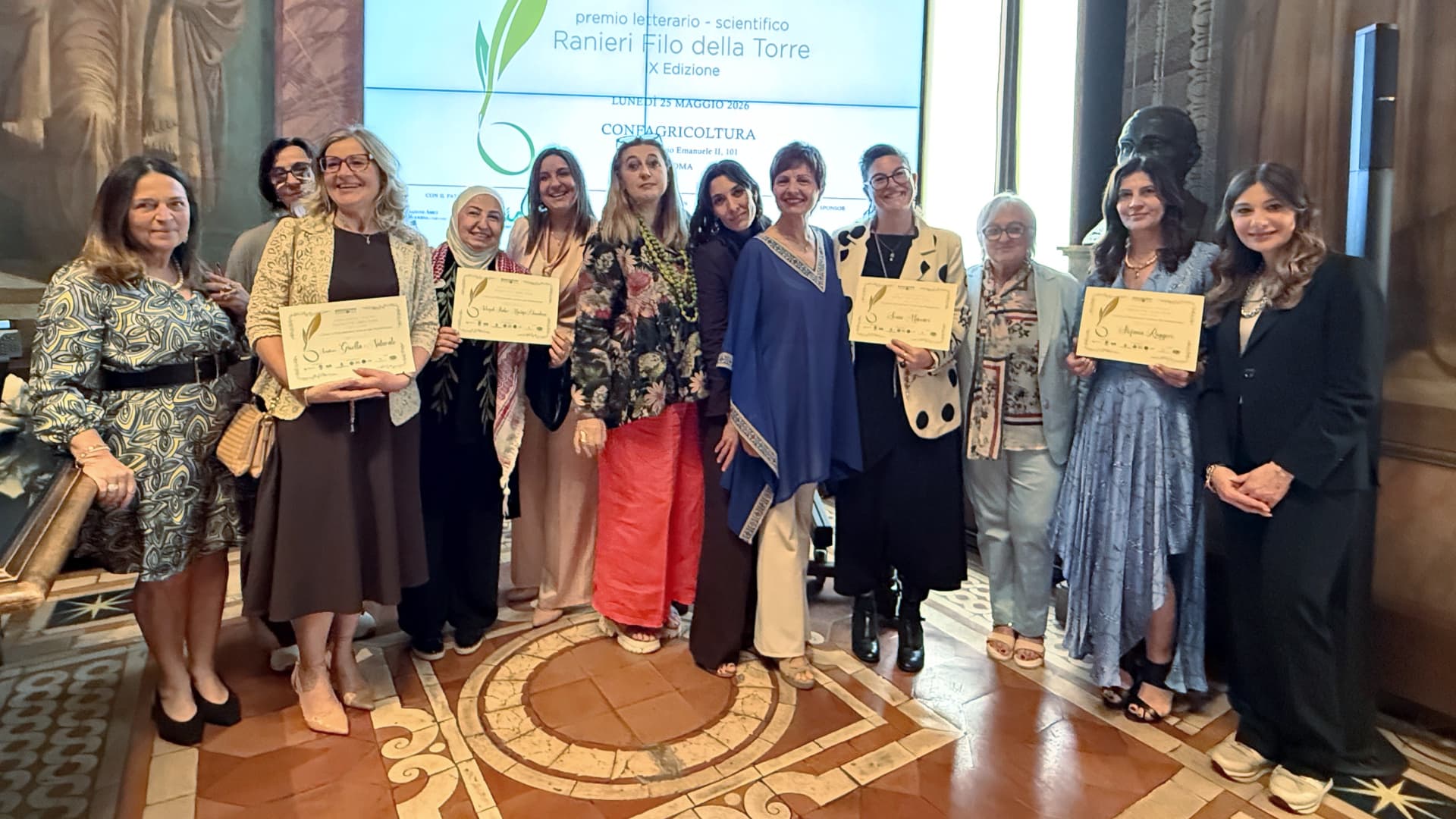
Winners of the Ranieri Filo della Torre special awards with representatives of Pandolea
She referenced the International Year of Women Farmers 2026, established by the United Nations to highlight the essential contributions women make to agrifood systems, which are often underrecognized.
Loriana Abbruzzetti, president of Pandolea, echoed those remarks. “We are proud to celebrate this edition during the UN Year of Women Farmers as we recognize, through culture and research, the essential role of women in feeding the planet and shaping its future,” she said while presenting five special awards to distinguished figures in research, public service and communications.
The honors went to Lorenza Vitali, founder of Witaly; Sonia Massari, researcher in agricultural sciences at the University of Pisa; Gisella Naturale, senator and vice president of the Senate’s Committee for European Union Policies; Stefania Ruggeri, director of CREA’s Food and Nutrition Research Center; and Nehaya Al Muhaisen, founder and president of the Jordanian and Arab Olive Oil Women’s Networks.
The recipients received artworks created by Italian artists Savina Tavano, Elisabetta Caracciolo, Luisa Grifoni della Valle, Carlo D’Orta and Patrizia Balzamo.
In her remarks, Al Muhaisen described the olive tree as a symbol of peace that transcends borders and political divisions. She said it serves as a bridge between Mediterranean communities and a reminder of shared humanity.
She attended the event alongside representatives of the Arab Olive Oil Women’s Network from Jordan, an organization that brings together women from several countries and operates within the Pandolea International platform.
The ceremony also featured the presentation of scientific and literary awards. For the science category, a committee established by the National Academy of Olive Tree and Oil selected the top three master’s and doctoral theses.
The winners were Marco Greco of Sapienza University of Rome for research on the valorization of olive oil extraction byproducts as plant biostimulants; Manuela Di Lauro of the University of Rome Tor Vergata for a study examining the effects of olive oil’s minor polar compounds on nephropathic patients; and Maria Grazia Provenzano of the University of Tuscia for work on the valorization of olive sector waste through a circular business model.
Cultural expert Domenico Nasini introduced the literary award winners. In poetry, the honors went to Vincenzo Screti for “Di quel che resta, mi basta l’odore di Itrana,” Gianni Terminiello for “Asperse di giardini tormentosi…” and Donatella Menolli for “Novembre.”
In the fiction category, the winners were Francesca Pecorella for “Albero genealogico,” Marco Angilletti for “Bea, ricordati l’amore!” and Nerina Poggese for “La sfida dell’uliveto.”
The haiku section recognized Antonietta Tiberia, Fiorenzo Fedrigo and Carlo Maria Vadim for “Come tre gocce d’olio.”
The winning works were published in an anthology by Orbis Edizioni and performed by members of the “Lettori giUlivi” reading group: Barbara Altomonte, Donatella Cioccolini, Fabio Bollo and Linda Botha.
The event also served as the venue for announcing the winners of the Silver Diploma competition, which recognizes the best olive oils produced by Italian agricultural institutes. The initiative was founded by Pandolea, coordinated by Elisabetta Mariotti and organized in collaboration with the ITA Senza Frontiere network.
The winning schools, introduced by Gianfranco De Felici, president of the Sabina Flavour Association and coordinator of the sensory evaluation panel, were the “Magliano” Comprehensive School in Larino, Molise; the “J.F. Kennedy” Upper Secondary Education Institute in Monselice, Veneto; and the “Di Poppa-Rozzi” Upper Secondary Education Institute in Teramo, Abruzzo.
Honorable mentions were awarded to the “Emilio Sereni” Agricultural Institute in Rome and the “Fratelli Agosti” Comprehensive School in Bagnoregio, Lazio.
Abbruzzetti concluded the event by inviting participants and members of the press to look ahead to next year’s tenth-anniversary edition. Additional information about the competition is available through Pandolea’s website and social media channels.