Xylella Arrived in Italy from a Costa Rican Coffee Plant, Researchers Say
A study concluded that the genomes of Xylella fastidiosa in Apulian olive trees descended directly from Costa Rican coffee plants.
An international team of scientists has investigated the enduring question of how Xylella fastidiosa arrived in Europe and adapted to its new environment.
The study, published in Microbial Genomics, sheds new light on the origin of the Xylella fastidiosa bacteria and how the pathogen has evolved, killing millions of olive trees in Puglia.
Our analysis suggests that the pathogen had arrived in Italy with a single introduction from Costa Rica, confirming 2008 as the most likely year when Xylella was introduced in Italy.
While the presence of the bacterium was originally confirmed in Europe in 2013, there remains very little information on the biological relationship between bacteria’s genotypes and host plant species, which is particularly relevant as Xylella fastidiosa continues to spread across Europe.
By analyzing a population of strains from Italian olive trees and closely related genomes from other plant species and locations, researchers have concluded that the Italian outbreak was caused by a single coffee plant imported from Central America in 2008.
See Also: Researchers Find Another Disease Afflicting Olive Groves in PugliaThe study spanned five years – 2013 to 2017 – during which scientists collected twig samples from more than 70 trees with Olive Quick Decline Syndrome, the disease caused by Xylella fastidiosa, using a new protocol to extract the trees’ DNA.
The genomic sequences of the Xylella fastidiosa isolate affecting the olive trees were then compared with three coffee and oleander isolates from Costa Rica, which had been previously sequenced and were publicly available.
Previous studies – and numerous reports of coffee plants infected with Xylella fastidiosa imported into Europe from Central America – identified the same bacterium in some Center America plants. However, there was no scientific evidence of genetic relatedness among the coffee isolates from Costa Rica, and the olive tree isolates in Puglia.
The data comparison of the genetic sequences reported in the study demonstrated that the Xylella fastidiosa bacterium from the olive trees is directly related to Central American variants.
The data also suggested that the contagion occurred with the introduction of an “asymptomatic” infected coffee plant, probably brought to Italy as an ornamental plant.
The study was led by an international team including scientists from the United States, France and Italy.
Among the authors, Italian biologist Maria Saponari of the National Research Council of Italy in Puglia was the first to detect Xyella fastidiosa in the nearby Salento region in 2013.
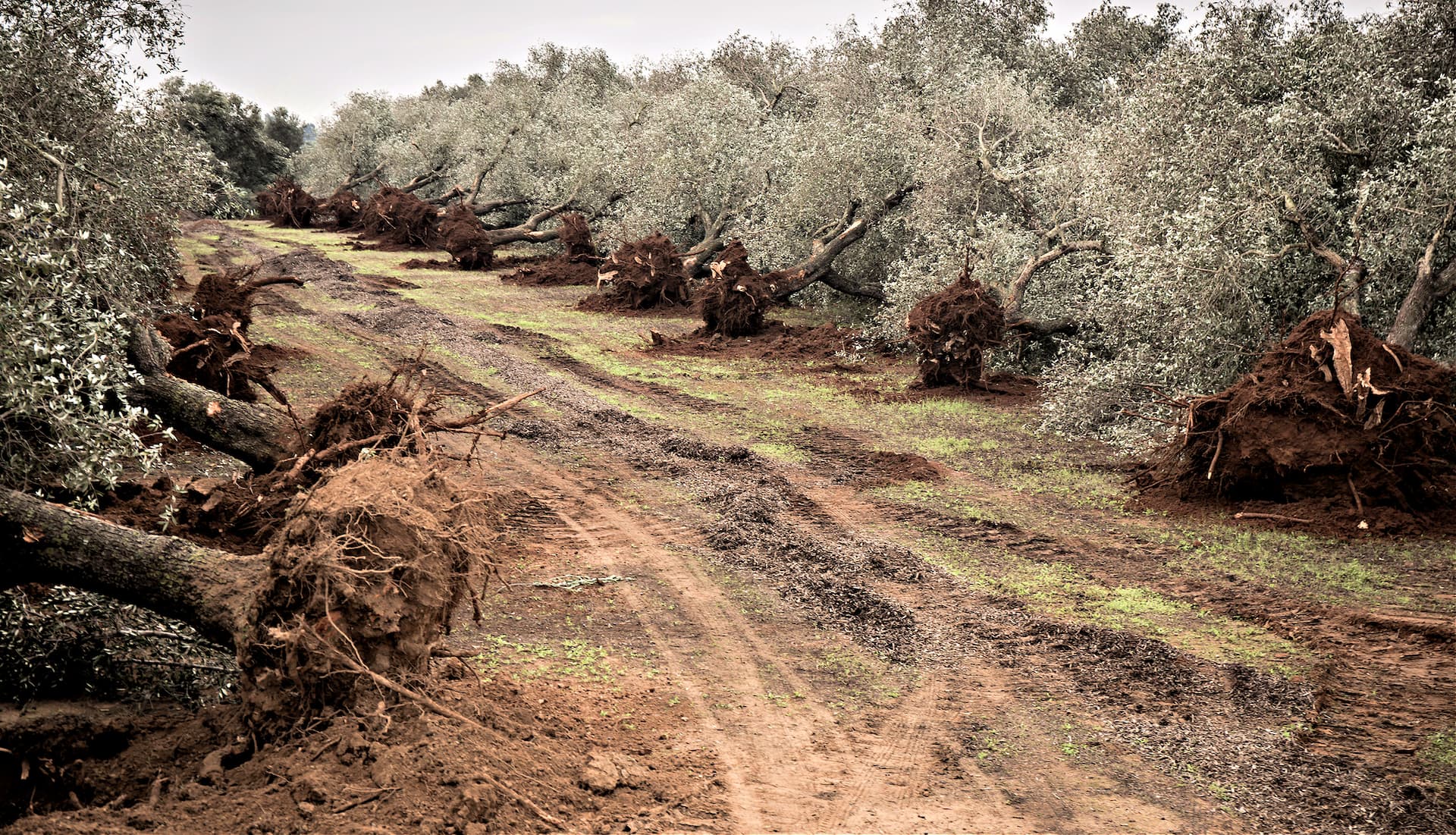
Felling of olive trees in Puglia, Italy (Getty Images)
“Previously thought to be restricted to the Americas, the detection of Xylella fastidiosa in Europe has raised new concerns worldwide due to its highly noxious potential,” she said. “The first confirmed report in Europe in 2013 was soon followed by its progressive detection in several other E.U. countries.”
“The pathogen gradually expanded its geographical range worldwide as well as its ability to form novel associations with host plants,” she added. “In this frame, we have used a genomic tool to study the processes driving an emerging bacteria toward a plant disease epidemic.”
“With particular regard to the spreading of the bacterium across southern Puglia, genomic data allowed us to reconstruct the emergence of the Olive Quick Decline Syndrome, which led to the death of several millions of olive trees, with significant environmental, social, political and economic consequences,” Saponari continued.
“Our analysis suggests that the pathogen had arrived in Italy with a single introduction from Costa Rica, confirming 2008 as the most likely year when Xylella was introduced in Italy,” she added. “This is consistent with Apulian farmers’ first reports of infected trees in 2010 since the disease incubation period can last more than two years.”
Coffee plants are widely used in gardens, villas, and resorts: their intense green foliage makes them ideal for decorating outdoor areas.
“While in colder areas, the plant is almost always kept inside; in Salento, it was most likely kept outside, thus favoring the contagion,” Saponari said.
To prove that Xylella fastidiosa could have been transmitted from one species to another, the researchers also conducted experiments where they inoculated the bacteria in coffee plants and spread the infection to olive trees in a controlled way using spittlebugs, the natural vector for Xylella fastidiosa.
“Results show that coffee plants may represent a latent carrier of the bacterium,” the researchers concluded.