Report Exposes Extortion and Violence in Syria’s Olive Heartland
Once responsible for a third of Syria’s olive oil, Afrin’s farmers now face illegal levies, intimidation and violence under militia control, according to a new report by Syrians for Truth and Justice.
Extreme conditions are devastating olive harvests and olive oil production in Afrin, the northwestern Syrian region that once accounted for about one-third of the country’s output.
A new report by the nongovernmental organization Syrians for Truth and Justice (STJ) reveals widespread abuses targeting Afrin’s olive growers and millers in recent years. Those violations, the group said, continue during the second national olive campaign since the Syrian transitional government was formed.
Dozens of witnesses interviewed by STJ described corruption among militias controlling parts of the region. Their accounts include property seizures, illegal levies, intimidation, harassment and violence — including torture and sexual assault.
Farmers reported olive tree cuttings as punishment or revenge, arbitrary arrests, and an atmosphere of fear amid population displacement, weak infrastructure and limited government presence.
“In the region inhabited by a large majority of Kurdish people, those militias were placed and funded by Turkey and were later absorbed into the Syrian National Army. They still maintain close ties with Turkey,” Bassam Alahmad, STJ executive director, told Olive Oil Times.
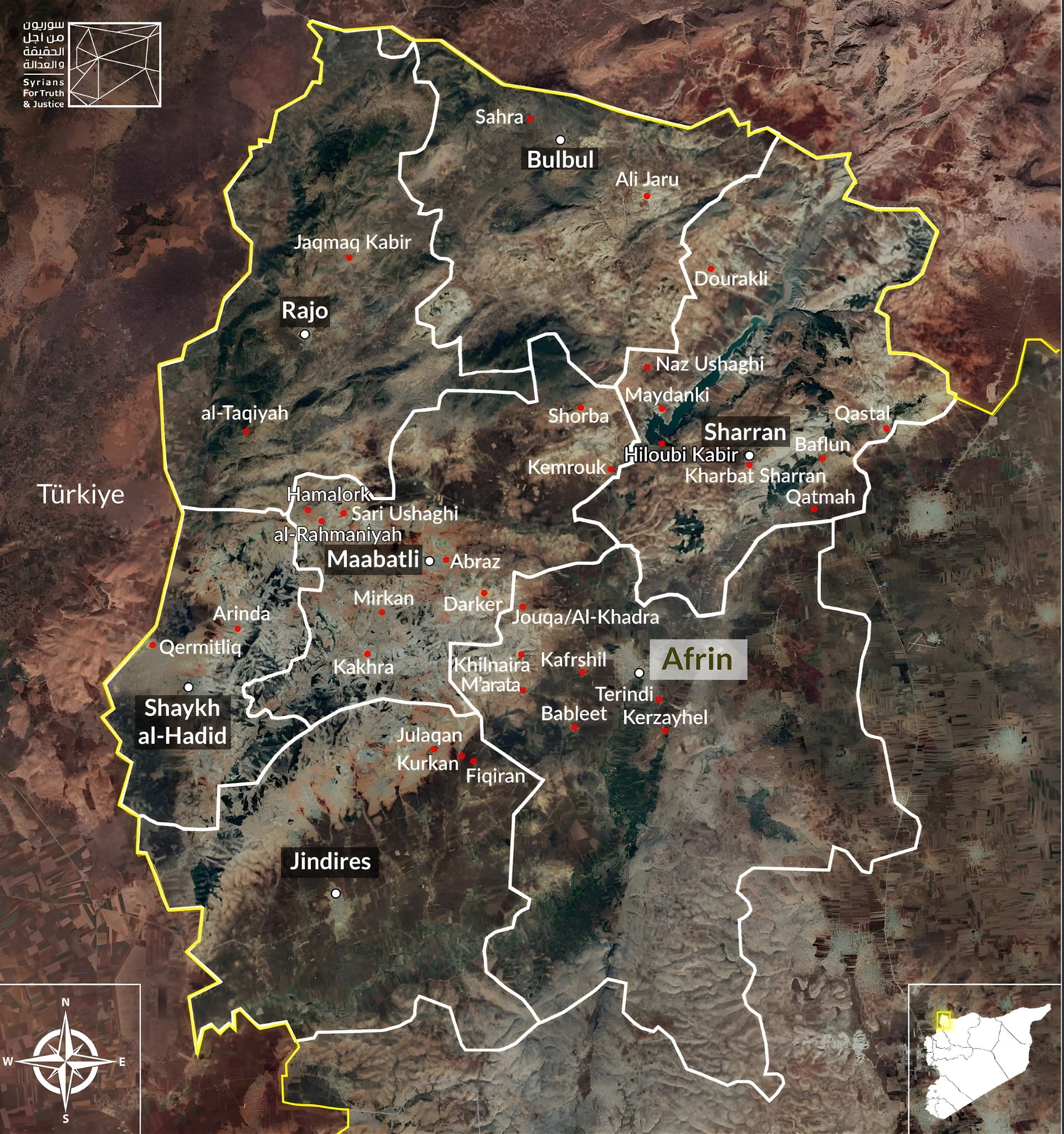
The locations of the violations listed in the STJ report (Photo: STJ)
In January 2018, Turkish forces and allied militias launched Operation Olive Branch, a military campaign involving heavy airstrikes followed by a massive ground assault on Afrin. Turkey viewed Syrian Kurdish political and armed groups as a direct security threat, associating them with the outlawed Kurdistan Workers’ Party (PKK) and seeking to curb their influence in the border region.
The offensive displaced much of the Kurdish population, depriving many of their livelihoods in an area once home to nearly 15 million olive trees — the backbone of Afrin’s economy. Before 2018, the region produced approximately 45,000 tons of olive oil annually. That prosperity collapsed after the invasion, as Kurdish farmers were uprooted and militias took control of their land.
Olive oil production is deeply woven into Syria’s agricultural, economic and cultural fabric. Before the civil war, Syria ranked among the world’s top five olive oil producers, with more than 80 million trees covering much of the country’s Mediterranean and inland regions.
The sector provides livelihoods for over a million Syrians, from small family farmers to mill operators and traders. Olive oil remains a staple of the Syrian diet and a symbol of resilience, continuity and connection to the land despite years of conflict and hardship.
Over the course of Syria’s 14-year civil war, roughly 90 percent of the population has fallen below the poverty line. In Afrin, many residents have fled due to violence and insecurity. Those who remained faced extortion by armed groups who taxed every stage of olive production — from tree ownership to harvesting and milling.
Militias have imposed levies on farmers and often seize large portions of olive oil as payment. “There is no law protecting farmers. What prevails is jungle law — the strong devour the weak,” said Sabah Jekar, a local council employee and landowner in Sari Ushaghi, who witnessed the confiscation of entire orchards.
“These factions have weapons and use them to rob people by force. Some take 30 percent of the harvest, others 40 percent or 60 percent, and some seize the entire crop. Their goal is to accumulate wealth and deepen people’s poverty,” Jekar said.
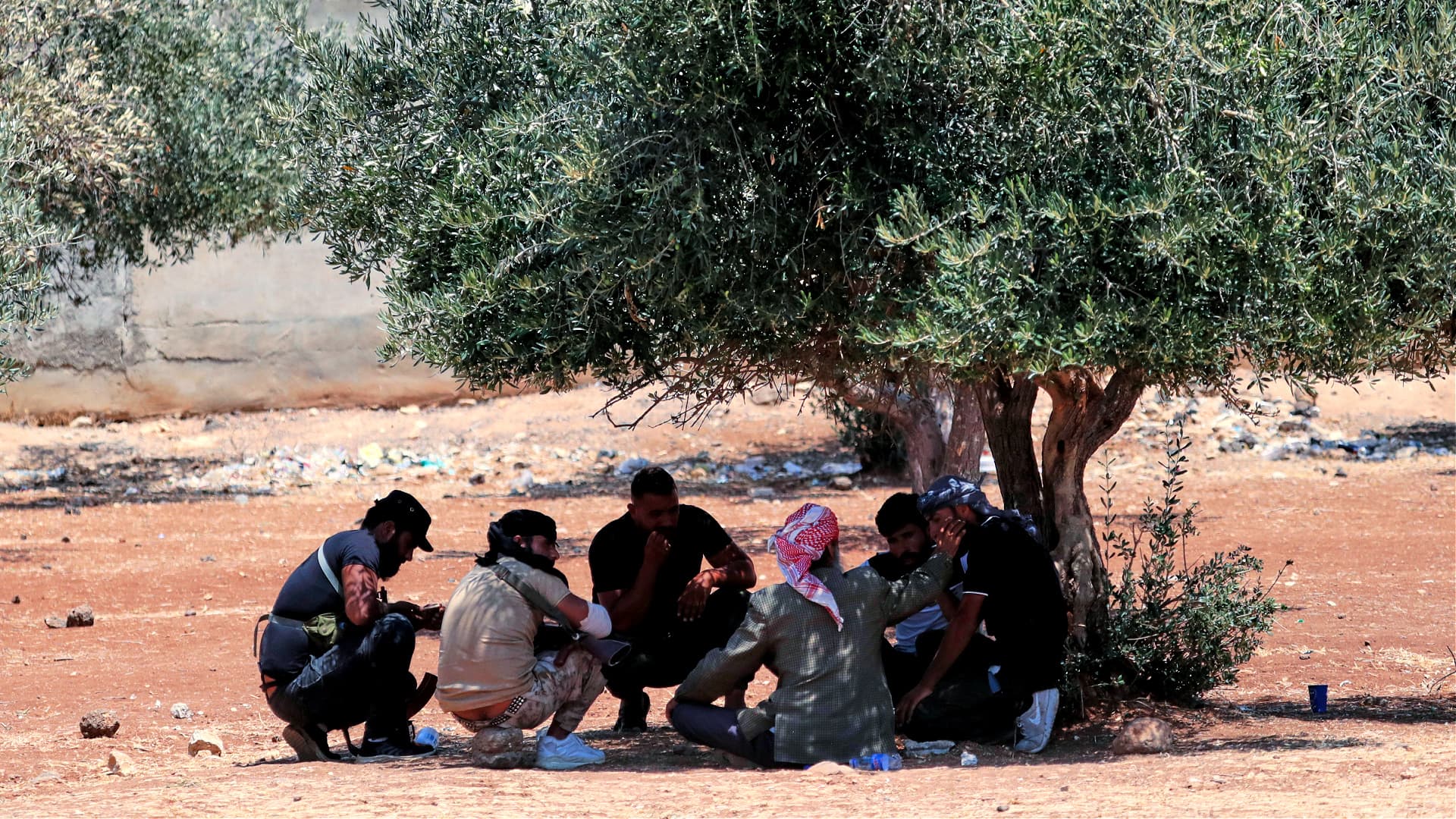
Bedouin fighters sit under the shade of an olive tree in Shahba, a town in Syria’s southern Sweida province. (Photo: AP)
Farmers are often compelled to deliver their olives to specific mills under the supervision of the militia. Sales are restricted to approved traders — typically affiliated with the militias — who set prices far below market value. The oil is then transported to Turkey, entering national and international markets through other channels.
Selling to those traders is frequently the only way growers can avoid confiscation or arrest. As a result, Afrin’s production this season is expected to remain very low. “Harvesting today in the region means being subjected to a lot of pressure. The area is far from stable,” Alahmad said.
According to Abbas Hassan, a member of a local council in Afrin, militias justify their actions by claiming the proceeds fund regional security and administration. “They say they guard the area and prevent looting, but 95 percent of shops and businesses have been confiscated and are run unlawfully,” he told STJ.
Growers who resist demands are often punished by having their trees destroyed. Meanwhile, in nearby regions such as Idlib, olive harvests proceed freely, Alahmad said.
“The current government and the temporary authorities could have stopped such violations already. But it did not happen,” he added. The STJ report documents how these practices violate the constitutional declaration that defines the transitional government’s temporary framework.
“If we are speaking of holding those people accountable, I do not see any willingness to do so,” Alahmad said. “I doubt there is any plan to prosecute anyone besides the higher officials of the Assad regime, especially in regions such as Afrin.”
The NGO called on the United Nations and the international community to intervene. “There is no sign of pressure on the current government. The U.S. and EU seem intent on giving the temporary government space — which means not confronting these issues,” Alahmad added.
“So, the question is not what the government should do to stop the violations, but whether they are willing to do it,” he said.
For the 2025–26 campaign, the Ministry of Agriculture in Damascus estimated a 45 percent drop in olive oil production compared with the 122,000 tons produced in 2024–25. The ministry cited severe drought and recurring heatwaves across regions such as Idlib and Hama. About 85 percent of Syrian olive orchards are rainfed and highly vulnerable to climate extremes.
In Afrin, climate stress compounds insecurity. Some militias have recently been redeployed to other areas, including Hama, Alahmad said. Yet reports indicate new human-rights violations by armed groups there, echoing Afrin’s situation.
Recent updates from Afrin also show continued extortion and looting of olive harvests, with some militias seizing entire village crops and damaging orchards.
“Any improvement seen in parts of Afrin does not come from political will to protect Syrian citizens, but simply because many militias moved elsewhere,” Alahmad concluded. “There is still no sign the authorities are stepping up to defend farmers, minorities or women. We need this government to take responsibility and protect the rights of all Syrian people.”
For many Syrians, the olive tree remains a symbol of endurance, even as the groves of Afrin stand as reminders of a harvest and a heritage under siege.