Then and Now: California Olive Growers Feared Imports Would Destroy Their Industry
In 1912, California olive growers warned that cheaper imports could destroy their young industry. More than a century later, local production is established, but imports still dominate the U.S. market.
Then and Now revisits olive oil stories from the archives to explore how the industry has changed and which challenges endure.
In 1912, California olive growers warned that reducing tariffs on imported olive oil could bring their young industry to an end. More than a century later, local production is firmly established, but imported oil still dominates the American market.
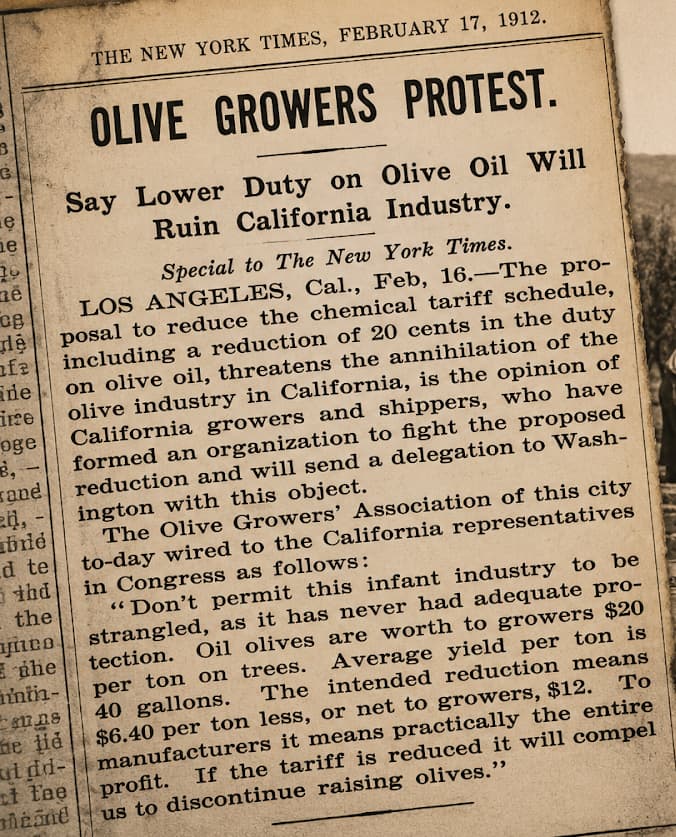
Don’t permit this infant industry to be strangled, as it has never had adequate protection.
On February 17, 1912, The New York Times reported that olive growers in Los Angeles were campaigning against a proposed reduction in the tariff on imported olive oil.
The growers described olive oil as an “infant industry” in need of protection and warned that cheaper imports threatened its survival.
“If the tariff is reduced, it will compel us to discontinue raising olives,” the Olive Growers’ Association of Los Angeles said, according to the report.
The prediction proved too dire. The California olive oil industry survived and eventually developed into a modern sector with mechanical harvesting, advanced mills, recognized producers and standards governing the testing, grading and labeling of locally produced oil.
However, the competitive imbalance that concerned growers in 1912 never entirely disappeared.
California olive oil is no longer a fledgling agricultural experiment.
The state now has established producers making extra virgin olive oil under mandatory standards administered by the California Department of Food and Agriculture and the Olive Oil Commission of California. Covered producers are subject to sampling, laboratory testing and grading requirements.
American demand has also grown far beyond what early growers could have imagined. U.S. olive oil consumption reached about 398,000 tons in the 2023/24 crop year, an increase of 22 percent over the previous decade.
More than a century ago, California growers warned that cheaper imported olive oil would wipe out their young industry. It didn’t, but the imbalance they feared never went away. (Olive Oil Times illustration)
The original argument over tariffs has also become more complicated. Olive oil now moves through a vast international market in which American producers, importers, retailers and consumers may be affected differently by trade barriers.
Tariffs may offer domestic growers some protection, but they can also raise costs for importers and consumers in a country that cannot produce nearly enough olive oil to meet its own demand.
Imports remain overwhelmingly dominant.
Domestic production was estimated at about 10,000 tons in the 2023/24 crop year, leaving the United States dependent on imports for more than 95 percent of its consumption.
California producers therefore compete with oils from countries that have far larger industries, longer-established supply chains and, in many cases, lower production costs. Italy, Spain, Tunisia and Türkiye together supplied nearly 95 percent of U.S. olive oil imports in June 2025.
The language has softened since 1912. Few would now suggest that imports could annihilate California olive oil production.
Still, the underlying question remains familiar: How can a small domestic industry compete in a market supplied predominantly by much larger foreign producers?
California’s olive oil industry was not strangled in its infancy. It grew, modernized and established a distinct place in the market. Yet, more than a century later, its growers are still making the case for why locally produced oil deserves a place on American shelves.
Archive: “Cal. Growers Denounce Proposed Tariff Reduction,” The New York Times, February 17, 1912.