Can Drones Save Europe’s Traditional Olive Terraces?
From erosion mapping to harvest transport, drone technology is expanding across olive groves as growers seek practical responses to labor shortages, water scarcity and rising production costs.
“Drones and precision agriculture, as part of the digitalization of farming, can be a decisive lever for the competitiveness of traditional mountain olive groves,” Agustín Andreu García, director of Spain’s Fundación JAV, told Olive Oil Times.
Fortunately, Europe has finally realized that it is holding back a technology that is fundamental to the competitiveness of European agriculture
Fundación JAV is a public nonprofit agritech innovation hub based in Jaén, in southern Spain, Europe’s largest olive oil-producing region. It promotes digital technologies and entrepreneurship in traditional agriculture.
Recent research suggests that drones could play a crucial role in assessing soil degradation across Mediterranean olive-growing regions.
Other studies highlight the growing importance of drones in monitoring crop conditions and supporting precision management in mountainous olive groves.
Growers are increasingly using the technology for practical operations ranging from pest control and foliar fertilization to irrigation management.
According to Andreu, digital agriculture is helping address some of the most demanding and dangerous tasks faced by growers working on steep slopes and uneven terrain.
“In mountain olive groves, where slopes and differences in elevation are significant, phytosanitary treatments against olive fruit fly, olive moth and peacock spot, as well as foliar fertilization, are particularly arduous, complicated and sometimes even dangerous for farmers,” he said.
“Drones make this work considerably easier in a fast, economical and effective way because a drone operating on autopilot works equally well on sloping or flat terrain,” Andreu added.
Advanced drones can detect early signs of pest outbreaks and water stress, allowing growers to intervene sooner and optimize irrigation in regions where water resources are increasingly scarce.
“Through drones equipped with multispectral cameras, it is possible to detect potential pest outbreaks and situations of water stress at an early stage, helping optimize the use of irrigation water, which is particularly limited in mountain olive groves,” Andreu said.
In a recent study, researchers used unmanned aerial vehicle photogrammetry to create high-resolution digital terrain models of areas treated with sustainable practices, including the use of mulch and biochar.
The researchers analyzed how topographic and management variables influenced land degradation.
Drone-derived data explained up to 81 percent of the variation in measured soil erosion. The researchers found that erosion was driven primarily by natural topography, particularly slope steepness and length, along with vegetation cover, rather than by the specific mulch or biochar treatments.
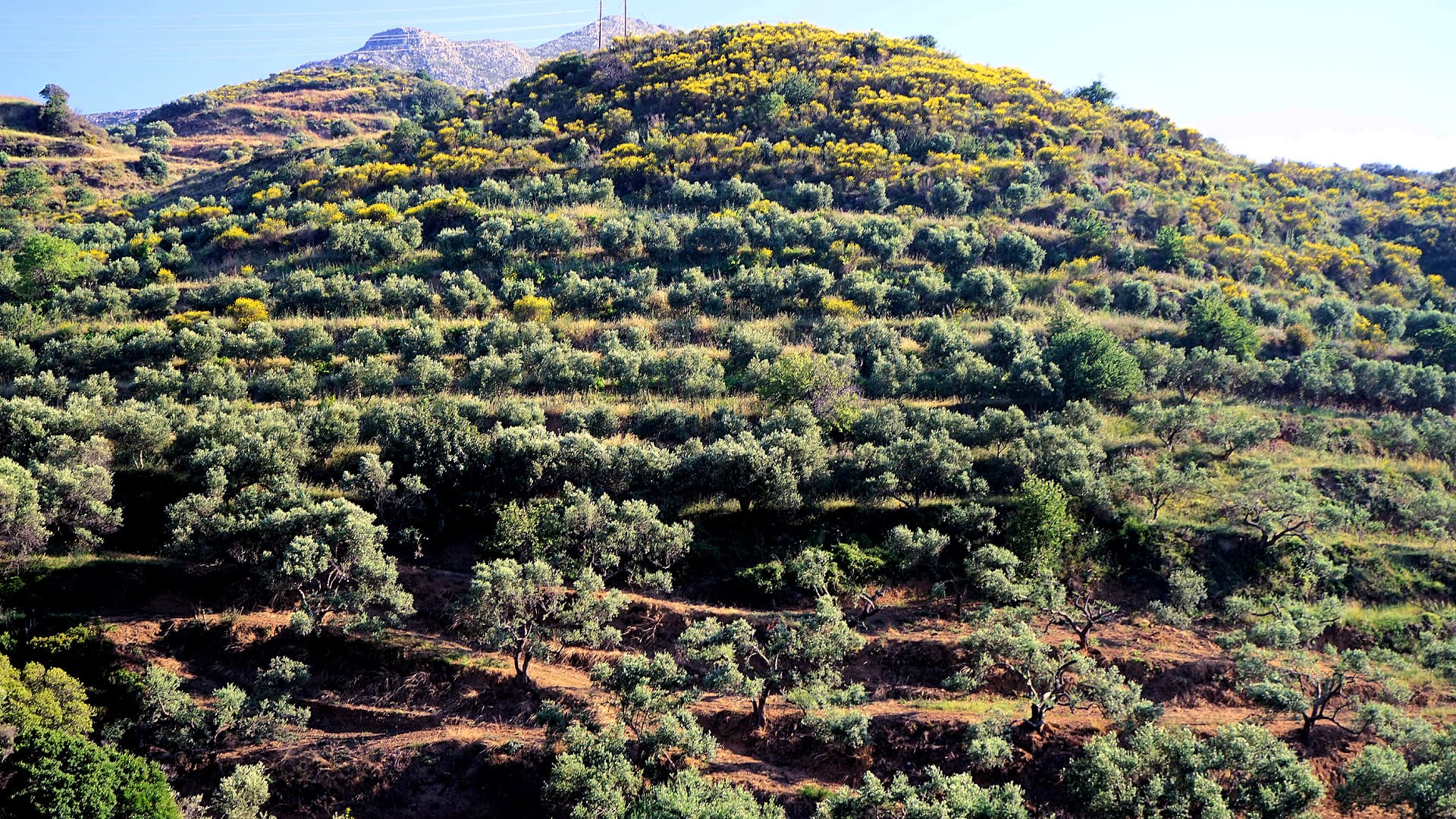
Terraced olive groves stretch across the steep hillsides of Crete, Greece.
In vulnerable agricultural landscapes, frequent drone monitoring provides unprecedented detail for assessing erosion patterns and field conditions.
Andreu also pointed to emerging applications that remain under development.
“In the case of drones with transport capabilities, such as the DJI Agras T70 or T100, drones may also help transport the harvest in areas that are very difficult to access because of steep slopes,” he said.
Startups emerging from Fundación JAV’s training program for drone operators are already carrying out a wide range of agricultural operations.
“These include phytosanitary treatments, liquid and granular foliar fertilization, pollination, biological pest control through the release of lacewings and sterile males, as well as multispectral surveillance and pest monitoring,” Andreu said. “Harvest transport operations are currently being studied.”
According to Miguel Córdoba of xFarm Technologies, these opportunities are no longer limited to large agricultural enterprises.
Speaking at the recent Olive Oil World Congress, Córdoba said digital platforms now allow medium-sized producers to monitor plots in real time, optimize irrigation and fertilization, detect olive fruit fly infestations and plan field operations with a level of precision previously unavailable to most growers.
The growing use of aerial precision systems in olive groves is part of a broader shift toward digital agriculture.
Data presented at the congress showed that global investment in digital innovation for the agrifood sector rose 21 percent in 2025 to $11.5 billion.
According to Andreu, however, significant obstacles remain.
“The main challenge is regulation,” he said. “Unfortunately, European legislation still does not distinguish between aerial treatments carried out by drones and those carried out by aircraft, even though drone spray drift is extremely precise.”
Andreu said a drone’s spray cloud extends only about 10 meters, compared with roughly 40 meters for a tractor-mounted sprayer and about 150 meters for an aircraft.
In his view, the current framework is slowing the adoption of a technology that could be particularly useful where ground machinery is difficult or dangerous to operate.
“Fortunately, Europe has finally realized that it is holding back a technology that is fundamental to the competitiveness of European agriculture,” Andreu said.
He was referring to regulatory changes approved at the end of 2025 intended to move national rules toward greater equivalence between ground- and drone-based phytosanitary treatments.
Other barriers to adoption include poor rural connectivity, limited interoperability between digital platforms and cultural resistance among farmers.
Drone-gathered multispectral and thermal imagery can also help producers monitor canopy health and fruit development, supporting more informed decisions about harvest timing.
However, collecting aerial data is only part of the process. Growers often need agronomists and specialized service providers to translate imagery into practical field decisions.
According to Fundación JAV, this technological approach represents an important step toward addressing the multiple challenges facing traditional olive groves.
“Digital agriculture represented by drones and precision farming is crucial to this objective, but we believe that defending the competitiveness of traditional olive groves requires multidisciplinary solutions addressing several areas,” Andreu said.
These include reforms to the European Union’s Common Agricultural Policy to provide greater support for traditional olive groves, along with stronger product differentiation, ethical labeling, carbon-credit programs, regenerative agriculture, agrivoltaics and digitally equipped agricultural service companies.
Drones therefore form part of a broader effort to keep traditional olive cultivation economically viable amid climate change, labor shortages and rising production costs.
Andreu said growers’ attitudes toward drones often change quickly once they experience the technology firsthand.
“Adoption is very rapid because of the low cost, the speed of execution and its proven effectiveness,” he said. “It is also addictive. Once a farmer tries it, he does not go back to using the tractor and conventional sprayer.”