Then and Now: Nearly 250 Years Ago, an Italian Reformer Fought for Fresher Olive Oil
In 1773, Calabrian agriculturalist Domenico Grimaldi warned that harvested olives deteriorated when left piled before milling. Nearly 250 years later, rapid processing remains fundamental to producing high-quality olive oil.
In 1773, more than two centuries before stainless steel mills, refrigerated storage and modern extra virgin olive oil standards, Domenico Grimaldi conducted a simple experiment in Calabria.
He took 100 pounds of freshly fallen olives, placed them together in a basket as growers commonly did in the region and watched what happened.
The first rule is to mill and press the olives as they come from the olive grove, without ever allowing them to heat up.
After two days, Grimaldi suspended a smooth piece of glass above the fruit. By the following day, he could see tiny droplets of oil on its surface under a microscope. He continued observing the olives day after day.
By the tenth day, he wrote, a microscope was no longer necessary. The glass had become visibly oily. When he ended the experiment after 15 days, the original 100 pounds of olives weighed only 85. They had become soft, partly decomposed and, in his description, emitted a strong odor.
For Grimaldi, the lesson was clear. Allowing harvested olives to heat and deteriorate before pressing was wasting oil and damaging the product.
“The best rule,” he wrote later in the work, according to a translation of the original Italian, was to press the olives “as soon as they come from the olive grove.”
The observation appears in Grimaldi’s Istruzioni sulla nuova manifattura dell’olio introdotta nella Calabria, published in Naples in 1773. An expanded edition followed in 1777 under a title referring more broadly to the Kingdom of Naples.
Nearly 250 years later, the principle is one of the foundations of modern olive oil quality.
Grimaldi was not simply writing about agriculture from a distance. Born in Seminara, near Reggio Calabria, in 1735, he was part of an Enlightenment-era movement that sought to apply observation, experimentation and technological innovation to agriculture and industry.
According to the Dizionario Biografico degli Italiani, Grimaldi studied law in Naples before moving to Genoa, where he became increasingly interested in technical and agronomic innovation. He later traveled to Provence to study olive oil production and examined manufacturing methods elsewhere in Europe.
What he saw convinced him that the problems facing southern Italy’s olive oil sector were not inevitable consequences of climate or fruit quality. They were, at least partly, the result of how olives were grown, handled and processed.
In Calabria, Grimaldi observed olives being accumulated in enormous containers before milling. His account said individual loads could weigh thousands of pounds and remain there not merely for 15 days, but sometimes longer, depending on the quantity awaiting processing and the judgment of the mill operator.
The practice was connected to a basic capacity problem. Traditional mills could not process the harvest quickly enough.
Grimaldi argued that the result was a destructive cycle: too few efficient mills meant olives had to wait; waiting caused them to heat, soften and decay; and deteriorated fruit produced less desirable oil.
His answer was both technological and agricultural.
Beginning in the late 1760s, Grimaldi brought knowledge and equipment from Genoa to his native Seminara. He introduced presses built in the Genoese style and later promoted water-powered mills that could work more rapidly and with less labor than the equipment commonly used in Calabria.
His calculations were strikingly practical. Grimaldi compared how much fruit different mills could process in a day, how many workers they required and how much oil might be lost when olives waited too long.
He argued that increasing milling capacity would allow producers to process ulive fresche — fresh olives — rather than fruit deliberately allowed to warm and soften.
The language belongs to the 18th century, but the production problem does not.
Modern research has repeatedly shown that the interval between harvest and milling can substantially affect oil quality.
A study of 228 batches of olives processed at seven commercial mills found that as storage time increased, free acidity, peroxide values and other indicators of deterioration rose, while phenolic compounds declined. Positive sensory attributes such as fruitiness, bitterness and pungency also weakened, while defects became more pronounced.
The reason is biological. Harvesting does not immediately stop activity inside the fruit. Damaged olives continue to undergo metabolic changes, while microorganisms can proliferate. When olives are piled together, heat and moisture can accelerate fermentation and other forms of degradation.
The University of California, Davis, advises producers to minimize the time between harvest and processing and warns that damaged fruit, long transport times, high temperatures and poor ventilation can contribute to fermentation.
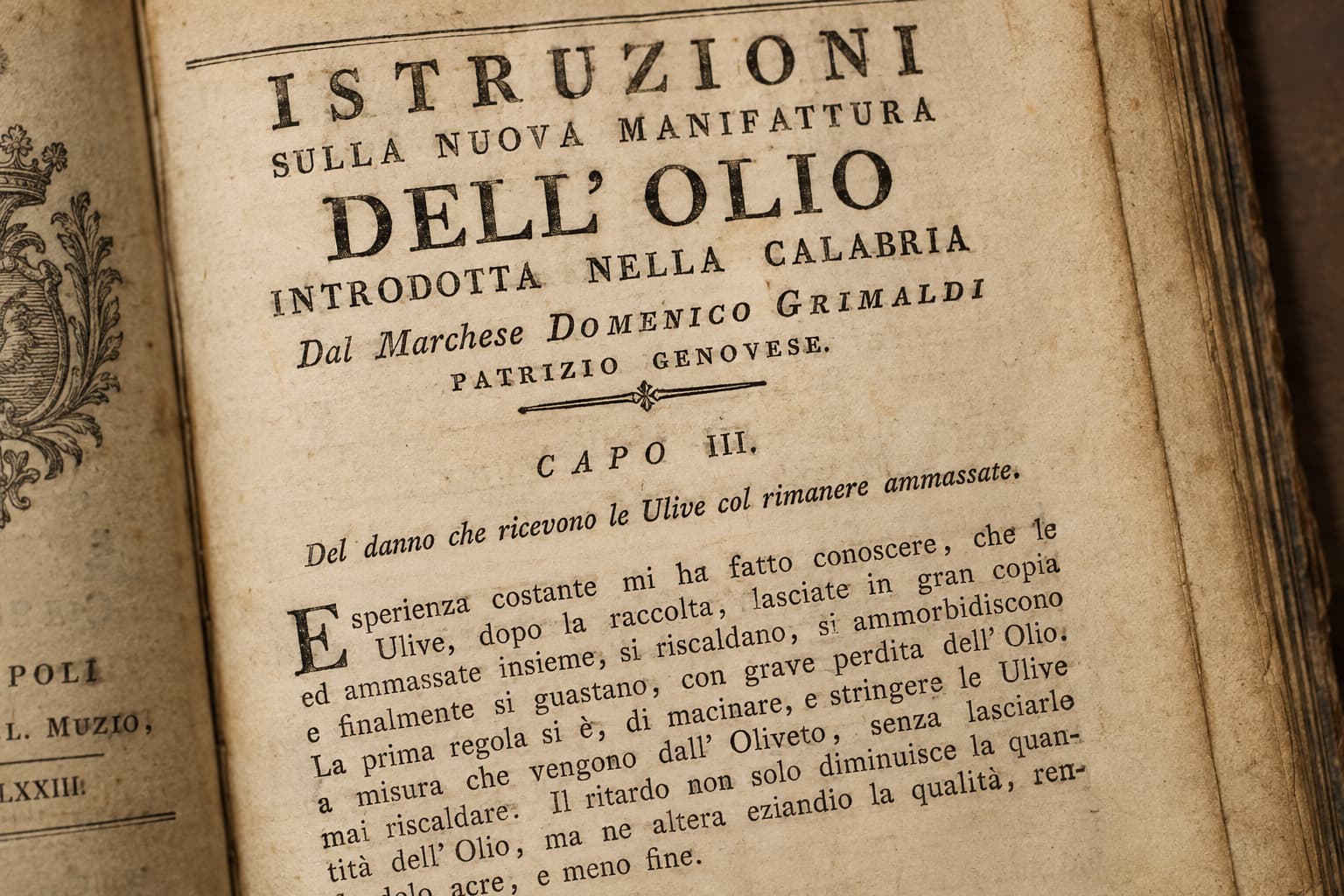
AI-generated reconstruction of a page from Domenico Grimaldi’s 1773 treatise on olive oil production, highlighting his warning that harvested olives should not be left piled before milling.
Modern producers have tools Grimaldi could not have imagined. Olives can be transported in ventilated bins rather than compressed into large piles. Mills equipped with crushers, malaxers and centrifuges can process far greater quantities of fruit continuously. Some producers even use refrigerated storage when short delays are unavoidable.
A modern study of refrigerated olive storage found that cooling harvested fruit could slow some of the metabolic and microbiological processes associated with deterioration when immediate milling was not possible.
The machines have changed almost beyond recognition. The objective Grimaldi pursued has not.
His reforms also reveal how differently olive oil quality was understood in his era.
There was no legally defined extra virgin category, no accredited sensory panel and no modern laboratory capable of measuring the chemical parameters used to classify virgin olive oils today. Much Calabrian oil was destined not for the table but for soapmaking, textiles and other industrial uses.
Grimaldi nevertheless distinguished between ordinary oil and olio fino, or fine oil, and devoted sections of his book to the care required to produce, preserve and transport the better product.
His concern extended beyond taste. He saw poor production methods as an economic problem holding Calabria back from competing with oils from Liguria and Provence.
Treccani’s biography of Grimaldi notes that he believed Calabria could produce excellent oil, but poor harvesting and storage practices produced low-quality, high-acidity oils that struggled in foreign markets.
In that respect, his campaign looks remarkably contemporary. Producers today continue to invest in faster harvesting, greater mill capacity, temperature control and better storage not simply to make better oil, but to remain competitive in an increasingly quality-conscious market.
There are important differences. Grimaldi was primarily concerned with preventing obvious deterioration and increasing usable oil. Modern producers may make far finer distinctions, adjusting harvest dates and processing conditions to preserve specific aromas, phenolic compounds and sensory characteristics.
Yet his experiment with a basket of olives anticipated a principle now supported by modern chemistry and sensory science: once fruit leaves the tree, delay has consequences.
Grimaldi could see those consequences without today’s analytical equipment. The olives became lighter. They softened. Oil escaped from damaged tissue. Eventually they began to rot and smell.
His solution was not to accept the deterioration as part of traditional olive oil production. It was to redesign the system so the olives could be processed while fresh.
Almost 250 years of technological progress have followed. On that fundamental point, modern olive millers are still following the same rule.
Archive: Domenico Grimaldi, “Istruzioni sulla nuova manifattura dell’olio introdotta nella Calabria,” Naples, 1773. An expanded 1777 edition is also available online.