Then and Now: Spain’s 1930 Search for an Olive Oil Fraud Test
The terminology and science have changed dramatically since 1930. The struggle to ensure that olive oil matches its label has not.
Then and Now revisits olive oil stories from the archives, exploring how the industry has changed and which challenges endure.
Nearly a century ago, Spain offered a substantial reward for a method to detect oil extracted from olive residue in edible olive oil. The science has changed dramatically, but the incentive to misrepresent what is in the bottle remains.
In 1930, Spain offered a handsome reward for a way to detect olive-pomace oil in edible blends.
On October 12, 1930, The New York Times reported that the Spanish government was offering 50,000 pesetas, roughly $110,000 in today’s U.S. dollars, for a reliable method to detect refined olive oil mixed with what the newspaper called “pure” oil.
The brief article, headlined “Aims at Olive Oil Fraud,” described a problem that remains recognizable today: a lower-value oil could be blended into a more valuable product without buyers knowing precisely what they were receiving.
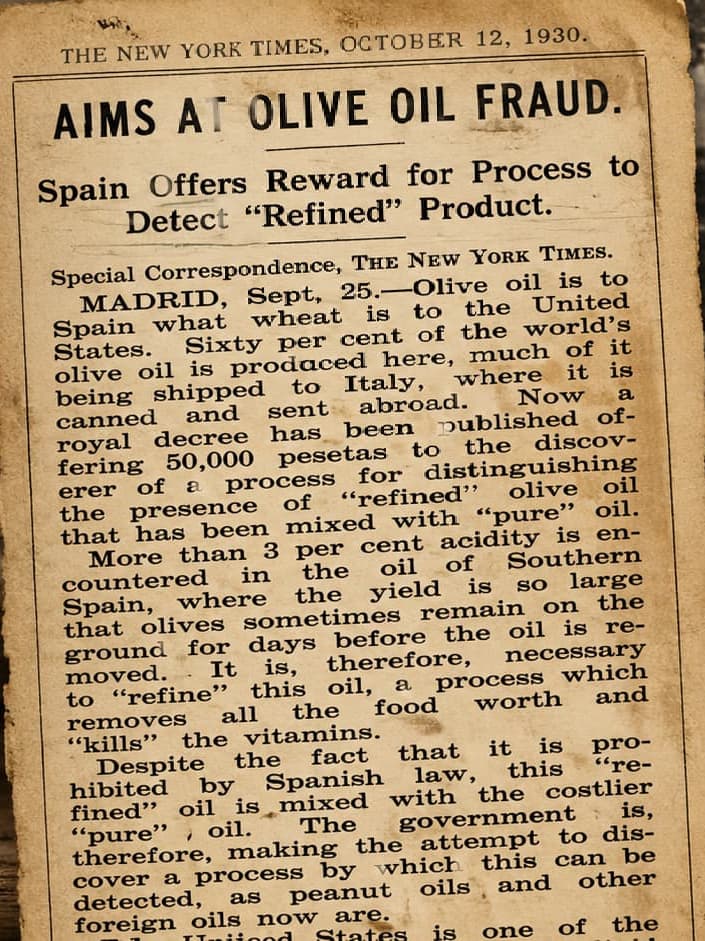
A nearly century-old report offers a revealing glimpse of the problems that shaped modern olive oil testing and classification. (Olive Oil Times illustration)
According to the report, abundant harvests in southern Spain sometimes left fallen olives on the ground for days before they could be collected. Oil produced from deteriorated fruit had high acidity and other defects, making it unsuitable for sale without refining.
But three days after the article appeared, a letter to the editor challenged its interpretation of the Spanish government’s competition.
Charles Segur, writing from New York, said the correspondent had misunderstood the term “refined.” The government was not trying to detect ordinary refined olive oil blended with virgin oil, he wrote, but oil extracted from olive residue and subsequently refined, known as orujo refinado.
Segur called it “extracted oil,” an earlier term for what is now known as refined olive-pomace oil. The original report appears to have confused it with refined olive oil made from defective virgin oil.
Segur said the extracted oil was intended for industrial uses, including soapmaking, and was prohibited for human consumption in Spain. Unscrupulous handlers nevertheless mixed it into edible olive oil because its presence was difficult to detect.
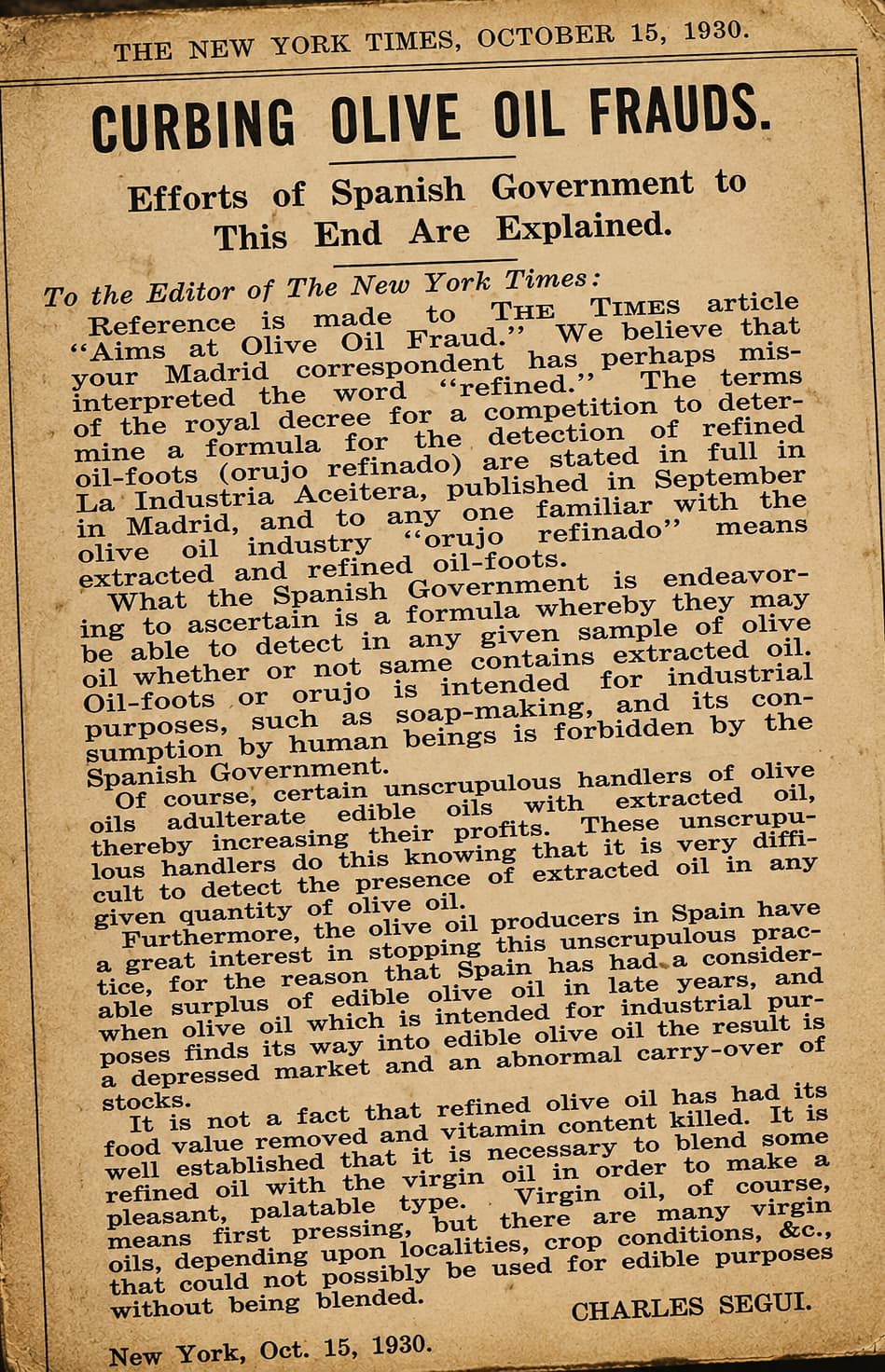
A letter published three days after the original report said Spain’s competition was intended to detect what is now known as refined olive-pomace oil, not ordinary refined olive oil. (Olive Oil Times illustration)
His letter also rejected the original article’s claim that refining removed all of the oil’s nutritional value and “killed” its vitamins. Segur described blending refined and virgin olive oils as an accepted way of producing a milder oil for the American market.
The exchange shows how easily olive oil terminology could be misunderstood, even by contemporary observers.
The language used to classify olive oil has since become far more precise. The 1930 report used “pure olive oil” differently from its modern commercial meaning. Today, the term generally refers to a product made by blending refined olive oil with virgin olive oil.
Olive-pomace oil is recognized as a separate category. It is produced from the residue left after the mechanical extraction of olive oil and must be refined before it can be blended with virgin olive oil and sold for consumption. It cannot be marketed as virgin or extra virgin olive oil.
Testing has also advanced far beyond measuring acidity. Modern laboratories examine a range of compounds and characteristics that can reveal refining, adulteration or the presence of oils inconsistent with the category stated on the label.
Virgin olive oils are also assessed by trained tasting panels, which can identify defects that basic chemical measurements may not detect.
Refined olive oil and olive-pomace oil are not inherently fraudulent. Deception occurs when an oil is used in a category where it is not permitted, concealed from buyers or sold under a false grade, origin or composition.
The financial incentive has not disappeared.
Higher-quality olive oil commands a premium, creating opportunities to profit by substituting, blending or relabeling cheaper products. Methods used to detect olive oil fraud have become vastly more sophisticated, but so have the practices they are designed to uncover.
The Spanish government’s 50,000-peseta challenge belongs to another era. The question behind it does not: How can buyers be certain that the olive oil in a container is what its label says it is?
Nearly a century later, Spain is still strengthening its response. In 2026, the government announced expanded anti-fraud controls across the olive oil and pomace products chain, including broader inspections, digital traceability systems and risk-based checks.
The terminology and tools have changed. The contest between authenticity and deception continues.
Archive: “Aims at Olive Oil Fraud,” The New York Times, October 12, 1930; “Curbing Olive Oil Frauds,” letter to the editor, October 15, 1930.