Tunisia’s Olive Oil Exports Surge, but Bulk Sales Still Dominate
Tunisia is exporting record volumes of olive oil, but most still leaves the country in bulk. Producers say building stronger Tunisian brands abroad is the next challenge.
Tunisian olive oil has steadily expanded its reach on international markets, with exports rising sharply, particularly to Spain and Italy, two of its largest buyers. The latest crop-year figures show record export volumes while underscoring the continued dominance of bulk sales.
Bulk business is great. It drives money, and it helps us grow the business. But diversification is more important.
Tunisia exported 381,200 tons of olive oil worth TND 4.78 billion (€1.42 billion) during the first ten months of the 2025/2026 crop year, according to the National Observatory of Agriculture (ONAGRI).
Export volumes rose 50.8 percent from the same period of the previous crop year, while revenues increased 41.2 percent. With two months still to be reported, the 381,200-ton total had already exceeded the 365,000 tons exported during the entire 2019/2020 crop year. Yet 85.5 percent of those exports were shipped in bulk.
Strong international demand is among the factors driving continued investment in new olive groves and expanded production capacity across the country. Despite the natural alternation between higher- and lower-yielding harvests and growing climate pressures, Tunisia’s average production has continued to increase over time.
“In the last ten years many have invested in new olive groves and expanded production, and you can see how the basic numbers of olive oil production tend to grow over the years,” Ahmed Hamza, co-founder and managing director of award-winning producer Olyfo, told Olive Oil Times.
USDA figures put planted area at 2.06 million hectares in 2024/2025 and 2.10 million hectares in 2025/2026, with 2.15 million hectares estimated for 2026/2027.
That expansion does not eliminate the sharp swings between individual harvests. Najah Saïdi Hamed, president of the National Chamber of Olive Producers, told Mosaïque FM that output could fall to around 300,000 tons in 2026/2027 from approximately 500,000 tons in the previous crop year, a decline of about 40 percent.
She attributed the expected drop primarily to the olive tree’s alternate-bearing cycle and said higher international prices could keep export revenues close to the previous season despite lower production.
Climate conditions can amplify those production swings. In Sousse, Hassen Latif, head of the Regional Union of Agriculture and Fisheries, said an initial estimate of 100,000 tons of olives was reduced by 10 percent to 90,000 tons after exceptionally high summer temperatures.
“The biggest challenge is climate,” Hamza said. In Kairouan, where he lives, temperatures exceeded 50 degrees Celsius on some summer days. “I don’t think it will have an impact immediately,” he said. “But in the mid-term and the long-term, that will test us all.”
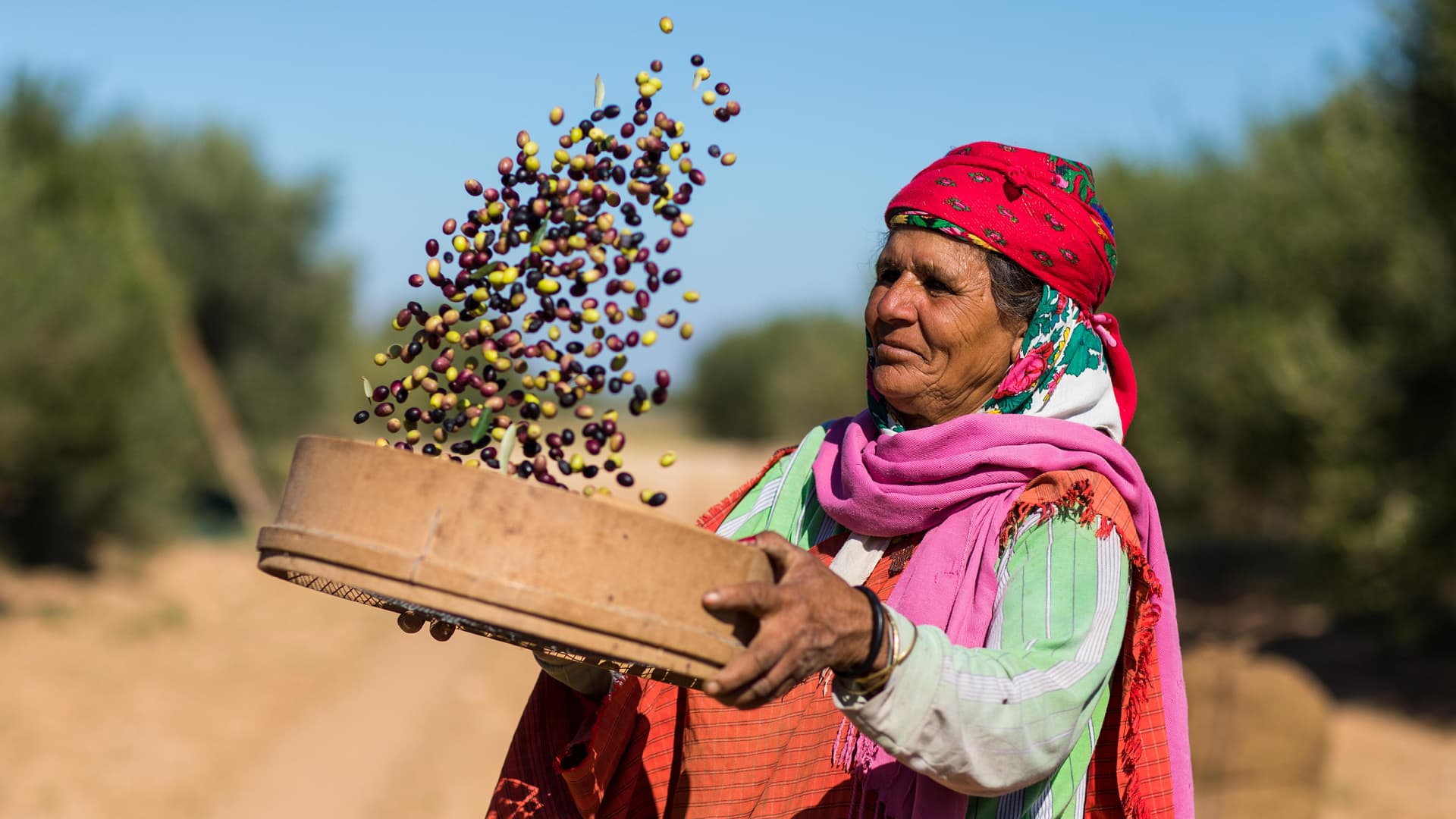
With olive oil production expanding and exports reaching new highs, Tunisian producers are looking for ways to capture more value by selling under their own brands. (Photo: Olyfo)
During the first ten months of the 2025/2026 crop year, bulk olive oil accounted for 80.7 percent of export revenues, compared with its 85.5 percent share of export volumes. Packaged olive oil represented 14.5 percent of volumes but generated 19.3 percent of revenues.
Those figures translate into an average export value of approximately TND 16.7 per kilogram for packaged olive oil, compared with TND 11.8 for bulk. Packaged exports, however, do not necessarily represent products sold internationally under Tunisian consumer brands.
At the same time, export volumes have been growing faster than revenues. The 50.8 percent increase in volume, compared with a 41.2 percent rise in value, implies that the average export value per kilogram during the ten-month period declined by about six percent year over year.
That follows a much sharper price correction during the previous crop year. ONAGRI data showed that by the end of February 2025, the average export price had fallen 48 percent from a year earlier, from TND 26.41 to TND 13.73 per kilogram. The market decline also prompted controversy over alleged financial irregularities that some sector representatives said contributed to pressure on domestic and international prices.
More recently, prices have shown signs of stabilizing. ONAGRI reported that the average export price in August 2026 was 7.1 percent higher than in August 2025.
“Bulk exports support farmers, exporters, millers… Everybody,” Hamza said. “We should capitalize on that, but also need to be going out there and trying to push branded products.”
Spain purchased 31.9 percent of Tunisian olive oil exports by volume between November 2025 and August 2026, followed by Italy with 19.8 percent. Together, the two countries absorbed more than half of Tunisia’s exports.
The concentration is even stronger for organic olive oil. Italy accounted for 39 percent of organic export volumes during the same ten-month period, and Spain accounted for another 26 percent. Only 6.3 percent of Tunisia’s organic olive oil exports by volume were packaged.
A 2020 World Bank analysis of Tunisia’s olive oil value chain, based on earlier trade patterns, found that Spain and Italy imported Tunisian olive oil in bulk mainly for re-export under their own brands or for blending with domestic oils.
Faouzi Zayani, president of the Zitouna association, said in September that the persistence of bulk exports deprives Tunisian olive oil of part of the value generated further along the supply chain.
Zayani said Tunisian olive oil shipped to European buyers may be blended with other oils and marketed with generic origin indications, such as non-European Union, without prominently identifying Tunisia as the source.
He also pointed to organic olive oil as an example of the problem, arguing that organic production continues to leave the country in bulk without fully benefiting from its origin and quality credentials.
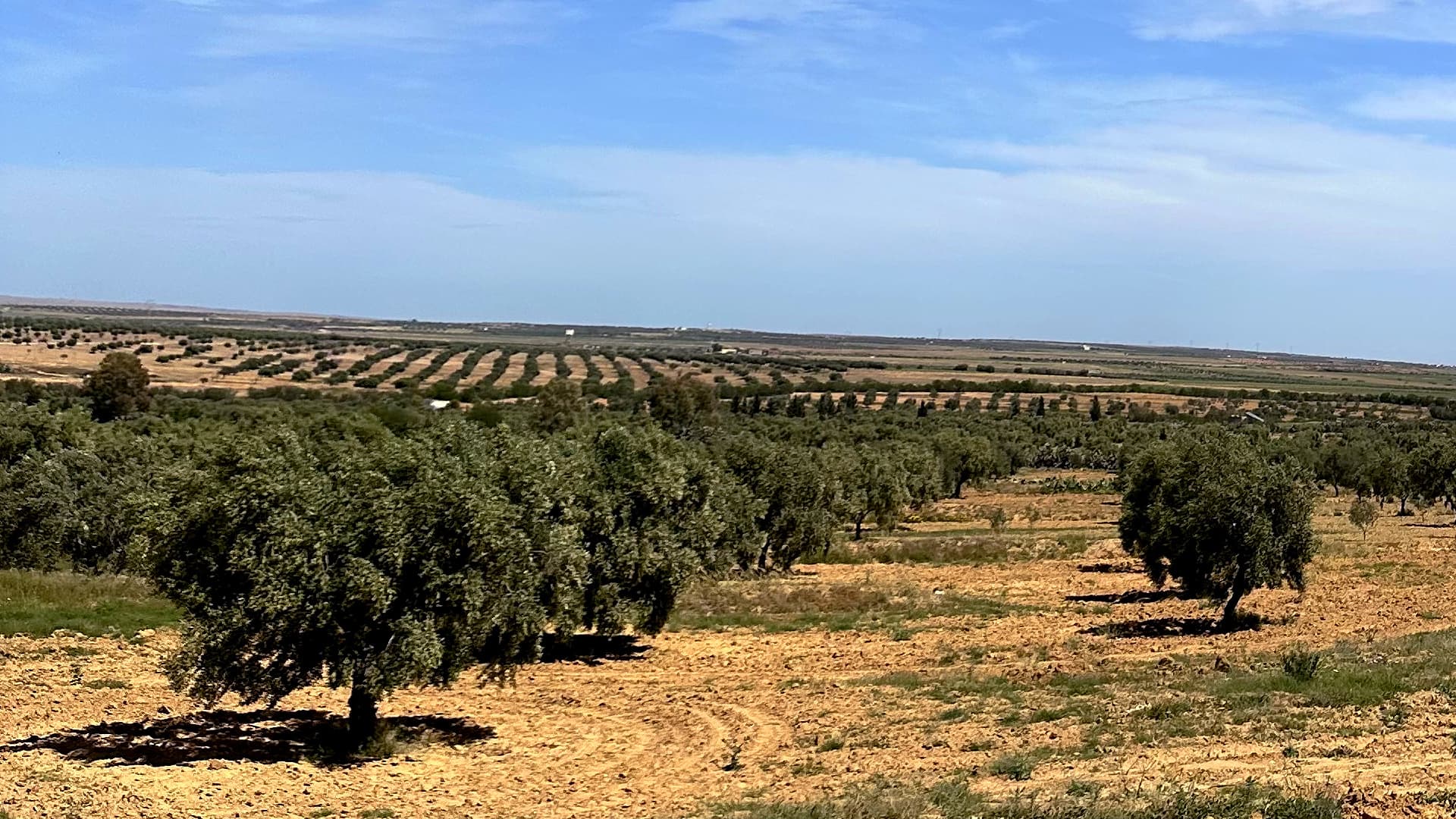
Olive groves stretch across Tunisia’s dry interior, where producers have continued investing in new plantings and expanded production capacity. (Photo: Olyfo)
“Bulk is a good business,” Hamza said. “But I think as our quantities keep growing and as more people invest in planting olive trees, we should not count just on the traditional buyers.”
Selling under a Tunisian brand requires establishing logistics and distribution, finding buyers and creating demand in each foreign market. New cooperative efforts and those of award-winning producers illustrate that effort.
“The main challenge is having the ability to go in the specific country you want to sell in, open a legal entity, have a warehouse, build a team, and go knock on every door,” Hamza said. “Two years ago, I rented a van, filled it with olive oil bottles and cartons, and drove across the U.S. from New York to Los Angeles, knocking on every door,” he added.
Olyfo followed a similar approach in the United Kingdom, establishing a local partnership, importing stock and approaching shops, chefs and food events directly. It took about a year to establish the logistics, reach dozens of shops and begin gaining recognition among chefs.
“You have to take a stock and go to that country and speak its language, learn its culture, and connect yourself with the right people,” Hamza said. “There is no magic or secret trick. It’s not going to happen overnight.”
Bulk exporters, by comparison, have decades of commercial relationships behind them. “It’s a traditional business that has been established for at least 30 years,” Hamza said.
Zayani has called for more permanent Tunisian commercial representation abroad to help producers gain access to developing markets and promote packaged products and Tunisian brands.
Hamza also sees Tunisian olive oil’s international identity as a missing part of the equation.
“Italy has built a brand over the years,” he said. “Music contributed, fashion contributed, the movie industry contributed. Italians have built the brand of dolce vita, beautiful food, and family-run. When you buy Italian, you buy not just the olive oil; it’s the nonna, it’s the family love.”
Spain’s coordinated promotional efforts include a three-year campaign that the Spanish Olive Oil Interprofessional launched in the United States in July 2026 with a €22 million budget, the organization’s largest investment in a single foreign market.
Tunisia has also increased its promotional activity. Mourad Ben Hassine, director general of the Export Promotion Center (CEPEX), said the agency planned to at least double the number of olive oil promotional initiatives in 2026 to 50 or more, with a particular focus on packaged olive oil and developing new markets.
Hamza believes much of the work of building Tunisia’s identity abroad still falls on individual producers. “I see a lot of efforts through embassies, but it’s not to the level that it should be,” he said. “Most of what happens is really private sector effort.”
Hamza said Olyfo’s efforts in foreign markets aim not only to promote the company but also to increase awareness of Tunisia as an olive oil-producing country.
“Before we sell us, we have to sell the country, and the country will sell us,” he said.
“Bulk business is great. It drives money, and it helps us grow the business,” Hamza added. “But diversification is more important.”
“Tunisia’s olive oil deserves to be spoken for its name,” he said. “And I think it should have its own flag.”