Olive Oil Treated With Ozone Shows Promise Against Common Fungal Infections, Study Finds
Researchers in Rome have found that ozonating extra virgin olive oil unlocks strong antifungal properties, disrupting the cell walls of Candida albicans and reducing its ability to cause infection.
A study conducted by the Charles Darwin Department of Biology and Biotechnologies and the Research Center for Nanotechnology Applied to Engineering at Sapienza University of Rome has highlighted the strong antifungal potential of ozonated extra virgin olive oil against the fungal pathogen Candida albicans.
The findings strengthen the scientific basis for using the product as a therapeutic treatment.
“The increasing emergence of resistance mechanisms and side effects associated with antifungal agents underscore the need for alternative therapies,” said Luciana Dini, co-coordinator of the research. “This study investigated this aspect with the aim of developing eco-friendly and highly effective treatments based on natural products.”
The work builds on an earlier investigation Dini took part in, which examined ozonated extra virgin olive oil made from cultivars native to Salento in Puglia, focusing on its ability to promote the healing of small wounds and skin blemishes.
“After discussing the matter with my colleague, Daniela Uccelletti, we decided to combine my experience with ozonated olive oil and her background in microbial physiology to develop a solution against Candida, a potentially dangerous fungus whose treatment can lead to resistance,” Dini added.
Candida species are among the most frequent causes of invasive mycotic disease, and Candida albicans is the most prevalent cause of candidiasis worldwide.
While usually harmless in healthy individuals, who harbor it as a commensal yeast in the oral cavity or gastrointestinal tract, it can become dangerous in severely immunocompromised patients. It can spread through the bloodstream and invade internal organs, resulting in life-threatening systemic infections.
Factors such as dietary changes, antibiotic treatments, pH alterations or immune imbalance can trigger its transition to a pathogenic state, enabling rapid proliferation and the onset of clinical manifestations. These range from common conditions, such as vaginal, oral and intestinal candidiasis, to invasive infections that can affect multiple organs.
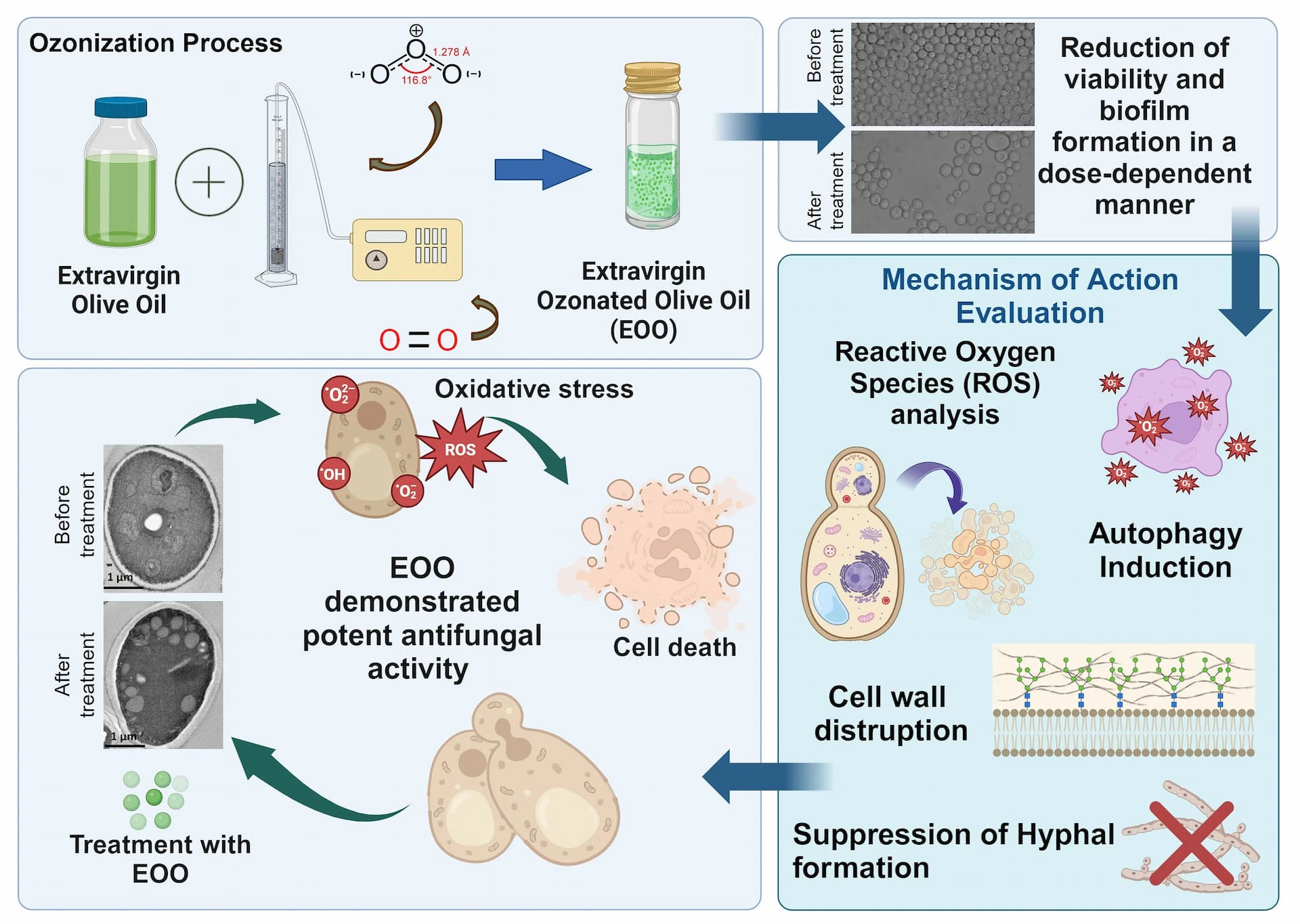
Graphical abstract of the study showing strong antifungal activity of ozonated extra virgin olive oil against Candida albicans, carried out by researchers at Sapienza University (Image by Augello et al., Biomolecules 2024, MDPI, CC BY 4.0.)
Treatment varies according to the severity of the infection. Common methods include topical formulations, such as creams, ointments, gels, lotions, sprays and powders, as well as oral antifungal drugs.
In recent decades, however, these agents have become increasingly ineffective due to the emergence of resistance mechanisms. These include target alteration, arising from mutations that reduce a drug’s affinity for its molecular target, and efflux pump overexpression, which actively expels the drug from the cell, thereby counteracting its effect.
Antifungal treatment can also interact with other therapies, reducing the efficacy of both and increasing the risk of adverse effects. When prolonged, it may lead to dysbiosis by altering the host microbiota.
These challenges underscore the growing need for alternative therapeutic strategies based on new antifungal targets and natural compounds with therapeutic potential.
“Ozonated oils are gaining interest due to their broad range of applications and antimicrobial activity,” Dini said. “Ozone is a highly reactive molecule, consisting of three oxygen atoms, functioning as both an oxidant and an oxidizer. Upon exposure, it induces oxidative stress by driving amino acid oxidation, altering the cell wall, and damaging DNA, ultimately leading to cell death.”
Dini said the study starts from the premise that ozonated extra virgin olive oil differs from conventional drugs because it acts through multiple oxidative effects, greatly reducing the likelihood of antimicrobial resistance.
For the research, an extra virgin olive oil made from cultivars native to Lazio was used for the ozonation process. Researchers bubbled ozone gas directly into the oil through an ozonator, allowing the reactive molecule to interact with the unsaturated fatty acids and generate the ozonated product.
“Ozonation is a rather basic process in which the gas is bubbled into oil under controlled temperature and time conditions,” Dini explained. “It reacts with the double bonds of the oil’s unsaturated fatty acids, and this reaction, called ozonolysis, generates ozonides, which act as carriers of the antimicrobial properties.”
“We first verified the product’s non-toxicity on keratinocytes, that is, the skin cells, and confirmed that its topical application as a spreadable oil had no adverse effects,” she said. “We then assessed its activity against Candida albicans, where it yielded excellent results.”
Dini noted that the in vitro study introduced a novel approach by evaluating the combined effects of varying concentrations of ozonated olive oil alongside different numbers of ozonides.
Building on this approach, researchers tested ozonated oil at concentrations of 1, 2 and 3 percent, combined with ozonide levels of 386, 853 and 2,492.
The results showed that ozonated extra virgin olive oil was effective in reducing Candida albicans cell viability, disrupting cell wall integrity, inducing oxidative stress and autophagy, and inhibiting both hyphal formation and biofilm development. These are key findings, given that the yeast-to-hypha transition is one of the fungus’s critical virulence factors.
Especially at higher ozonide concentrations, 853 and 2,492, the oil significantly reduced cell viability. At a concentration of 3 percent, ozonated olive oil containing 853 ozonides caused the death of more than 90 percent of the cells within just four hours of treatment.
While other studies have explored the antifungal properties of ozonated oils against vegetative cells, this research is among the first to examine how these variables affect hyphal morphology, a crucial aspect of Candida albicans virulence that had not been investigated in such detail before.
Because ozone shows strong biocompatibility with epithelial cells and oral tissues, its prolonged use does not appear to pose risks. On the contrary, it may promote the remission of mucosal lesions and enhance oral epithelial cell turnover, thereby accelerating wound healing.
Other findings suggested that ozonated extra virgin olive oil may also be an effective antifungal agent against Candida glabrata, an emerging fungal pathogen that causes infections less susceptible to commonly used antifungal drugs.
“Another interesting aspect is that, once prepared, the product retains its antimicrobial efficacy for a long time, over six to eight months, with minimal degradation, therefore falling within the range of over-the-counter medications,” Dini pointed out.
She said the study is now progressing along further research directions. One line of work will explore the combined effect of ozonated extra virgin olive oil and other oils with biocompatible nanomaterials synthesized by microorganisms, aiming to amplify the antimicrobial activity.
The research team is also evaluating whether other vegetable oils, especially those no longer used for human nutrition, could be equally effective for this application.
“We now need to move on to the in vivo phase,” Dini added. “In the meantime, the evidence suggests that this approach may be useful not only in humans but also in veterinary medicine, where it could elicit an even more effective response in small pets as well as larger animals, such as cows, extending its use for maintaining cleanliness and preventing infections. This is a promising area we intend to explore further through future studies.”