Veterans’ Cooperative Offers Blueprint to Revive Rural Dalmatia
On 14 hectares of rocky terrain, the Modro Zelena Cooperative has planted 3,200 olive trees representing 72 native varieties, offering a model for restoring abandoned land across Dalmatia.
Anyone who has traveled through the Dalmatian hinterland has seen the same landscape: vast expanses of gray stone, scrub and thorny brush.
Silence now prevails among the abandoned dry-stone walls built by previous generations. An estimated 100,000 hectares of karst fields and slopes lie neglected across Dalmatia, while all of Croatia has only 20,000 to 24,000 hectares under olive cultivation.
The government cannot simply hand a farmer bare rock and say, ‘You are on your own.’
The figures point to a vast and largely untapped agricultural resource.
A project in Desne, in the municipality of Kula Norinska in southern Dalmatia, demonstrates how even the most demanding rocky terrain can be transformed into productive land.
In late 2004, the Modro Zelena Production and Service Cooperative began working on 14 hectares of karst leased from Croatian Forests under a 50-year concession.
Led by secretary Nebojša Jerković and assembly president Mijo Vukušić, the cooperative has become an example of how sustained work and collective organization can turn marginal land into an economic opportunity.
Founded by members of an association of Croatian War of Independence volunteers and veterans, the cooperative brought together former soldiers who decided to exchange their weapons for agricultural tools.
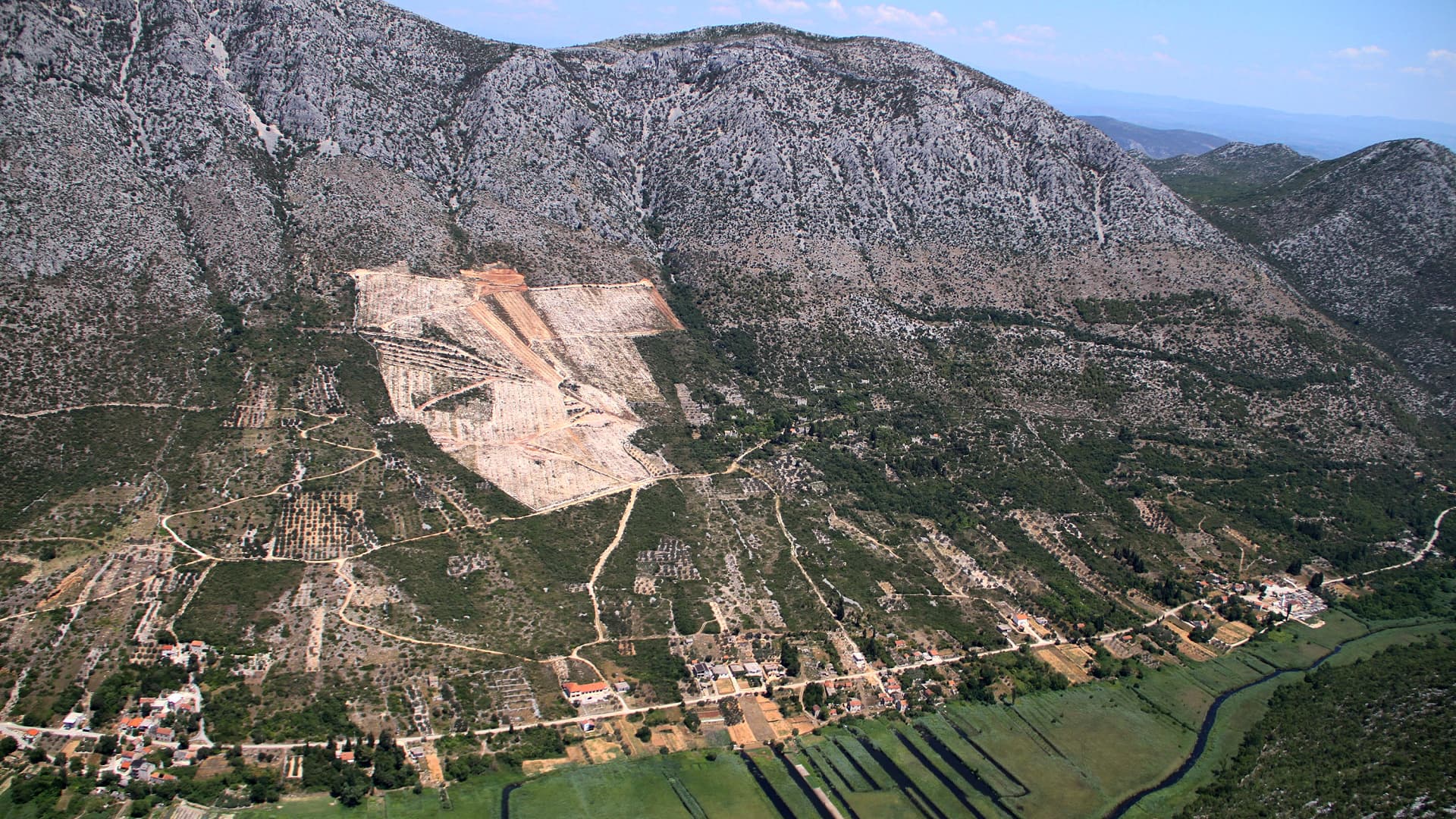
An aerial view of the initial land preparation on the rocky slopes near Desne, where the Modro Zelena Cooperative established its olive grove.
On 14 hectares of hard, exposed karst, which they initially cleared by hand, they established a distinctive organic olive grove.
The grove now contains 3,200 olive trees representing 72 native varieties. It ranges from 420 to 50 meters above sea level, with gradients exceeding 40 percent in some places. Fragrant fields of lavender surround the trees.
The achievement led the Ministry of Croatian Veterans to designate the cooperative as a reference center serving seven coastal counties.
However, the project is more than a veterans’ success story. Under the technical direction of Jerković, an agronomist, consultant and member of the steering committee of Croatia’s National Common Agricultural Policy Network, Desne has also become a lesson in adapting olive cultivation to a changing climate.
“Our collection in Desne is not merely an experimental olive grove; it is a living gene bank and a form of insurance for Croatian olive growing,” Jerković said.
Speaking at the first cross-border panel of eastern Adriatic olive growers, held during the inaugural Herz Olive Fest in Mostar, Bosnia and Herzegovina, Jerković explained how the Desne grove has become a natural laboratory amid increasingly severe climate change.
Growing 72 varieties on the same rocky soil and under the same sun makes it possible to see which trees can withstand climatic extremes and which begin to struggle.
Jerković said climate change is not limited to higher temperatures. It also brings prolonged drought, sudden heat during the sensitive flowering period, severe winds and a persistent risk of wildfire.
The findings from the veterans’ grove have been striking.
Oblica, the region’s traditional variety, has reaffirmed its reputation as the queen of the karst, demonstrating considerable adaptability and resistance to drought, cold and bora winds.
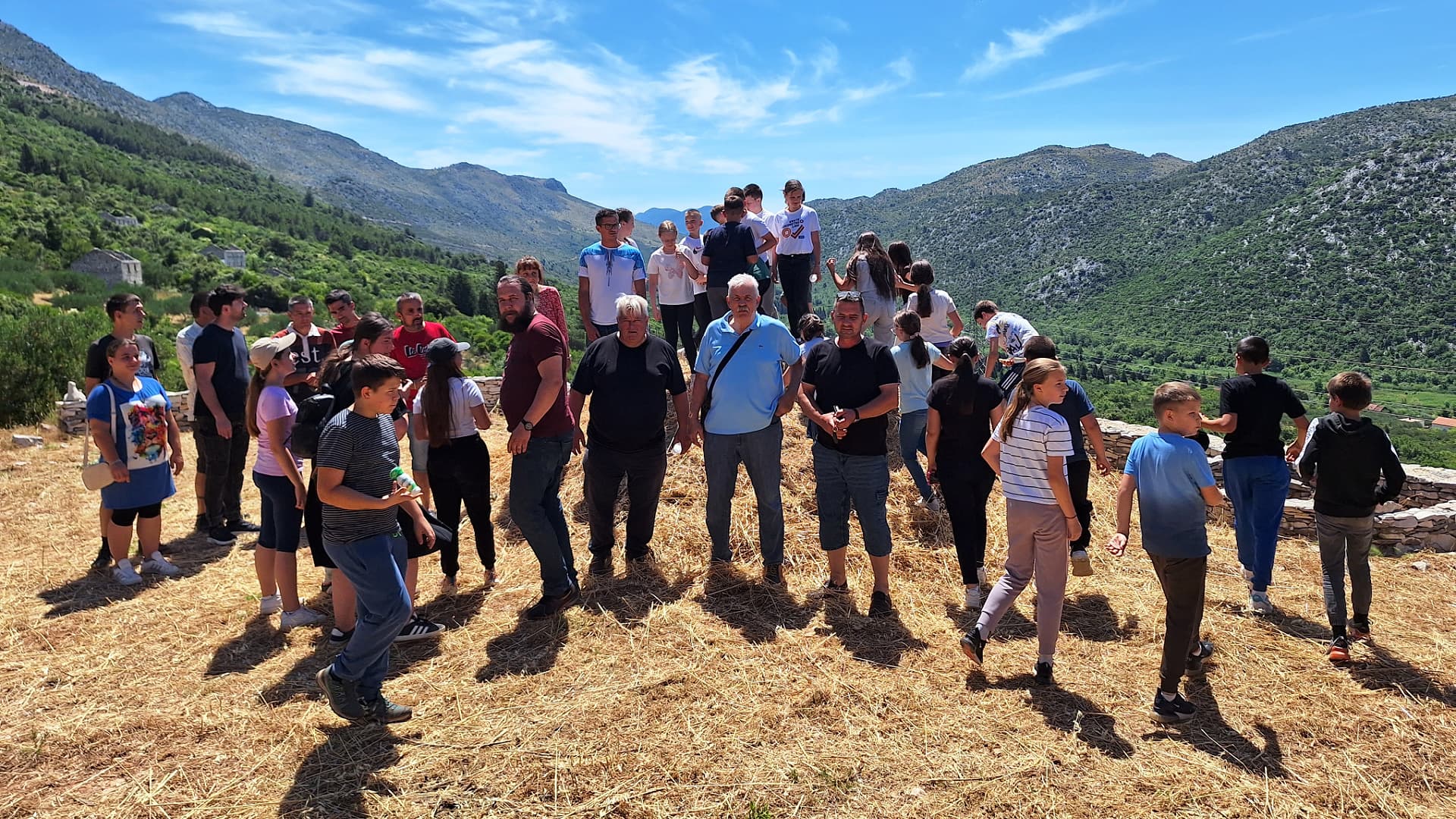
Young visitors gather in Desne during one of the cooperative’s educational programs.
Lastovka and Drobnica withstand months of heat without rainfall, while the highly regarded Levantinka is among the first to show signs of stress and cannot achieve its full potential without irrigation during critical stages.
Other native olive varieties, including Paštrica and Buharica, have demonstrated remarkably consistent yields and resistance to disease.
“Our native varieties already provide a biological response to the climate crisis,” Jerković said. “These old varieties have spent centuries adapting to our microclimates.”
“Our task is to evaluate those genes scientifically and use them when establishing new groves instead of blindly copying solutions from elsewhere,” he added.
If the Desne model is practical and sustainable, the question is why similar groves are not spreading across Dalmatia.
According to Jerković, young Croatian farmers face three formidable barriers: bureaucracy, technological and financial risk, and an unfair market.
The first is a thicket of administrative obstacles. Unresolved ownership issues, small and scattered parcels and chronic discrepancies between cadastral records and land registries can turn access to state-owned land into a years-long ordeal.
“We often spend more time and energy resolving paperwork than preparing the land and establishing the grove itself,” Jerković said.
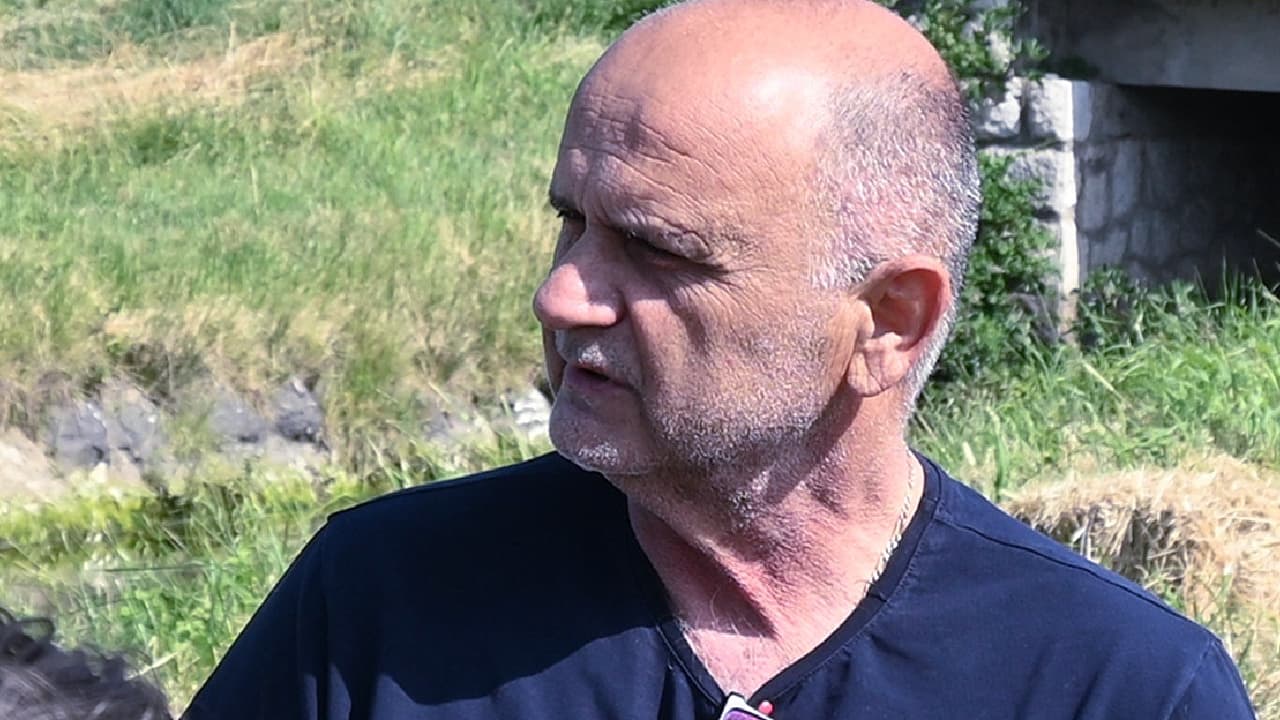
Agronomist Nebojša Jerković, who helped lead the project in Desne, said it could provide a model for restoring abandoned agricultural land across Dalmatia.
The second challenge is the technological and financial risk inherent in the rocky terrain.
Preparing karst for cultivation is costly work, closer to mining than conventional farming. Heavy machinery is needed to break up the rock, create planting sites, protect the limited fertile soil from erosion, build access roads and secure a water supply.
After that initial expense, farmers face several years of maintenance without income as they wait for the trees to reach commercial production.
Because assistance from European Union funds is often paid only after an investment has been completed, young farmers must assume substantial financial risk at the outset.
The third and most severe barrier, Jerković said, is a market dominated by import interests and large retail chains.
“A domestic producer who invests in karst land, native varieties and organic cultivation simply cannot compete on price with mass-produced imported oil,” he said. “Retail chains prioritize the lowest purchasing price, while origin and the work of local farmers remain secondary considerations.”
To encourage the government and investment funds to support the restoration of abandoned karst, Jerković has proposed a three-step action plan inspired by successful European models.
First, the government should create a registry of suitable karst land. The objective would not be to cultivate every natural area but to identify parcels that can be brought into agricultural production without causing environmental harm.
National and local authorities would then consolidate the parcels, resolve their legal status and offer them for long-term leases of 30 to 50 years. Establishing permanent crops on land without secure tenure, Jerković said, makes little sense.
Second, Croatia needs a national karst restoration program as part of its Common Agricultural Policy strategic plan.
The program should provide advance payments and affordable long-term loans for young farmers. Assistance should continue through the critical first years of establishing a grove, when growers have expenses but no harvest income.
“The government cannot simply hand a farmer bare rock and say, ‘You are on your own,’” Jerković said.
The third and perhaps most important step would be a fundamental change in how cooperatives operate, with the development of professionally managed second-tier cooperative organizations.
Jerković cited large Spanish cooperative groups such as Dcoop and Grupo Jaencoop, as well as the Italian cooperative C.A.B. Terra di Brisighella, as examples.
“These systems bring together tens of thousands of farming families,” he said. “Small olive growers retain ownership of their land and deliver their fruit to a local mill.”
“The larger umbrella cooperative handles storage, branding, quality control and, most importantly, negotiations with major buyers and export markets,” Jerković added. “This means the small producer is no longer alone and powerless in the market.”
In Croatia, he said, cooperatives too often exist primarily to apply for funding rather than operate as professionally managed commercial organizations.
Jerković also had a direct message for young people considering a return to the land: anyone planning to sell olives or oil as a cheap, anonymous commodity to middlemen should reconsider.
He argued that farms on the karst can survive only by creating high-value products and experiences.
With that objective in mind, the Modro Zelena Cooperative is planning a facility in Desne that will extend beyond agricultural production.
The complex will bring modern processing equipment, a winery, exhibition space, a tasting room and luxury accommodations under one roof. Electricity was recently extended to the site.
“Agriculture creates authentic content, while agritourism allows us to sell that experience directly, without intermediaries,” Jerković said. “Visitors do not come only to buy a product. They want to experience the landscape, see how premium oil is made and hear the story of people overcoming the karst.”
Olive and grape harvests, lavender flowering and culinary workshops could extend Dalmatia’s tourism season across most of the year.
The veterans of Desne have demonstrated that karst can be transformed into productive and economically valuable land.
Whether Dalmatia’s 100,000 hectares of neglected karst remain a monument to depopulation and abandonment or help form the foundation of a premium Croatian olive oil sector will depend largely on government policy.