At the Foot of Sicily’s Climiti Mountains, a Family Estate Looks to the Future
A fifth-generation producer in southeastern Sicily is restoring his family estate while investing in olive oil quality, sustainability and education.
In southeastern Sicily, the Climiti Mountains form the final edge of the Iblean Plateau as it slopes toward the Ionian Sea.
Designated as a European Union Site of Community Importance, the area supports rich biodiversity across stark white limestone terrain containing Miocene-era shell deposits.
We should not deplete the land for profit but improve it and leave what we received in better condition than we found it.
The landscape is dotted with caves and grottos known for paleontological discoveries, Bronze Age necropolises and Byzantine rock-cut remains.
Santacatrini lies at the foot of the uplands near the village of Melilli. The 90-hectare estate includes about 40 hectares of olive groves planted with native varieties.
Named after the local contrada, the estate’s name probably refers to a nearby rock-cut church, of which only a few stones remain.
“I think I fell in love with this land and this work thanks to my grandfather, Gaetano Peluso, whom I followed around the farm during my childhood summers,” said Giovanni Bonfiglio, the fifth generation of his family to manage the company.
“He was exceptionally brilliant, creative and proactive, a volcano of ideas who constantly launched new, often innovative projects and was always tinkering with something,” Bonfiglio recalled.
“He involved me, explaining what he was doing and drawing me in,” he added. “I followed him everywhere on the farm in admiration. As a curious child eager to see everything and discover new things, this place, with its cliffs, prehistoric remains and woodlands, was like a huge playground. That is how I fell in love with it all.”
Bonfiglio now lives in the house once occupied by his grandparents. The summers he spent with them at Santacatrini were so influential that the company’s website opens with the sound of cicadas intended to evoke those days.
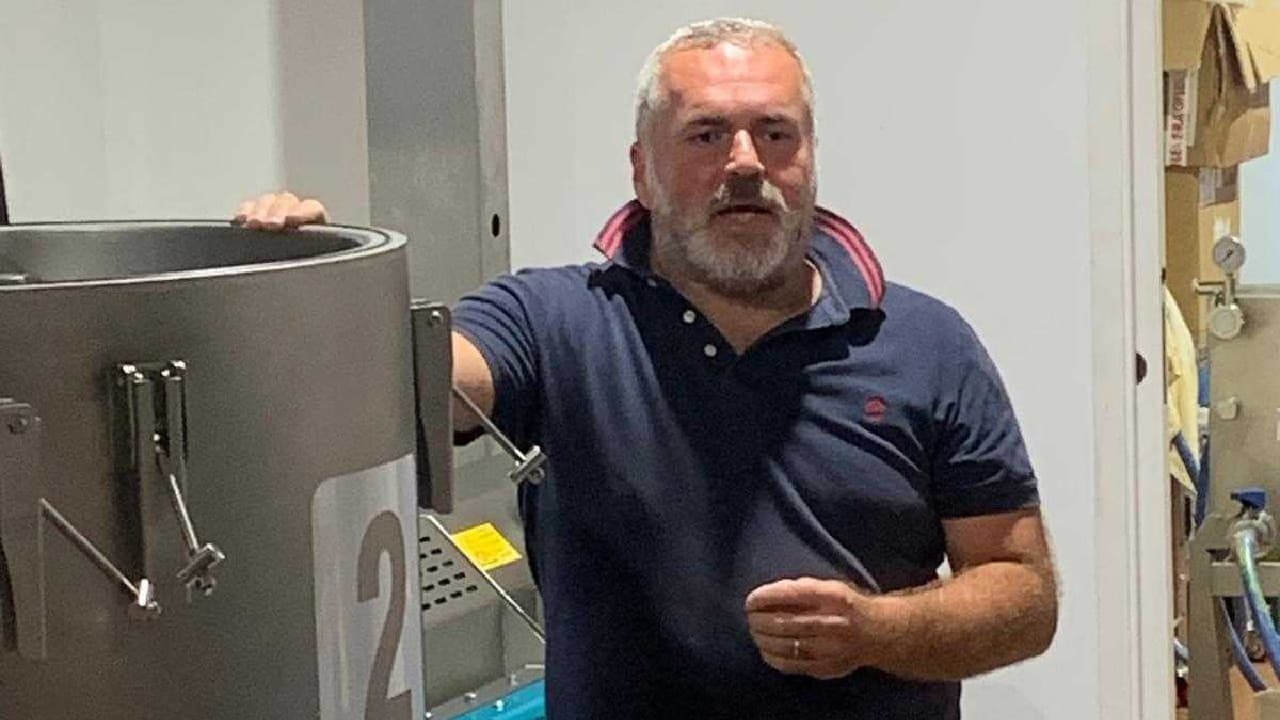
At Santacatrini, Giovanni Bonfiglio combines modern milling, water conservation and hospitality with a family agricultural tradition spanning five generations.
The sound recalls the estate’s sun-drenched orchards, where olive, almond, carob and lemon trees grow among chalk-white dry-stone walls.
The estate produces organic DOP Monti Iblei Arita, a blend made primarily from Nocellara Etnea olives, along with the Sicilian cultivars Biancolilla, Moresca, Nocellara Messinese and Nocellara del Belice.
A historic grove contains about 150 ancient olive trees. A second orchard, planted in the 1960s, follows a wide 12-by-12-meter layout, while the newest groves are spaced six meters apart.
“My grandfather handed the farm down to my mother, who essentially maintained it and continued to sell most of the olives,” Bonfiglio said.
Meanwhile, Bonfiglio earned a degree in economics and began working for a large multinational company, where he remained for 15 years.
“As a specialist, I traveled extensively, sometimes taking as many as 90 flights a year,” he said. “It was a globetrotter’s life, but my heart was always here, at Santacatrini. So I invested all my free time and financial resources in modernizing the company.”
Bonfiglio joined the estate’s management in 2008, began modernizing its operations and planted an additional 20 hectares of olive groves. In 2015, he left his previous career to work full-time at Santacatrini.
“Throughout my earlier career, I had planned this for a long time, but when you are on a treadmill, it is hard to step off,” he said. “Eventually, I said, ‘Enough.’”
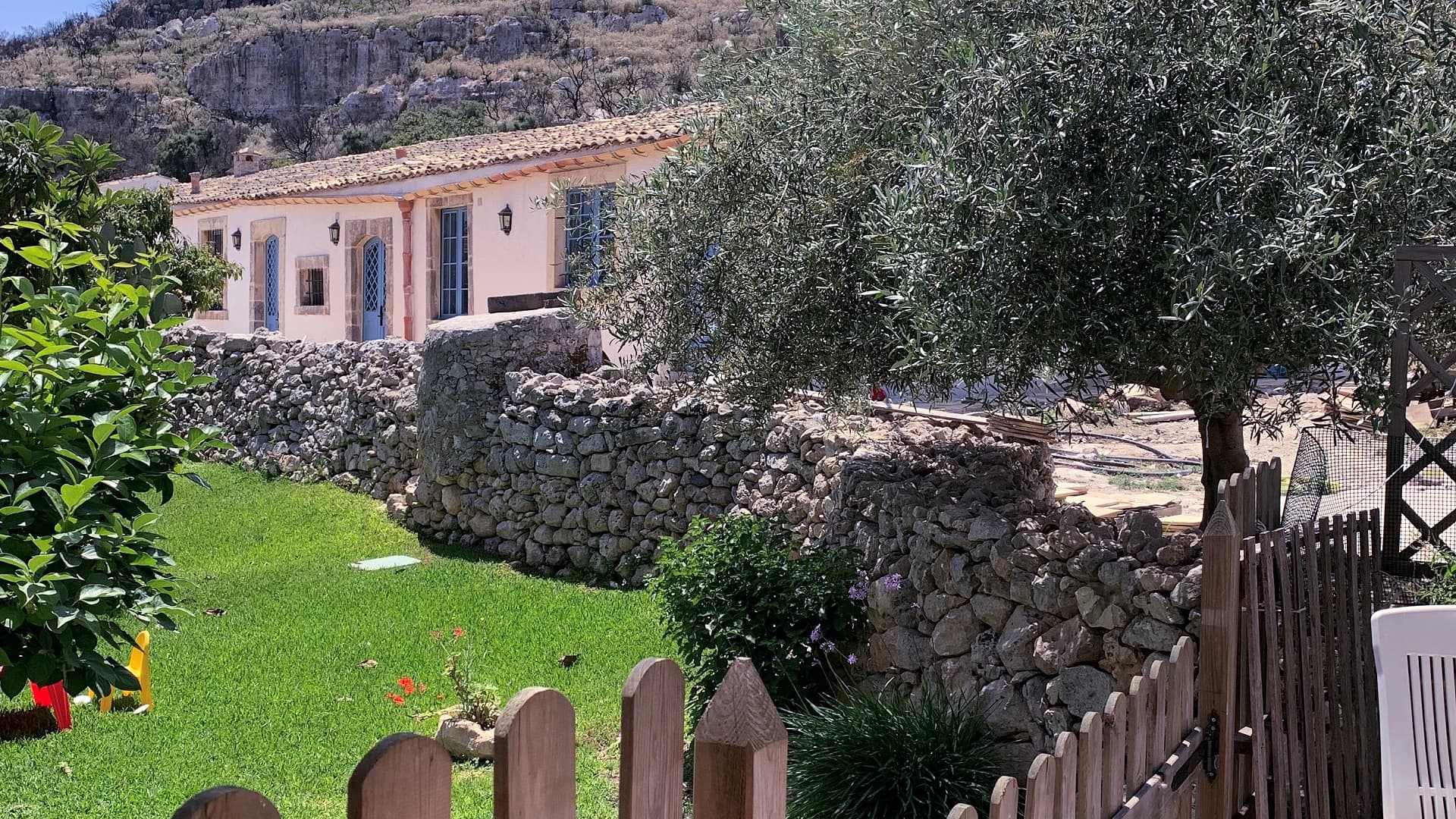
At the foothills of the Climiti mountains, Santacatrini’s dry stone walls are built from the area’s white limestone.
“That chapter of my life was over, and it was time to dedicate myself entirely to my company and to something that was truly mine,” Bonfiglio added. “From the outset, I focused on producing high-quality oil and expanding into foreign markets. In 2022, I fulfilled my dream of establishing a company-owned mill.”
Bonfiglio personally operates the Mori-Tem milling system, which features modern olive oil milling technology.
Because the harvest generally begins in September, when temperatures remain high, an integrated chiller allows him to maintain the extraction process at a controlled temperature.
“Quality is at the core of my personal philosophy,” Bonfiglio said. “Whatever I do, I strive to do it in the best possible way.”
“Even before we had our own mill, I did not work with the closest one; I traveled farther to reach the best,” he added. “The same standard guides my vision for this territory, where we are blessed with an excellent terroir and a healthy environment that we are committed to preserving.”
The farm is working to implement a circular economy system. Wet pomace from the two-phase mill is used partly as feed for horses that roam freely on the estate and partly as fertilizer for the olive groves, which are also enriched with shredded pruning residues.
Photovoltaic panels provide at least half of the property’s energy needs.
Efficient water management is another cornerstone of the estate’s sustainability strategy.
Groundwater from a well is collected in a header tank at the farm’s highest point. From there, gravity maintains pressure throughout the distribution system, eliminating the need for pumps except when the tank is refilled.
The orchards are irrigated at night using a drip system to reduce evaporation and conserve water.
A network of channels also collects rainwater from the roofs and terraces of the estate’s buildings and directs it into an underground tank connected to a pond formed in a former stone quarry.
The reservoir is not yet operational but is designed to capture and store water for future emergencies.
“I believe the key word for our company is authenticity because that is what I hear most often from visitors and guests,” Bonfiglio said.
“We do not advertise much, so I suppose those who come here discover more than we present,” he added. “When I ask our guests for feedback, what emerges most consistently is that they feel a deep sense of authenticity in what we offer.”
An ancient mill fitted with millstones and pressing mats, once used by Bonfiglio’s ancestors, still stands at the heart of the property.
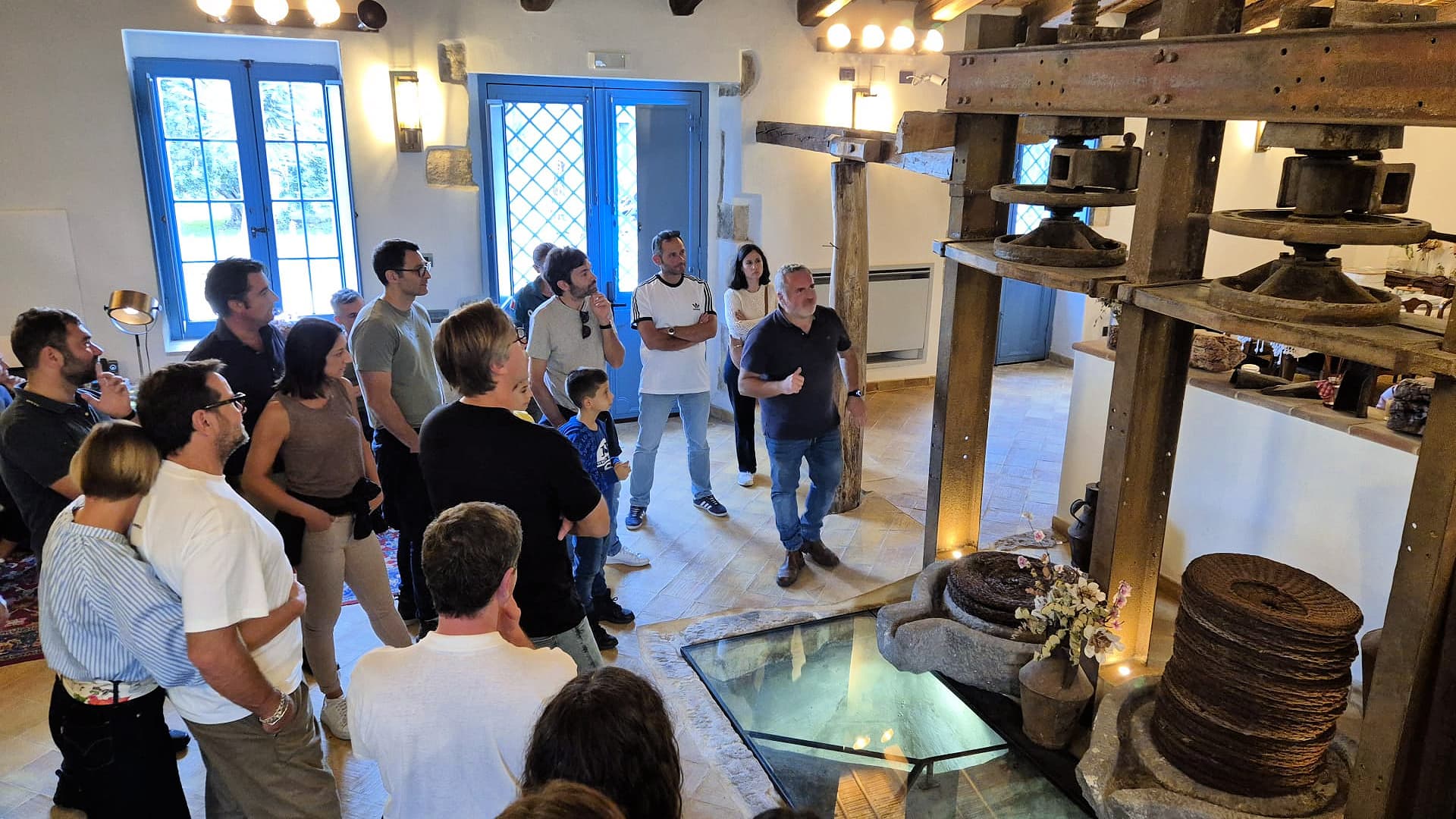
An ancient mill dating to the 1880s -1890s is the centerpiece of the tours offered through the Santacatrini estate’s oleotourism program.
Installed between 1880 and 1890, the mill was powered by a mule and remained in use until the 1950s, when it became obsolete and was set aside.
“When you enter the lobby of the company’s main building, you immediately feel immersed in history because of this old machinery, which is still almost operational,” Bonfiglio said.
“When I cleaned the farmhouse during the renovation, after 70 years of disuse, I tried to push the millstone, and it began turning again as though it had been moved the day before,” he added. “I felt I was dealing with something designed not to break.”
The historic mill now serves as the centerpiece of tours offered through the estate’s oleotourism program. It stands beside hospitality facilities created during the renovation of the family’s 19th-century masseria.
“The old mill is now enjoying a second life through our oleotourism activities,” Bonfiglio said. “I use it to introduce our guests to the history of this land and the world of olive oil.”
“I think the main problem in our sector is a lack of knowledge and the persistence of false beliefs about olive oil,” he added. “For this reason, I am strongly committed to fostering and promoting olive oil culture.”
Bonfiglio said stewardship is central to that culture.
“We should not deplete the land for profit but improve it and leave what we received in better condition than we found it,” he said. “To me, this is the key to looking toward a better future for everyone, and it is what I am trying to pass on to my son.”
“I hope the same thing happens as when I was a child and that he follows in my footsteps,” Bonfiglio added. “Of course, I want him to feel free to choose whatever makes him happy.”