Young Croatian Grower Wins International Acclaim for Oil from Historic Grove
Young Croatian grower Stjepan Dević wins international acclaim at the NYIOOC for his award-winning olive oil, produced from a historic grove.
Croatian olive oil producers are once again proving their mettle on the global stage, and a young grower is leading the charge with an award-winning oil steeped in history. Stjepan Dević (30) from Sukošan near Zadar has earned international recognition at the prestigious NYIOOC World Olive Oil Competition (NYIOOC), a testament to his dedication and the unique terroir of his olive grove.
The feeling is unique. Indescribable. The award is the culmination of my ten years of work and dedication to olive growing.
Croatian olive oils are making waves at the 2025 NYIOOC. They hold a strong second place with an impressive 77 awards, closely trailing Italy’s 83 accolades with just over half of the results in, according to the status monitor on the Olive Oil Times World Ranking app. Particularly noteworthy is the growing number of young Croatian producers achieving such high standards, with Dević being a prime example.
“The feeling is unique. Indescribable. The award is the culmination of my ten years of work and dedication to olive growing,” Dević shared with Olive Oil Times, reflecting on his achievement.
His award-winning Perliano oil, crafted from Levantinka, Istrian Bjelica, and Leccina olive varieties, boasts a harmonious profile. It is fresh with a medium intensity and presents attractive, fruity notes of Mediterranean herbs, pepper, green banana, artichoke, and almond. Notably, the oil is also rich in polyphenols, which are known for their significant health benefits.
The olive grove that yields this exceptional oil is located on a terraced hill in the former medieval settlement of Prljane, Latin Perliano, from which the oil derives its name. This historic site carries a dramatic past, having been devastated by Ottoman incursions and later suffering further destruction during the Serbian aggression before its eventual rebuilding after the Croatian Homeland War. Only the Church of St. Martin remains from the original settlement.
Dević’s connection to olive growing runs deep. His family has cultivated olives since 1640. He proudly carries on this tradition, initially inspired by his ancestors, who produced oil using traditional methods.
Driven by his passion, Dević pursued formal education in agriculture, earning a master’s degree in agronomy. He gained valuable experience and eventually established his own business, Hortus Agro, which specializes in landscaping and landscape maintenance. Leveraging the earnings from his grandfather’s land in Sukošan, he established his olive groves with 400 trees and later acquired an older grove, grafting in more native and introduced varieties.
“When you do what you love, and you love what you do, anything is possible,” says Dević, encapsulating his philosophy.
Beyond oil production, Dević has also become a certified taster with the Olea Zadar Association of Sensory Analysts of Olive Oil. In November of this year, he co-founded the Olive Pruning School in Dalmatia with Dr. Šimo Marcelić, demonstrating his commitment to knowledge sharing.
“Our intention is to connect science, profession and practice. To transfer knowledge. Because, if knowledge is not transferred, it is dead,” explains Dević. They have partnered with young enthusiasts and gained expertise in Italy under the guidance of olive-growing visionary Giorgio Pannellio, whose name graces the current Italian Olive Pruning School.
The school focuses on pruning using the polyconic vase method. Dević highlights the numerous advantages of this technique over traditional spherical or bushy shapes, including a better ratio of wood and leaf mass, reduced fertile area, and more even fruit ripening. This leads to improved harvests and significantly lower harvesting, pruning, and protection costs.
The Olive Pruning School’s courses have garnered interest not only from Dalmatian and other Croatian olive growers but also from neighboring countries like Bosnia and Herzegovina and Montenegro. “We are satisfied with the response. Hundreds of participants have already attended the courses,” states Dević.
Furthering his commitment to the olive oil community, Dević is organizing the first pruning competition for the Dobroslav Elezović Trophy, honoring the founder of modern olive growing in Dalmatia.
“Competing and being better is in the blood of us Croats,” remarks Dević, drawing parallels between sports and olive growing. Alongside his partner, Toni Družijanić, they pruned an impressive 20,000 olive trees this season alone.
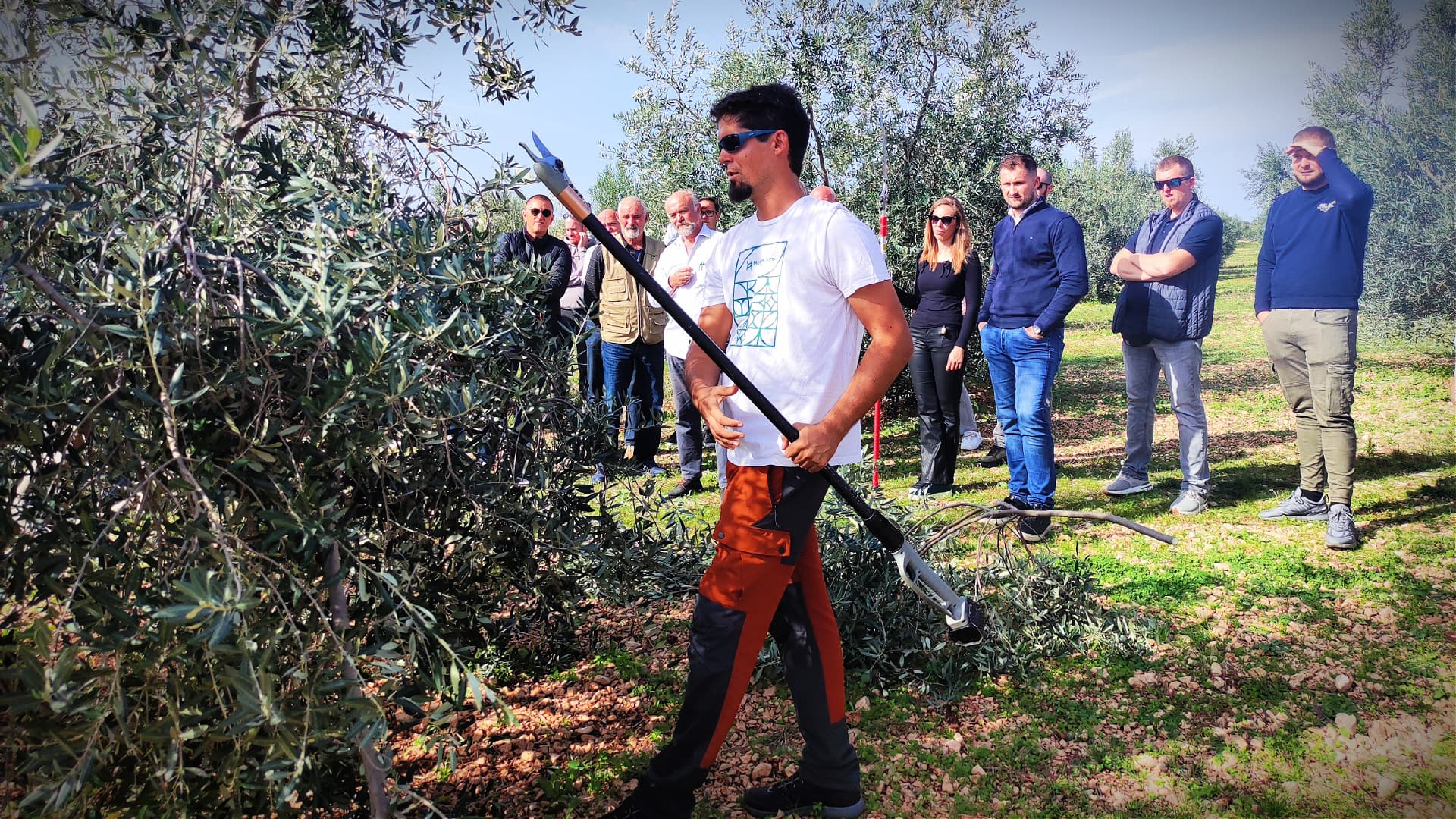
Stjepan Dević carving on a polyconical vase
Dević emphasizes the benefits of the polyconic vase in his own groves, noting that it “enables a better distribution of light and airflow between the trees, which contributes to a higher quality of the fruits and the oil itself.”
He underscores the importance of harvesting each olive variety at its optimal time to achieve the highest oil quality. For his award-winning oil, he picked at the beginning of October when the first oil mills opened.
Expanding his ventures, Dević is also involved in olive tourism. His holiday home, Villa Perliano, offers visitors the opportunity to experience award-winning olive oils, participate in tastings, and explore the olive groves. The villa is conveniently located just a 12-minute walk from the renowned Zlatna luka beach, 5 kilometers from the airport, and near the historic city of Zadar, considered older than Rome.
When asked about the secret behind the success of Dalmatian and Croatian olive growers, Dević attributes it to the “unique terroir,” the soil and earth that enhance the taste and aroma of the native region, as well as the diverse olive varieties. He also highlights the importance of the karst landscape, stating, “the olive gives its best when it is most difficult.”
Dević is optimistic about Croatian olive growers’ performance in this year’s NYIOOC competition. “I hope that we will keep second place, and for more than that, they should participate in the NYIOOC with more samples. Because, for example, Italy this year has 255 samples, and Croatia has 143. If we had the same number of samples, maybe they could be the overall champions in terms of the number of prizes won,” he concludes.
The young olive grower continues to receive congratulations for his New York success. Ivica Vlatković, a multiple award-winning olive grower and president of the Association of Zadar County Olive Growers, wrote to him, “Well done, Stjepan. This great award is an important incentive for you and Sukošan.” Dević’s achievement highlights his dedication and underscores the growing reputation of Croatian olive oil on the global stage.