Sustainable Olive Oil Production Helps Mitigate Climate Change
The International Olive Council attended the Conference of the Parties of the United Nations Framework Convention on Climate Change (COP22) to present research on sustainable olive oil production.
Scientific studies have documented the positive effects of olive growing on the environment. In addition to the role played by the olive tree in safeguarding biodiversity, improving soil, and as a barrier to desertification, there is evidence that specific agricultural practices have the capacity to increase the atmospheric CO2 fixed in permanent vegetative structures (biomass) and in the soil.
On this basis, the International Olive Council (IOC) was present at the annual climate conference COP22, (Conference of the Parties COP to the United Nations Framework Convention on Climate Change UNFCCC), which this year took place in Marrakech, Morocco, November 7-18 2016.
COP22 has special importance after the Paris Agreement, that just entered into force and enshrined the first-ever universal, legally binding global deal to tackle climate change, with the main goal to keep “a global temperature rise this century well below 2°C.”
At the conference, 197 Parties (196 States and the European Union) met to turn their promises into action and wound up with a “call for the highest political commitment to combat climate change, as a matter of urgent priority.”
In Marrakech, during a session entitled “Olive oil, the liquid gold helping to reduce greenhouse gas emissions,” the head of the environment R&D department of the IOC, Francesco Serafini, gave a speech about the role of olive trees and olive oil as a sustainable alternative to mitigate climate change. One of the IOC deputy directors participated alongside olive oil and CO2 experts to present results that indicate that the production of olive oil, using the right farming techniques, can contribute significantly to reducing greenhouse gas emissions.

“The olive tree forest has existed for thousands of years. Their fruit and the oil it produces are good for your health but olive trees are also good for the environment,” Serafini told Olive Oil Times. “They are a barrier to desertification and erosion. Olive orchards are a CO2 sink, remove CO2 from the atmosphere and fix it in the soil,” he added, and explained that “in the production of 1 liter of olive oil, olive trees remove 10 kg of CO2 from the atmosphere.”
“In fact, according to the research published to date, during the life cycle of the product, an average 1.5 kg CO2e is emitted into the atmosphere to produce one liter of virgin or extra virgin olive oil,” said Serafini.
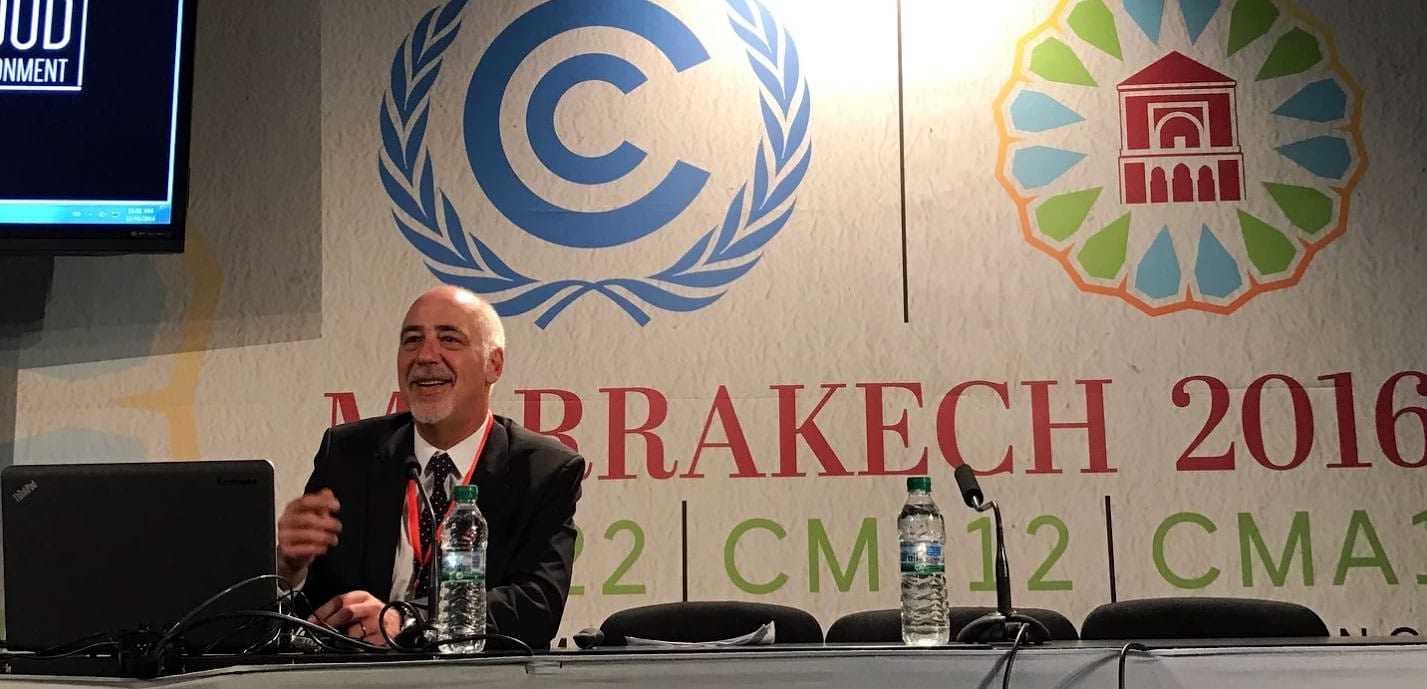
Francesco Serafini
“However, if the proper agricultural practices are applied, in a mature semi-intensive olive orchard with average crop yields, an olive tree can fix 10t CO2e/ha/year, resulting in a clear positive balance.” It can be therefore demonstrated that, when proper agricultural practices are applied, the carbon sink effect of olive trees is much greater than the amount of CO2 emitted to produce one product unit.
In relation to climate change, a sink is any process, activity or mechanism that extracts greenhouse gasses from the atmosphere. These gasses include CO2, the concentration of which has increased exponentially in recent years and is the main cause of global warming.
During the IOC conference, it was remarked that olive trees can be grown in extreme climactic conditions, where few other woody crops survive. Seventy percent of the world’s olive orchards are rain fed, without water from irrigation and using rainwater only. In some regions of the Mediterranean, olive trees are grown with barely 200 mm of rain and constitute an essential source of livelihood for many sectors of the population.
Participation of IOC in COP 22 has been a decisive opportunity to show the world how the production of olive oil, virgin or extra virgin, according to specific agricultural practices, helps to mitigate the effect of greenhouse gas emissions. “It is important to emphasize that we are talking about not only the logical environmental benefit of the olive tree but in particular the environmental benefit of producing virgin and extra virgin olive oil,” Serafini pointed out. “Olive trees are part of the solution to climate change.”
#Olive oil production and environmental impact https://t.co/emCkqrnKHO HT @oliveoiltimes #sustainability #COP22
— Agora MedSpring (@AgoraMedSpring) August 3, 2016
The IOC at COP22 – International Olive Council | @scoopit https://t.co/ZyIC346GYN
— Olive News (@iocolivenews) November 12, 2016
Olive trees & Vineyards near #Meknes #Maroc #Cop22 #Morocco #olivetrees #olive #oliveoil #… https://t.co/oJqQhUV254 pic.twitter.com/rkIUVj7w3l
— NOW Maroc (@NowMaroc) November 15, 2016