A Sanctuary for Mendoza’s Ancient Olive Trees
A family in Mendoza has relocated more than 5,000 ancient olive trees threatened by urban expansion, creating a growing sanctuary dedicated to preserving Argentina’s olive-growing heritage.
In April, Mendoza turns yellow and the air smells of fresh-cut grass. Autumn settles over the Southern Hemisphere, and the olive harvest moves at an unhurried pace as growers wait for the fruit to reach its ideal stage of ripeness.
Between olive mills, rural roads and narrow streets, thousands of century-old olive trees emerge as silent witnesses to a time when public policies helped drive the development of Argentina’s olive sector. Over the decades, many of those groves were abandoned amid political and economic shifts.
Some trees survive as part of the landscape in gated communities that have pushed the urban frontier into former agricultural land. Others remain standing by the roadside, a testament to the olive tree’s resilience. Many, however, are threatened by real estate, agricultural and commercial development projects that cut them down and sell them as firewood.
“Mendoza was once the country’s leading olive-growing region, with more than 20,000 hectares planted,” said Miguel Zuccardi, a prominent Argentine producer.
The olive tree is a very noble tree, and I developed a special affection for it.
“Today there are around 11,000,” he added. “A great deal has been lost, especially because many of these olive trees were located in areas that now have significant real estate value. Then, with the ups and downs of the industry, nearly half of the region’s olive sector disappeared.”
Zuccardi has worked to highlight the value of Arauco olive oil, making him especially sensitive to the disappearance of century-old trees of the emblematic variety, which is protected by a Geographical Indication (PGI) in Mendoza.
Arauco is the only olive variety internationally recognized as originating in South America. Descended from trees introduced by Spanish colonists in the 16th century, it adapted over centuries to the conditions of the Southern Cone.
Faced with the increasingly uncertain future of the region’s ancient olive trees, the Cicero family decided to intervene.
Emilio Cicero, the son of a Sicilian immigrant, grew up among Italian and Spanish families who arrived in Argentina “with nothing.” He recalls watching them propagate trees from small cuttings brought from their home countries.
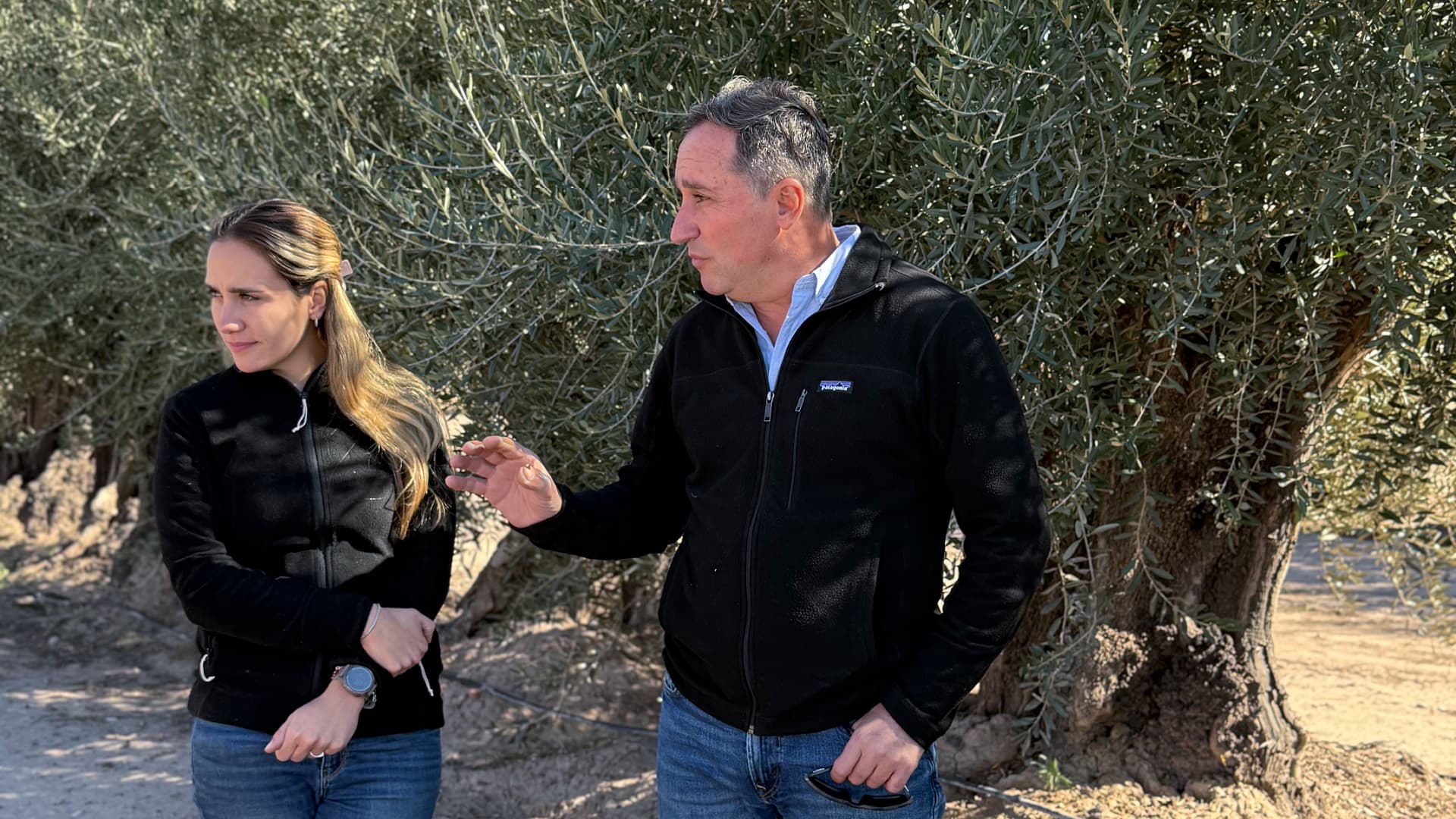
Emilio Cicero, with his daughter Valentina, among rescued century-old olive trees at the Los Inmigrantes Sanctuary in Mendoza, where the family has relocated thousands of historic specimens threatened by urban expansion.
“The olive tree is a very noble tree, and I developed a special affection for it,” he said.
By 2015, Cicero had become a major almond producer after purchasing a property in Maipú for his business. But he could not bring himself to remove the old olive trees growing there.
There were 3,000 trees spread across 30 hectares.
Using heavy equipment, he relocated them to three hectares and arranged them in circular plantings designed to give each tree space and the best possible conditions to continue living.
“I got tired of the straight lines of almond orchards and vineyards,” he said.
That marked the beginning of Los Inmigrantes Sanctuary in Maipú.
With nine hectares already planted and three more in preparation, Cicero has relocated more than 5,000 ancient olive trees, about half of them Arauco, along with other oil varieties. Many were at risk of ending up in brick kilns.
As the reserve expanded, the original property became too small.
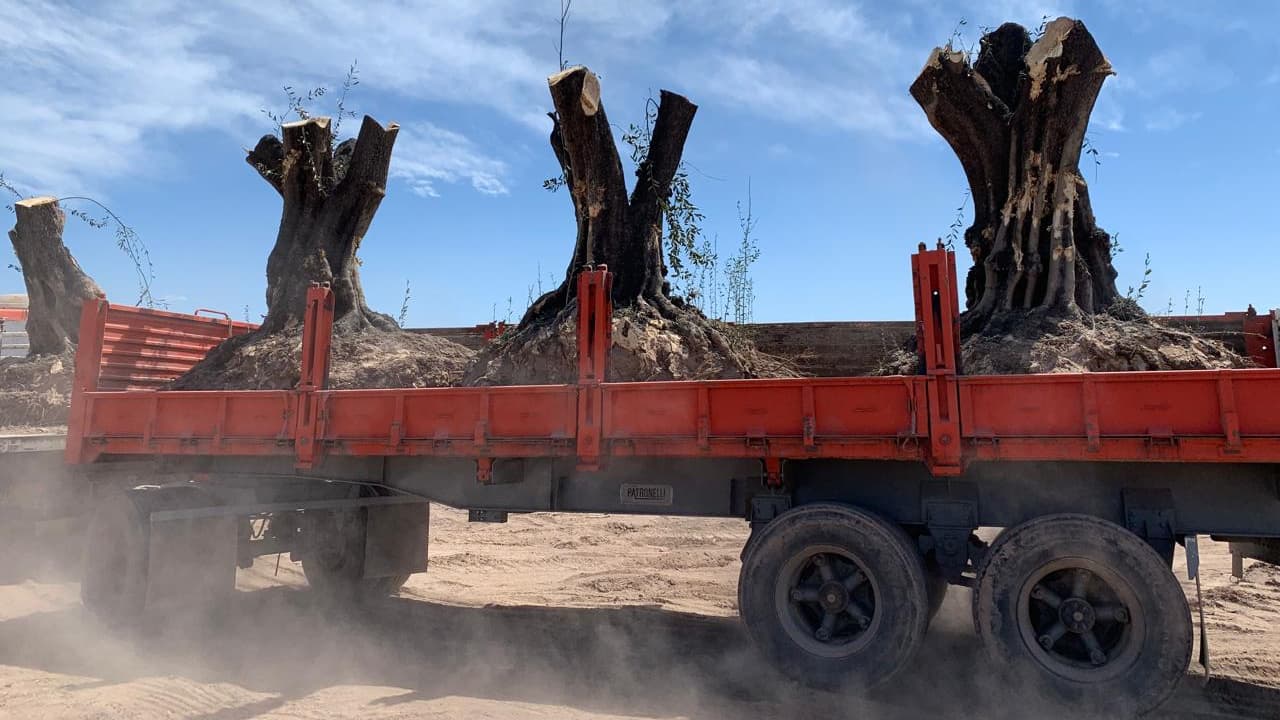
Centuries-old olive trees are transported across Mendoza after being rescued from properties slated for redevelopment, part of the Cicero family’s effort to preserve the region’s historic groves.
Cicero is now transforming another 23-hectare property, El Paraíso, into a new sanctuary for historic trees. The site already houses 500 specimens.
He is also developing a project in Cruz de Piedra, where an intensive grove will eventually surround a smaller reserve dedicated to rescued trees.
“At some point we’ll have a small olive mill,” he said.
Although producing olive oil was not part of the original plan, Cicero said he had gradually come to believe he must do something with the large amount of fruit the trees produce each year.
To Cicero, the trees are “monsters” of nature, and he says he knows each one individually.
He speaks about the rescue efforts with the same pride he shows when talking about his four children: Emilia, Valentina, Luciano and Franco.
Over the past decade, all four have taken on roles in the family business and the rescue project.
“Watching him work, learning everything he shares with us and being able to accompany him in this is priceless,” said Emilia, the eldest daughter and the company’s accountant.
“It’s impossible to put into words,” added her sister Valentina. “It’s a great honor to rescue olive trees alongside him and my family, caring for these living beings that carry so much life, history and time in every branch.”
The rescue process is complex and expensive. Each tree is extracted with specialized machinery and transported to the sanctuary, often through difficult journeys along rural roads.
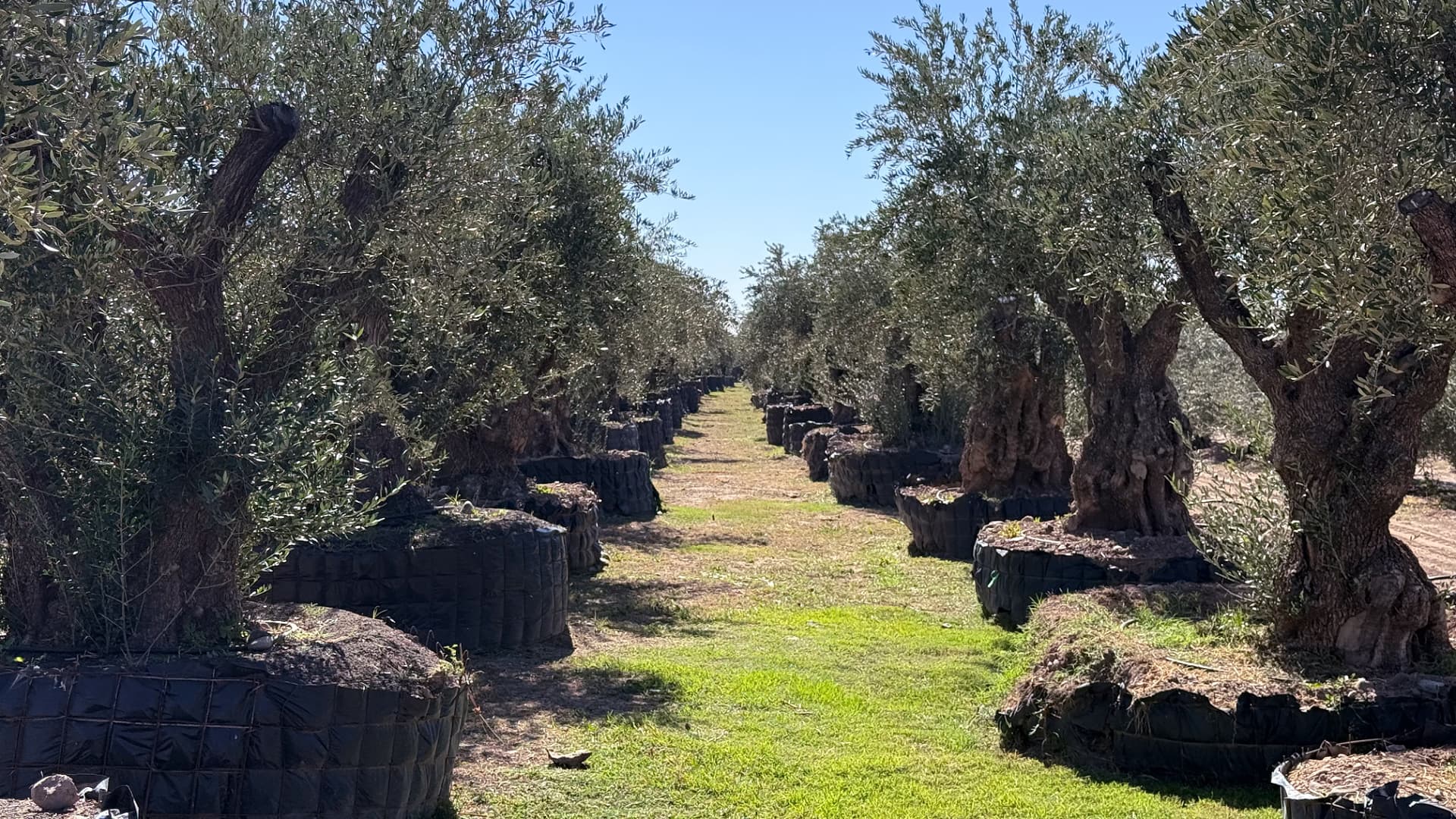
Rescued century-old olive trees stand replanted at the Los Inmigrantes Sanctuary in Mendoza, where the Cicero family is preserving thousands of historic specimens threatened by urban expansion and neglect.
On one occasion, the family moved an olive tree 16 kilometers using a front loader that traveled just above ground level, with people walking alongside to support its branches.
On another occasion, Emilio discovered 15 olive trees more than 300 years old and, after lengthy negotiations, managed to save them all.
Moving another specimen required three cranes.
“We’re investing a great deal of resources to keep this going, but it’s what makes me happy,” Cicero said. “I feel like a painter: my brush is the machinery, and my paint is the olive trees.”
Cicero sees the sanctuary as a tribute to his roots and to the agricultural legacy of the immigrant families who transformed the landscape of Cuyo.
More than a collection of ancient trees, the reserve represents a long-term commitment to preserving one of the most authentic expressions of Argentina’s olive-growing heritage.
“I always tell my children: the day I’m gone, and the day you’re gone, this must be preserved for posterity,” Emilio said.
“The goal is for them to keep living, to find a place of peace, a true sanctuary,” he added. “I imagine a great promenade where people can admire these trees, their shapes and roots — a place of tranquility, peace and connection, like a large public park.”
For now, the sanctuary remains private, but the family is planning projects to open it to the community and showcase the trees to visitors.
Even the specimens that did not survive have a place in the park, which also includes a section dedicated to the immigrant families who helped shape the region’s olive industry.
It is a hidden corner of Mendoza that invites visitors to walk among the living history of Argentine olive growing and reflect on the extraordinary beauty of these remarkable trees.