
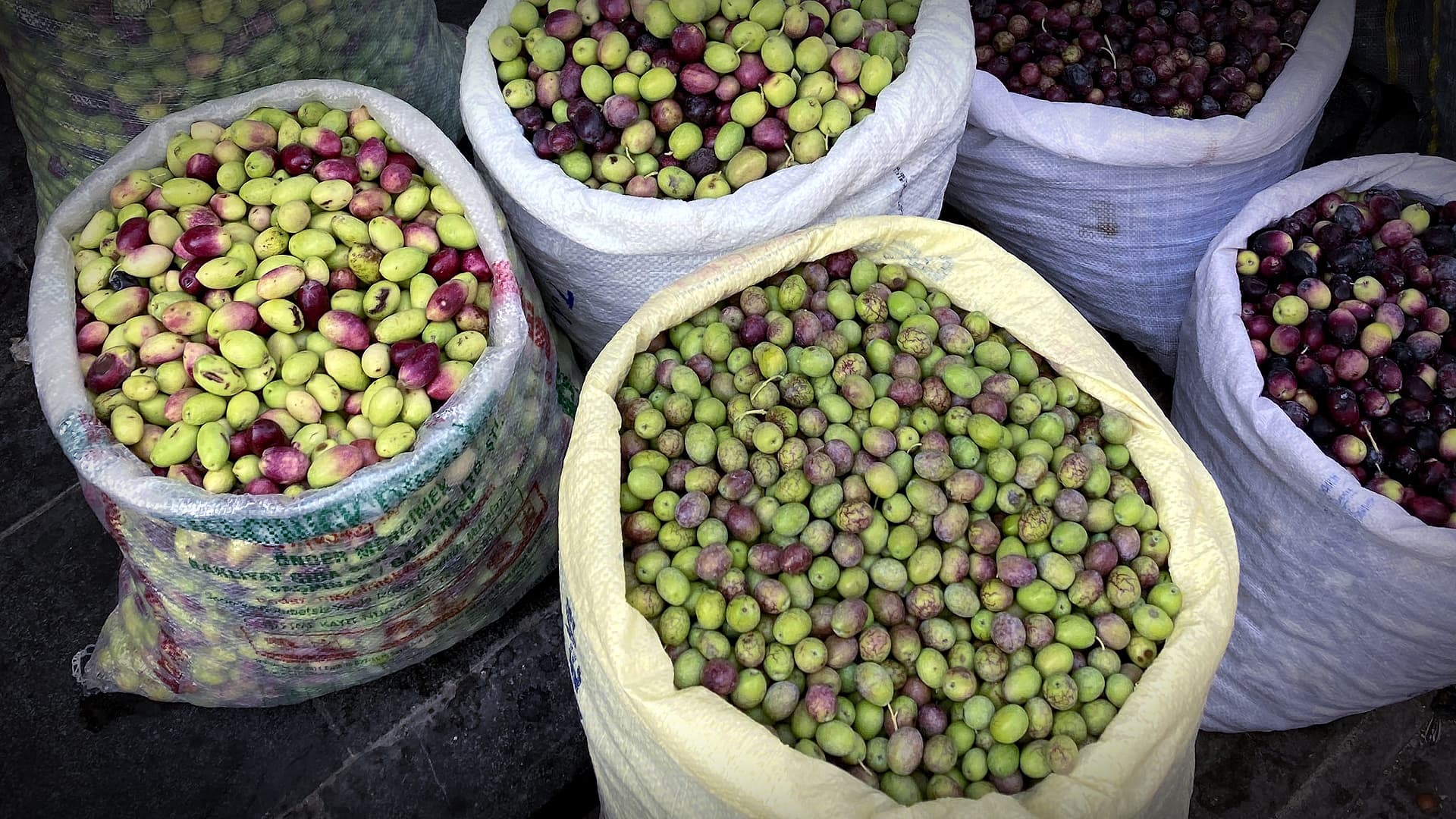
Low harvest forecasts and a sharp decline in producer prices have fueled discontent among growers of Chalkidiki table olives in Greece.
Producer prices for large Chalkidiki olives have fallen to around €1.10 per kilogram this crop year, compared with €1.80 in 2025/26. The variety typically accounts for about 40 percent of Greece’s table olive production and half of its annual table olive exports.
As is customary in the industry, prices paid by processors and packers depend on olive quality and size, with larger olives commanding higher prices.
Filoklis Gotzias, head of the agricultural association of Simantra in Chalkidiki, said production of the region’s olives is expected to fall by half this year, even as purchasing prices remain too low to cover growers’ costs.
“Despite the reduced supply, the olive packers have announced prices starting at 1.10 euros, resulting in producers earning 90–95 cents net [for a kilogram], when the cost of cultivation reaches 1.10 euros per kilogram,” he said.
Growers have called on packers to establish a minimum purchasing price of €1.50 per kilogram, arguing that the threshold is necessary to keep their operations financially viable.
However, Kostas Zoukas, head of PEMETE, the Greek Association of Manufacturers, Packers and Exporters of Table Olives, disputed forecasts of a steep production decline. He said new olive plantings in recent years would help ensure sufficient supplies.
Zoukas also argued that climate change would have a greater impact on the quality of Chalkidiki olives than on production volumes in the coming years.
Greece produced more than 150,000 metric tons of Chalkidiki olives last year, while output can reach 200,000 tons in particularly productive seasons.
The outlook is more favorable for growers of Kalamon olives, commonly marketed internationally as Kalamata olives, both in terms of prices and expected production.
Producer prices for Kalamon olives are hovering around €2.00 per kilogram this year, while the harvest is expected to match last season’s domestic output of approximately 100,000 metric tons.
Nevertheless, PEMETE warned that quality problems in this year’s Kalamon harvest could threaten exports. The association said some olives harvested last year showed color defects and damage associated with olive pests.
“Any recurrence of quality issues…would further undermine the product’s credibility and competitiveness due to the ongoing geopolitical conflicts and the U.S. import tariffs,” the association said in a statement.
In Laconia, in the southern Peloponnese, some Kalamon olive growers are optimistic about the approaching harvest.
“We expect a yield between 2,000 and 2,500 tons this season,” said Giannis Plataniatis of the local agricultural association of Gouves. “This quantity gives us some room to breathe and allows us to address problems that arise in olive oil production.”
Despite the more favorable outlook for Kalamon olives, low producer prices and high production costs have fueled broader unrest across Greece’s olive and olive oil sectors.
At a nationwide meeting held last month in Stylida, central Greece, olive growers and olive oil producers called on the government to establish minimum guaranteed prices that would “cover production costs and secure a sustainable income.”
“To ensure that we have a sustainable income, the merchants and manufacturers who exploit our hard work must lose out,” the producers said in a statement.
Meanwhile, data from ELSTAT, the Greek Statistical Authority, showed that table olive exports declined by nearly one percent in value and 2.25 percent in volume during the first half of 2026, marking the first annual decline in a decade.
Industry observers attributed the downturn partly to U.S. import tariffs and weakening economic conditions in Germany, both important markets for Greek table olives.
Growing competition from Egyptian table olives in Australia was also cited as a contributing factor. Greece remains Australia’s largest table olive supplier, accounting for an estimated 70 to 80 percent of the roughly 17,000 tons imported annually.
Greece exports more than 90 percent of its domestic table olive production. According to PEMETE, exports reached a record 282,000 metric tons in 2025, with a total value of €872 million.