
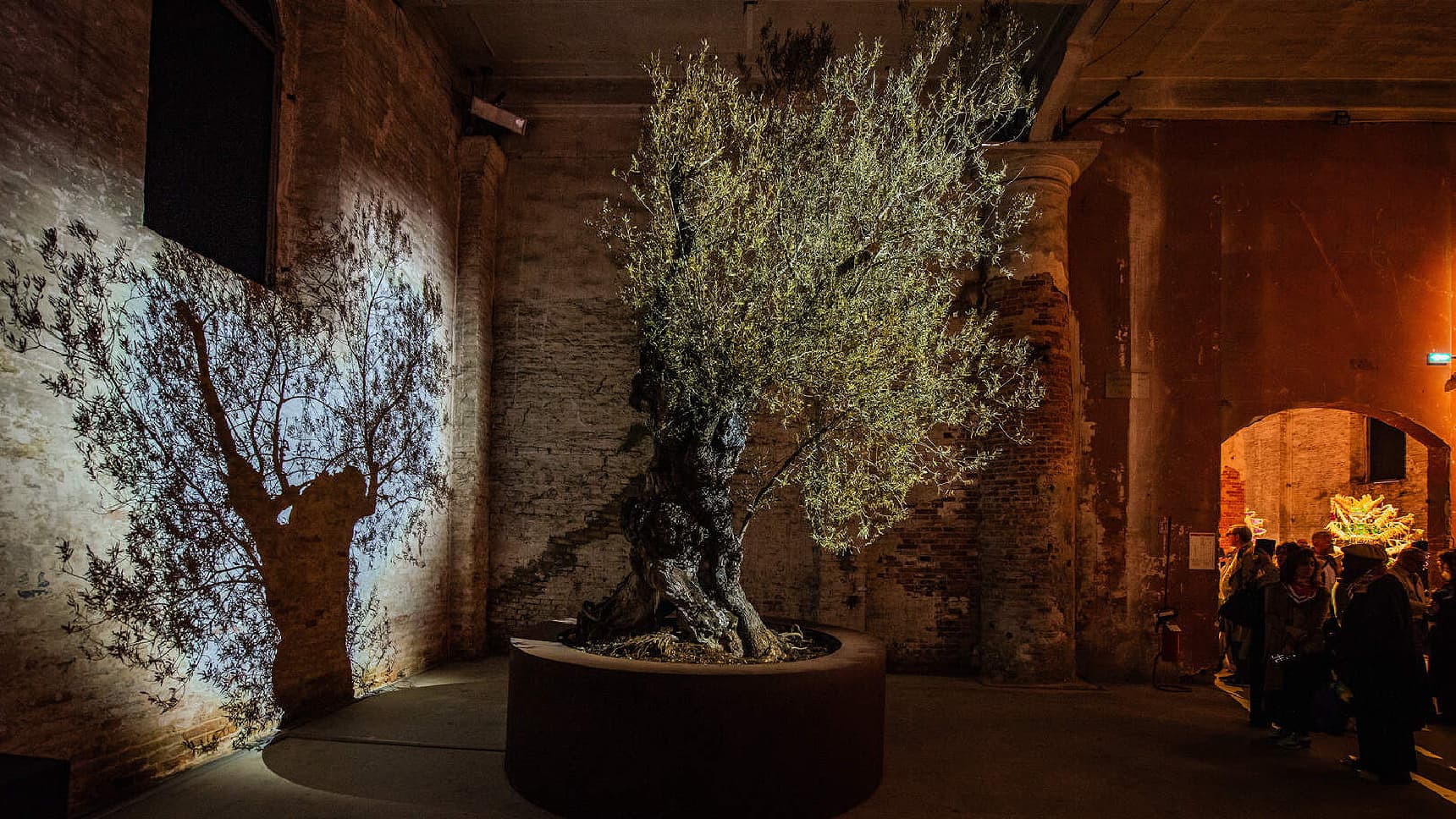
A centuries-old olive tree stands at the heart of Theo Eshetu’s installation Garden of the Broken Hearted, on display at the 61st International Art Exhibition of La Biennale di Venezia, held at the Giardini, the Arsenale, and venues across Venice from May 9 through November 22, 2026.
One of the world’s major art events, this edition of the Venice Biennale is curated by Koyo Kouoh under the title In Minor Keys. It features 111 artists from 99 countries and an all-female jury chaired by Solange Oliveira Farkas.
This is also a work about a powerful presence, as the potent force that endures is nature.
“This work is the first I have created where video remains invisible, though not entirely absent. At its core, it is a reflection on absence,” Eshetu told Olive Oil Times.
A video artist and filmmaker, Eshetu was born in London in 1958. He spent parts of his life in Ethiopia, Senegal, the Netherlands and the former Yugoslavia, and now lives between Berlin, Germany, and Rome, Italy. His work, spanning video installations, experimental films, photographs and documentaries, is held in several collections, including the Museum of Modern Art (MoMA), the Metropolitan Museum of Art (The Met) and the Smithsonian National Museum of African Art.
Garden of the Broken Hearted features a 4.5-meter-high olive tree placed on a rotating stage, onto which overexposed video images of the same tree are projected as a gentle music-box melody plays.
“I had participated in many exhibitions curated by Koyo, and I was also a very close friend of hers,” Eshetu said of the late artistic director of the Venice Biennale’s Visual Arts Department, who died on May 10, 2025, almost exactly one year before the exhibition opened. “After her loss, I no longer wished to pursue the idea I had originally proposed. Instead, I wanted to reflect on her absence, and in doing so, I chose to render myself absent as a video artist as well.”
Widely recognized as a leading figure in the international contemporary art scene, Kouoh was born in Cameroon and raised in Switzerland. She founded RAW Material Company in Dakar, Senegal, and later served as executive director of the Zeitz Museum of Contemporary Art Africa (Zeitz MOCAA) in Cape Town, South Africa.
Kouoh’s In Minor Keys project was completed posthumously by her team, comprising Gabe Beckhurst Feijoo, Marie Hélène Pereira, Rasha Salti, Siddhartha Mitter and Rory Tsapayi.

An olive tree selected for its expressive form takes on new life in Theo Eshetu’s installation, where its growth becomes part of the artwork. (Photo by Anna Faragona)
“This is also a work about a powerful presence, as the potent force that endures is nature,” Eshetu pointed out. “I have been working on a series of gardens, and during preparations for Venice I told Koyo that I would create one. When I decided to change course, I chose to present only the olive tree as the embodiment of the absolute essence of a garden.”
Eshetu said he intended to explore the garden as a space at the root of our consciousness, from which our cultures have emerged, and as the secret place from which imagination springs. While tradition tells of a paradise garden from which humans were expelled, his intention was to represent a return to the garden as a place of healing, a space in which to listen to what nature might reveal about the human condition.
“The olive tree, in particular, is capable of unlocking a multitude of meanings, offering something unique to every individual,” Eshetu added. “Thus, without the need for an overt artistic intervention, the tree itself is able to communicate with everyone. It carries many meanings, the most widely recognized being peace. It is a plant that transcends cultures, holding deep significance for Christians, Muslims and Jews, as well as for many other communities and traditions around the world.”
The essence of Eshetu’s work has always been to bridge different cultures. Whether through visuals, subject matter or themes, his approach fosters intercultural and interdisciplinary dialogue. Choosing the olive tree is consistent with this artistic practice, and, in keeping with it, he decided not to disclose the tree’s place of origin.
“People frequently ask where the tree comes from, and by refusing to answer, the tree is able to unlock a wider range of meanings,” Eshetu explained. “As I am not interested in defining myself through my origins, I do not wish to reveal the tree’s origin either, so that the viewer is compelled to consider it for what it is, rather than through the narratives that might otherwise arise from its provenance or circumstance. In short, a human being is a human being, and a tree is a tree.”
Eshetu said that, in selecting the tree, he was drawn to the dual nature it appeared to embody through two distinct faces. One side appeared healthy and vigorous, with what he described as a vaguely masculine quality, while the other was visibly damaged and evocative of feminine forms. The interplay between these different dimensions constituted a narrative that the tree could unfold through its movement on the stage.
“This ancient olive tree possessed a certain charisma,” said Elisabetta Margheriti, agronomist and commercial director at Vivai Torsanlorenzo Nursery in Ardea, near Rome, which supplied the tree and oversaw its transportation logistics.
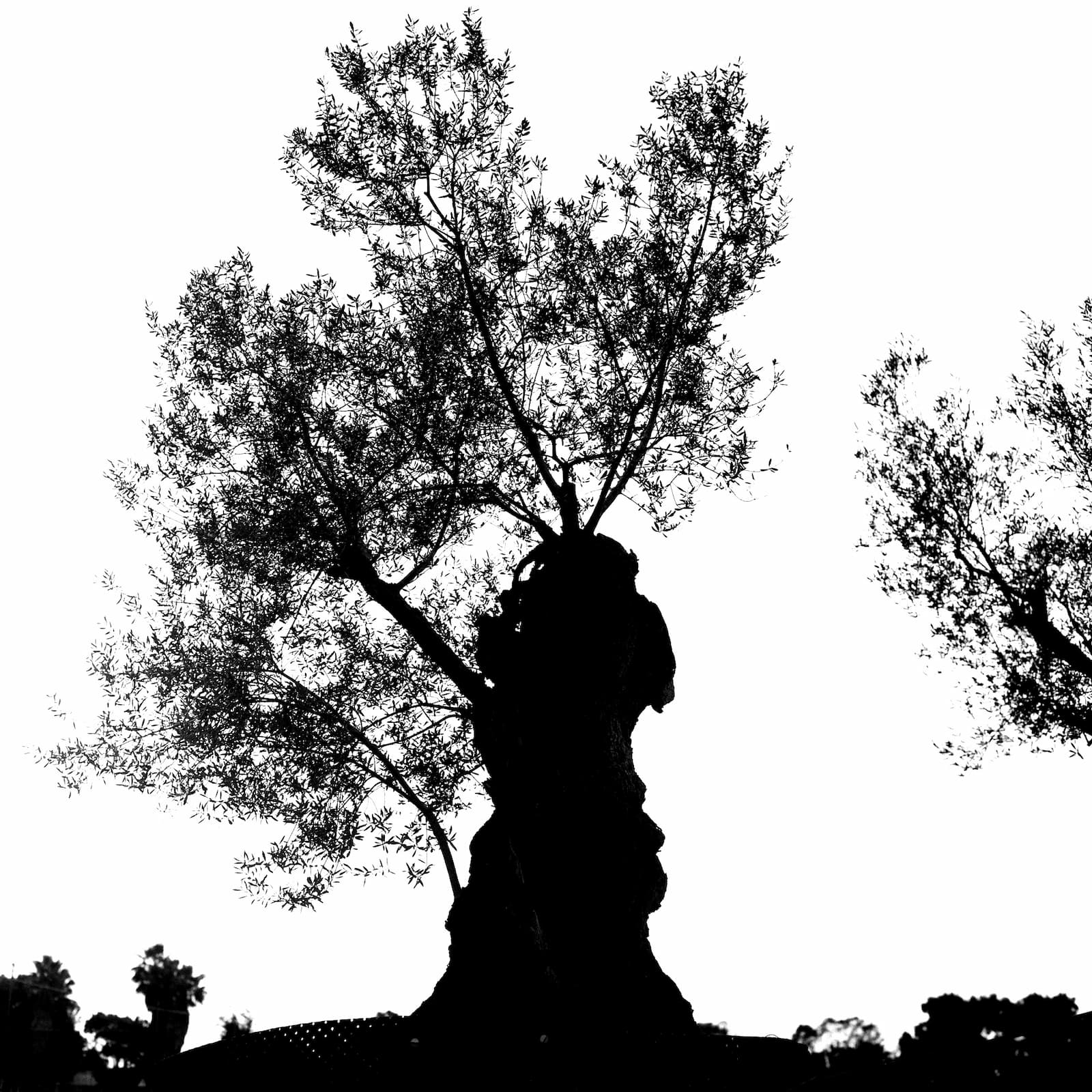
The centuries-old olive tree selected by Theo Eshetu for Garden of the Broken Hearted, an installation at the 2026 Venice Biennale exploring loss, renewal and the enduring presence of nature. (Photo courtesy of Theo Eshetu)
“I had initially suggested some imposing olive trees to Theo, but when he came across this particular group, which had been overlooked due to their hollow trunks and damaged canopies, he was immediately drawn to this one and its expressive shapes,” she recalled. “Its large root ball also presented considerable logistical challenges, and a smaller tree would certainly have been easier to manage. Yet Theo was completely captivated by this specimen and chose it for his work. I was thrilled to be part of this project. I embraced the challenge of bringing the tree to the Venice Biennale and overseeing its care throughout the exhibition with great enthusiasm. Seeing it come to life was wonderful.”
Over the course of the exhibition, the tree produced new leaves. Margheriti guided the gardeners responsible for its care and stayed in constant contact with them, receiving regular updates and photographs documenting its development.
“Ensuring the tree’s wellbeing was one of our primary goals,” Margheriti said. “Caring for it presented some challenges, especially since irrigation had to be carefully managed to avoid damaging the pavilion. However, it ultimately produced new leaves at the top and fresh shoots from the base. We devoted considerable effort to encouraging this growth, which was itself part of the artwork. Seeing the tree begin to flourish again during the exhibition was deeply moving. Ultimately, it emerged as one of the most compelling presences at the Venice Biennale.”
Eshetu explained that bringing the olive tree to Venice meant moving it from the realm of nature into that of culture. Much like a person who travels and returns transformed by experience, the olive tree underwent its own journey, evolving from a natural object to a cultural one.
To preserve the memory of the cultural significance it acquired at the Venice Biennale, the olive tree will be planted in the garden of a cultural institution once the exhibition concludes.
“In this context, the garden is an imaginary enclosure that allows us to return to a time before human thought, to a time that predates the emergence of any culture, when the very roots of our identities were being formed, to listen to the lessons offered by nature and, if we so choose, to place our trust in the intelligence of plants,” Eshetu said. “It is a return to an archaic form of consciousness, in which all of nature was imbued with spirit. The presence of an olive tree provides a foundation from which we can listen and learn; drawing upon this lesson, we may envision new creative forms and narratives, new cornerstones for navigating the future.”
“The work is a song in a minor key,” Eshetu concluded, responding to Kouoh’s invitation in her Venice Biennale curatorial text “to shift to a slower gear and tune in to the frequencies of the minor keys.”
“Because, though often lost in the anxious cacophony of the present chaos raging through the world, the music continues,” Kouoh wrote. “The songs of those producing beauty in spite of tragedy, the tunes of the fugitives recovering from the ruins, the harmonies of those repairing wounds and worlds.”