Slovenian Istria Harvest Brings High Quality, Low Yields
Low oil yields are testing producers in Slovenian Istria, but exceptionally healthy fruit and high polyphenol levels are raising expectations for the quality of the 2026 harvest.
As the first autumn fog settles over the hills of Slovenian Istria, olive groves and mills across the region are entering the busiest part of the 2026 harvest.
The season is shaping up as one of extremes. Prolonged summer drought and high temperatures forced growers to make difficult harvesting decisions, while exceptionally healthy fruit is raising expectations for oil quality.
Harvest timing is always a compromise between quantity and quality.
Although the traditional Oljka županov event, organized under the auspices of the Slovenian Istria Olive Growers Association (DOSI), symbolically marked the beginning of the harvest on September 25 at Belvedere above Izola, work in some groves had begun considerably earlier.
On September 9, the Terra Centuria cooperative began an ultra-early harvest of still-green olives.
Seeking extremely high concentrations of health-promoting polyphenols, the cooperative processed its first olives in its own experimental micro-mill, deliberately sacrificing extraction yield in pursuit of quality.
“Our oils this year reached as much as 2,473 milligrams of polyphenols per kilogram, which is significantly above the 250-milligram-per-kilogram threshold for oils with health properties established by the European Commission,” award-winning olive grower and scientist Danijel Stojković Kukulin told Olive Oil Times.
Stojković Kukulin, a specialist in molecular genetics and biotechnology, initiated and co-founded the cooperative.
Commercial mills did not begin operating at full capacity until late September, after most local growers’ olives had reached technological maturity.
Extraction yields have emerged as one of the main concerns among Istrian growers this autumn.
The first September pressings produced exceptionally low oil yields of just six to nine percent, meaning that as much as 15 kilograms of olives were required to produce one liter of oil.
By early October, as the fruit gradually ripened, yields had increased to an average of nine to 13 percent but remained noticeably below long-term averages.
Despite the disappointing yields, conditions have given growers reason to be optimistic. While the previous season was marked by persistent pressure from pests and moisture, the hot, dry summer of 2026 sharply reduced olive fruit fly populations.
Growers report that fruit arriving at mills is exceptionally healthy, without the punctures and internal rot associated with pest damage, reducing the risk of fermentation defects.
Maja Podgornik, head of the Institute for Olive Culture at the Science and Research Center Koper, also highlighted the unusual conditions while presenting a new technical publication, When Is the Right Time to Harvest Olives?
Podgornik said this year’s oils would strongly reflect the specific microclimatic conditions of individual groves because of pronounced drought stress.
She expects oils with particularly high concentrations of phenolic compounds, resulting in more pronounced but pleasant bitterness and strong pungency.
Her central message to growers is that harvest timing is always a compromise between quantity and quality. She added that the potential of healthy fruit must then be preserved at the mill through carefully controlled processing below 27 ºC.
Fourteen Slovenian producers in the 2026 Slow Food Guide to Extra Virgin Olive Oils share the emphasis on preserving the fruit’s natural qualities.
Among them is the organic Olje Morgan estate in Grintovec near Šmarje, whose oil received the guide’s Grande Olio distinction.
The 1,200-tree farm is headed by Jenny Morgan, Slovenia’s first, and currently only, woman to hold the professional NPK Oljkar national vocational qualification for olive growing.
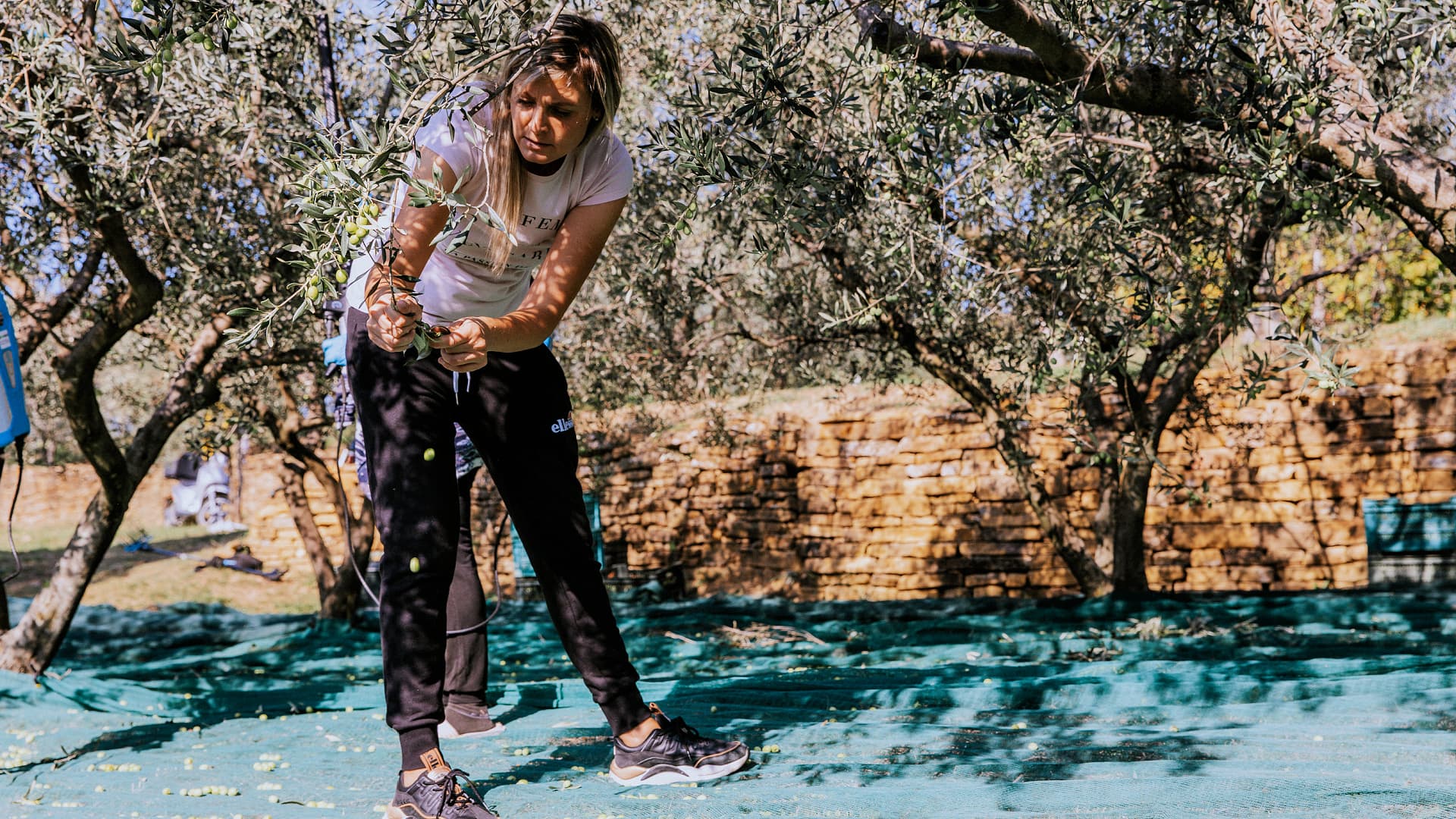
Jenny Morgan, Slovenia’s first professional female olive grower, is pleased with this year’s harvest and the quality of the organic extra virgin olive oil.
Morgan is seeking to combine organic production with olive oil tourism, including plans for glamping accommodations within the olive grove.
“Our customers keep coming back because they trust us, and demand for high-quality oil is growing every year,” Morgan said. “My vision differs somewhat from my father’s within the family. I want to take another step forward, not only through olive oil but also by expanding our range of natural olive-based cosmetics and creating authentic tourism experiences on the estate.”
“International recognition, such as Slow Food and gold in New York, not only raises our profile globally but is also a tremendous recognition for our entire region,” she added. “In challenging years like this one, it is crucial to remain committed to an organic approach and offer the market something truly distinctive.”
At Oljarna Babič in Babiči, near Marezige, the family-run mill operates 24 hours a day, seven days a week during peak season to ensure olives are processed within hours of harvesting.
Sandi Babič heads the mill, with his son, Rok, also actively involved in operations, combining the family’s experience with expertise gained at the Institute for Olive Culture.
The family also received international recognition this autumn. In early October, the Čisti svet consortium associated with the Italian publication Teatro Naturale awarded the mill its Green Ribbon prize for sustainable operations and its interpretation of local traditions through environmentally conscious technology.
The mill’s modern two-phase systems, including equipment from Officine Meccaniche Toscane (OMT), require no additional water during processing. Byproducts, including olive pomace, are used to produce biogas and natural fertilizer.
The family’s oil also placed third at this year’s BIOL competition in Rome, and the mill was included in the 2026 Slow Food guide.
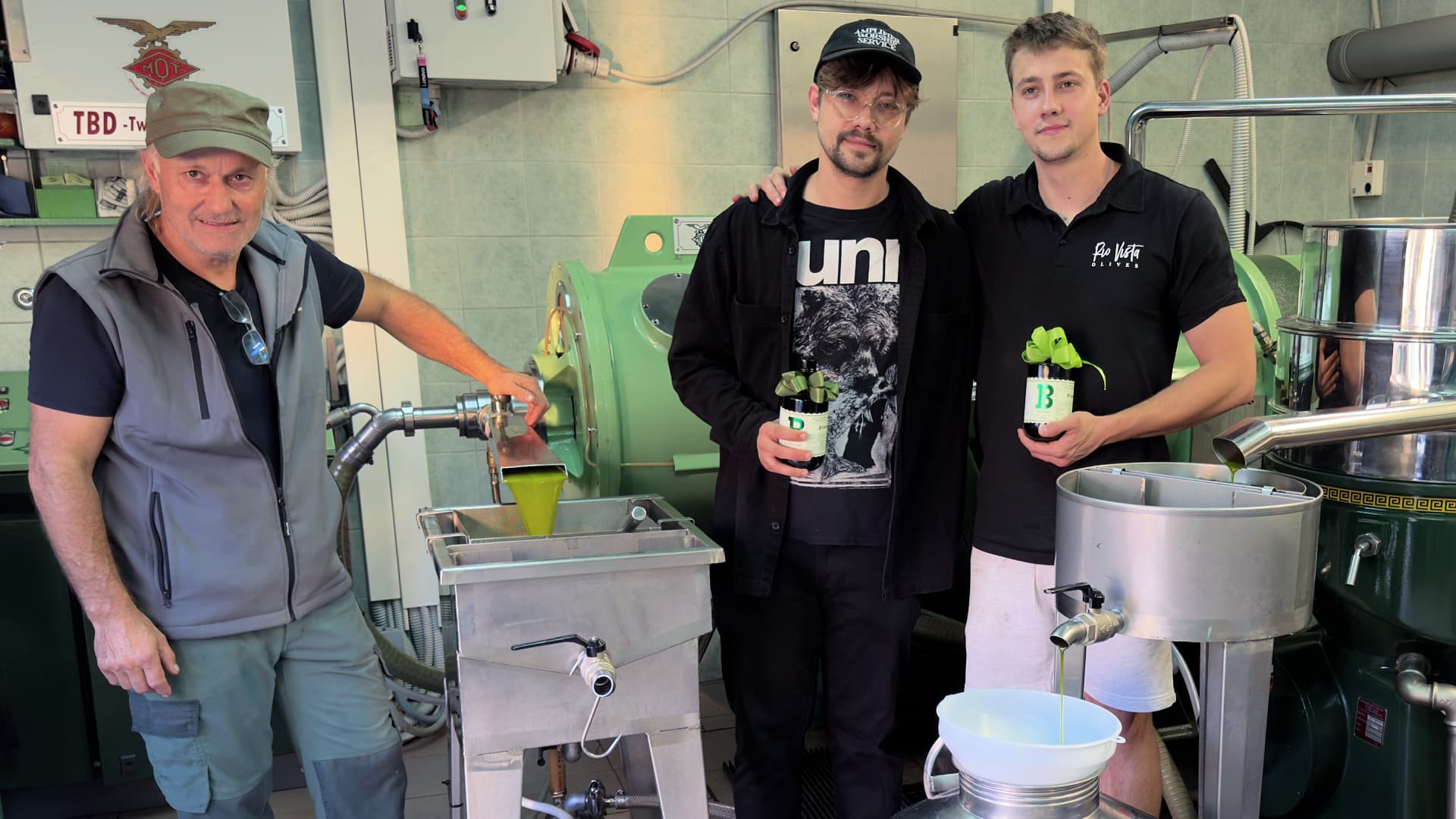
Freshly milled olive oil flows at the Babič family mill in Babiči
Lower extraction yields and rising production costs have contributed to a modest increase in prices for freshly produced oil this season.
Standard extra virgin olive oil sold directly by producers is priced at €18 to €22 per liter, while premium early-harvest oils and those bearing a Protected Designation of Origin sell for €25 to €35 per 500-milliliter bottle.
Experts advise filtering early-harvest oils to remove residual moisture and storing them away from light at a stable temperature between 15 ºC and 18 ºC to help preserve their phenolic compounds.
Alongside premium oils dominated by the indigenous Istrian Bjelica variety, as well as traditional Črnica and Buga olives, Slovenian producers are increasingly developing small-scale table olive production.
Although volumes remain small and are largely destined for local tasting rooms, naturally debittered olives in brine with local herbs and olive spreads are becoming part of the region’s growing culinary tourism offering.
Slovenia has about 500,000 olive trees planted across slightly more than 2,000 hectares, 96 percent of which are in Slovenian Istria.
The sector remains highly fragmented, with the average farm comprising just 0.4 to 0.5 hectares. The country has 36 registered mills and domestic production meets only about 15 percent of national olive oil demand.
Rather than competing through large-scale production, many Slovenian growers have focused on premium quality, modern milling technology and scientific expertise.
For producers navigating another challenging harvest, healthy fruit, high phenolic concentrations, and continued investment in quality are reinforcing Slovenia’s position as a small but increasingly recognized olive oil-producing country.