Eastern Adriatic Producers Propose ‘Jewels of the Adriatic’ Brand
Olive oil experts from Croatia, Slovenia, Bosnia and Herzegovina and Montenegro proposed a regional quality seal designed to strengthen the international profile of the Eastern Adriatic’s small but highly awarded producers.
When the olive groves of Slovenia, Croatia, Bosnia and Herzegovina and Montenegro are combined, their annual output amounts to barely half a percent of global olive oil production.
On a global scale, the region is a small player in a market dominated by major producers including Spain, Tunisia, Türkiye, Italy, the United States and Portugal.
We are not selling a guest only a bottle of oil, but a landscape, people, varieties, tradition, knowledge and the experience of a particular place.
The figures illustrate the region’s modest position. In an average year, Croatia produces about 3,500 to 4,000 tons of olive oil, Slovenia produces around 500 tons, and Montenegro produces several hundred tons. Despite the rapid expansion of olive cultivation in Herzegovina, Bosnia and Herzegovina produces only approximately 200 to 300 tons annually.
However, producers and experts across the Eastern Adriatic argue that the region has a powerful advantage: rather than competing on volume, it can compete on quality and excellence.
Recent results at the NYIOOC World Olive Oil Competition have reinforced that argument. Croatia finished second worldwide in total awards, while Bosnia and Herzegovina, with 16 awards, and Montenegro, with nine, achieved their best results to date.
“Our oils, from northern Istria to southern Ulcinj, regularly rank among the best in the world,” said Marko Ivanković, director of the Federal Agromediterranean Institute in Mostar. “We are connected by karst, abundant sunshine, the harsh bora wind and a tradition stretching back thousands of years – from the ancient trees of Bar and the Herzegovinian miracle on stone to world champions in Istria and Dalmatia.”
Climate challenges and regional cooperation
At the same time, the natural environment is presenting Herzegovina and the wider Eastern Adriatic with new challenges.
Ivanković warned that climate change is no longer theoretical. Drought is increasingly affecting olive groves, extreme heat can persist from flowering through ripening and harvest, and new pests are emerging that do not recognize national borders.
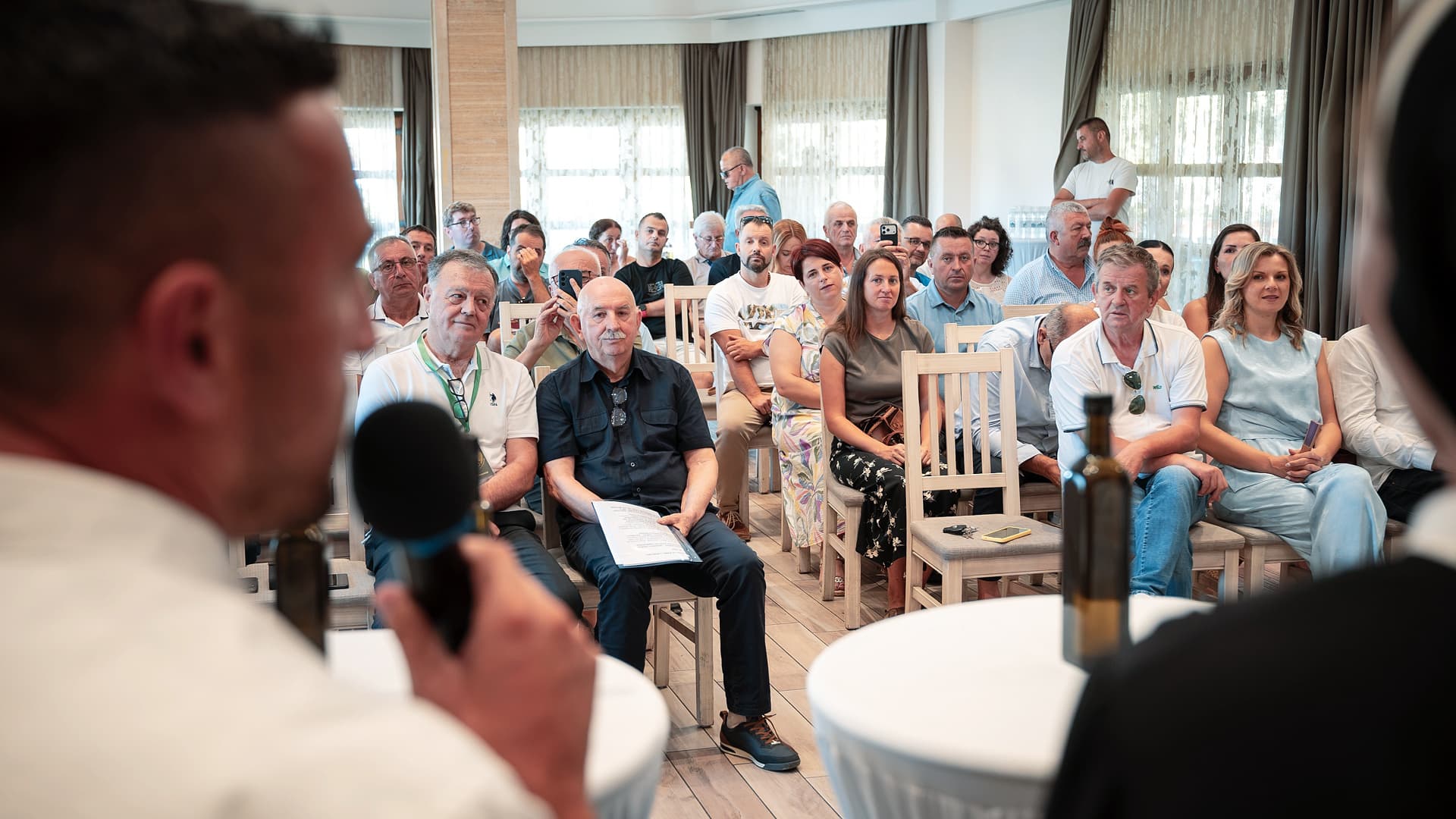
Attendees gather for a panel discussion on the proposed “Jewels of the Adriatic” regional olive oil initiative at the Herz Olive Fest in Mostar.
Those concerns were among the reasons for convening the first international panel of Eastern Adriatic countries at the Herz Olive Fest in Mostar. Participants discussed ways to overcome administrative boundaries and turn regional cooperation into a practical economic advantage.
Panel moderator Nedjeljko Jusup raised questions about how the region could increase production, quality and consumption despite a changing climate and how agricultural drones and smart technologies could help protect olive trees from diseases and pests.
The discussion also addressed the development of olive oil agritourism and the potential creation of a unified Trans-Adriatic Olive Oil Route.
Among the most ambitious ideas was the creation of a regional olive oil brand that overseas visitors could associate with premium gastronomy and the distinctive character of the Eastern Adriatic.
Along with Ivanković, the panel included experts from across the region.
Croatia was represented by Nebojša Jerković, a consultant, social entrepreneur and olive oil specialist from the Neretva Valley who also serves on the management board of Croatia’s National Common Agricultural Policy Network.
Slovenia was represented by young researchers Rok Babič and Karlo Kopjar, associates at the Institute for Olive Growing at the Science and Research Centre Koper. Montenegro was represented by Ivan Ilić, president of the Boka Olive Growers Association, and Ćazim Alković, president of the Bar Olive Growers Association and Montenegro’s representative to the International Olive Council in Madrid.
An umbrella brand for quality
Asked how the region could create an umbrella brand that overseas tourists would recognize as a symbol of gastronomic luxury, panelists put forward a range of proposals.
One proposed name was “Jewels of the Adriatic,” with every participating product continuing to carry a clear indication of its country of origin.
The goal, panelists said, would not be to erase national identities but to establish a recognizable regional framework that could help producers from small countries gain greater visibility in international markets.
“A strong and recognizable identity is almost essential today, amid the flood of advertising and information,” Babič said. “However, before choosing a name, we have to ask whom we want to reach, what those people value and why the oils of the Eastern Adriatic should interest them.”
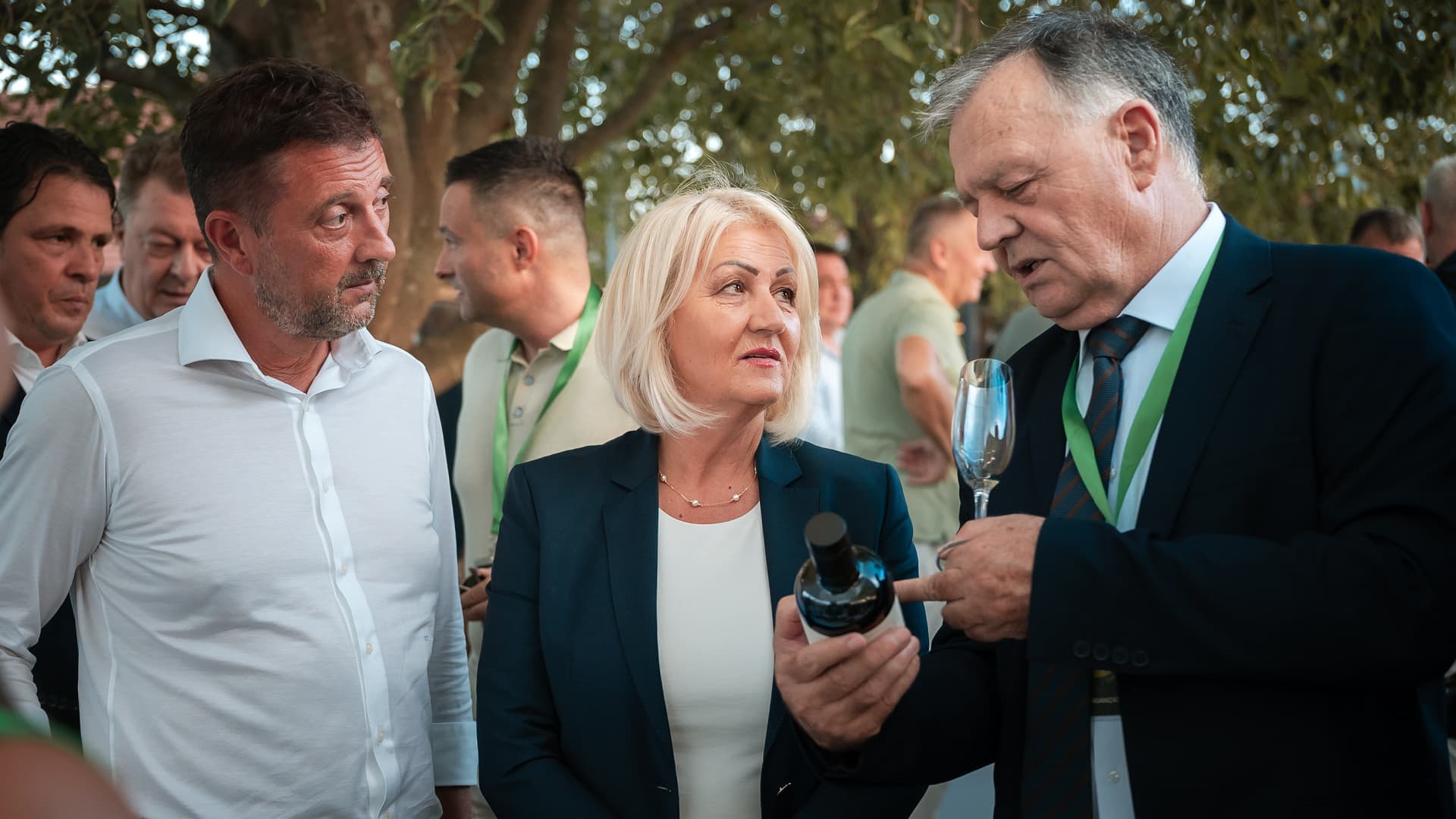
Guests gather ahead of the opening of the Herz Olive Fest, held under the patronage of Borjana Krišto, chairwoman of the Council of Ministers of Bosnia and Herzegovina.
In his view, success would require a strong presence on social media and professional expertise ranging from photography and video production to content planning.
More important, Babič said, would be developing a compelling story and learning to communicate it simply, honestly and memorably.
“We are not selling a guest only a bottle of oil, but a landscape, people, varieties, tradition, knowledge and the experience of a particular place,” he said. “That is why we must develop hospitality and learn to present olive oil in a way that guests will remember for the rest of their lives.”
Panelists agreed that a common brand could help smaller countries reach larger markets, but only if it were supported by clear and verifiable quality standards.
“An umbrella brand should bring us together while allowing every oil to retain its name, variety, place and story,” Babič said. “The name ‘Jewels of the Adriatic’ could be an excellent starting point, but its real value would come from outstanding quality, common rules and the authentic stories of the people who produce these oils.”
A boutique approach backed by strict standards
The proposed umbrella brand reflects the economic realities facing Eastern Adriatic producers. Taken individually, the countries have neither the production volumes nor the marketing budgets needed to establish a strong presence in major global markets.
“Together, however, we can offer what large producers find difficult to replicate: an extraordinary diversity of indigenous varieties, thousands of years of tradition, distinctive karst landscapes, hand harvesting, small family farms and oils closely connected to their place of origin,” Jerković said. “The name ‘Jewels of the Adriatic’ conveys that idea extremely well.”
He said the initiative should not become another commercial brand for inexpensive, standardized oil or blends of uncertain origin. Instead, it could serve as a common seal for premium extra virgin olive oils, with each producer retaining its own name, varieties, production area and clearly identified country of origin.
Under such a system, labels could carry designations such as “Jewels of the Adriatic – Croatia” or “Jewels of the Adriatic – Montenegro.”
Jerković said the common framework could significantly increase global visibility while keeping national and local identities at the center of each product’s value.
However, he warned that such a brand could succeed only if it were supported by rigorous and independent standards.
Simply producing olive oil near the Adriatic would not be enough. Participation, he suggested, should be limited to verified extra virgin olive oils meeting predetermined chemical and sensory criteria, with complete traceability from grove to bottle, proper storage and a clearly stated harvest year.
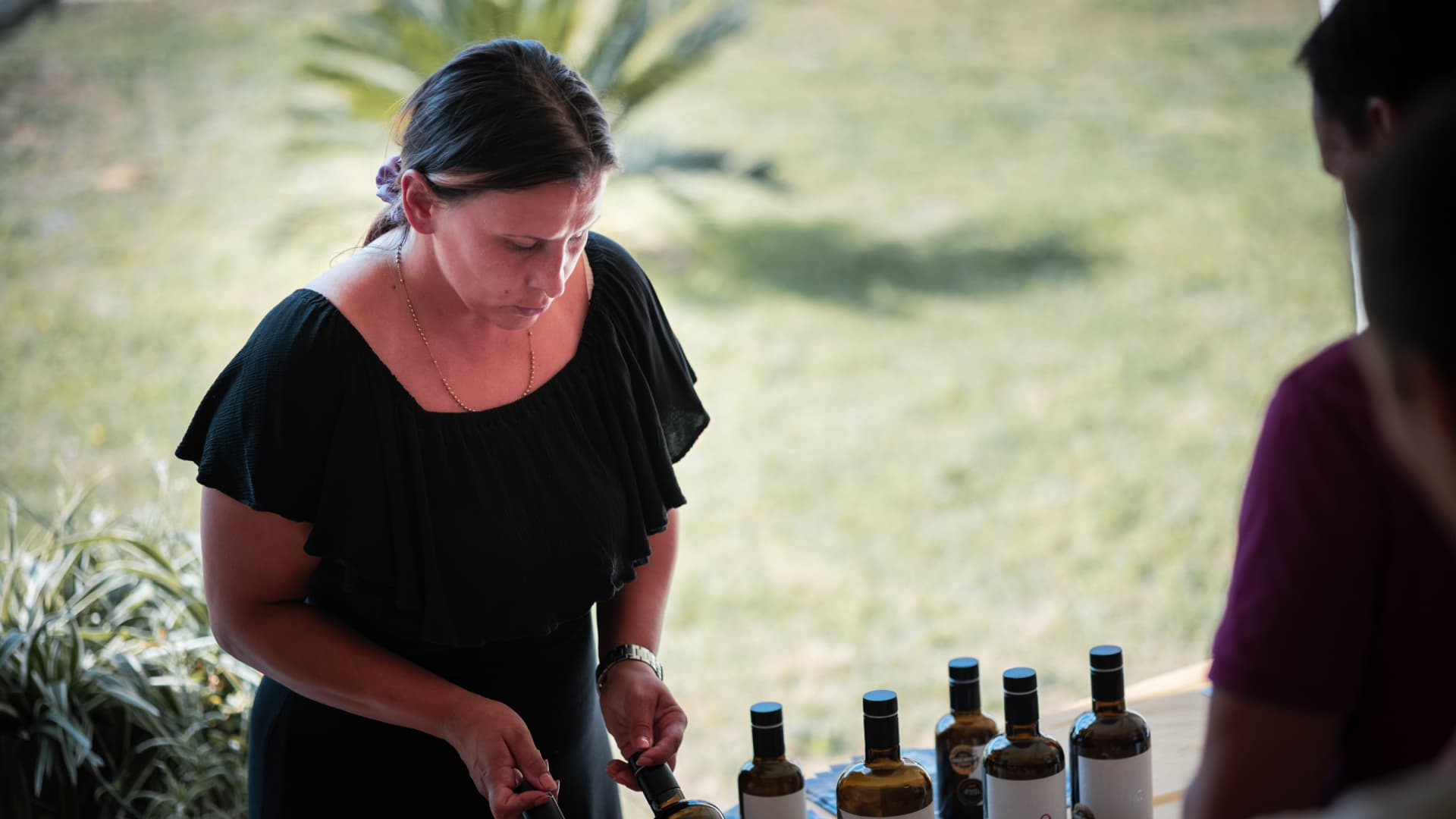
Olive oils are prepared for tasting at the Herz Olive Fest, where participants discussed the proposed “Jewels of the Adriatic” regional quality brand.
Preference could also be given to oils made from indigenous varieties, produced organically, harvested early and produced using practices that protect the environment and traditional landscapes.
“The producers should not be responsible for policing themselves,” Jerković said. “A joint international body or consortium should be established, bringing together producer organizations, professional institutions, certified laboratories, sensory panels and the tourism sector.”
Such a body, he added, would establish the rules, conduct oversight, grant the right to use the seal, and remove participants who damage the brand’s reputation.
“A single bad or falsely labeled bottle could undermine confidence in the entire project,” Jerković warned.
Transparency and a ‘tasting journey through the Adriatic’
In addition to strict controls, Jerković proposed that each bottle carry a unique number and QR code giving buyers immediate access to information about the producer, exact grove location, indigenous variety, harvest year, production methods, quality-control results and suggested food pairings.
He argued that buyers in the luxury market are purchasing more than olive oil. They are also paying for credible provenance, limited production and a story they can share with others.
For that reason, he said, transparency may be more important than lavish packaging, although bottle design, presentation boxes and the overall visual identity would also need to support the product’s premium positioning.
“The first market for ‘Jewels of the Adriatic’ is already here,” Jerković said. “It consists of the millions of visitors who come to the Eastern Adriatic every year, particularly higher-spending guests staying in luxury hotels, visiting marinas, traveling on cruise ships, dining in top restaurants and passing through airports.”
He said visitors should encounter the oils as part of a high-end gastronomic experience, learn the stories behind individual varieties and producers, and have the opportunity to purchase them as premium souvenirs.
“In that way, the tourist becomes a customer, but also an ambassador for the product after returning home,” Jerković said.
For overseas markets, he proposed collections of smaller bottles, such as luxury presentation boxes featuring several indigenous varieties and oils from different Eastern Adriatic countries.
Rather than forcing small producers to compete against one another for limited shelf space, he said, they could jointly offer consumers a “tasting journey through the Adriatic.” Such collections could be marketed through specialty retailers, luxury department stores, restaurants, wine clubs, corporate gift programs and targeted online sales.
“The biggest mistake would be trying to compete with major global producers on volume and low prices,” Jerković said. “Our advantage must be exactly the opposite: small batches, exceptional quality, indigenous varieties, verified origin and a strong sense of place.”
“‘Jewels of the Adriatic’ should not be an oil for everyone, but an internationally recognized selection of the best the Eastern Adriatic has to offer,” he added.
Before any public launch, Jerković said, the proposed name and logo would have to be legally reviewed and protected in target markets, and brand ownership would have to be clearly established.
With clear rules and professional management, he argued, a common regional brand would not dilute national identities. Instead, it could give Croatian and other Adriatic producers access to audiences they would struggle to reach on their own.
“National origin remains the author’s signature, while ‘Jewels of the Adriatic’ becomes the international guarantee of premium quality,” Jerković said.
Regional support and cross-border projects
Ivanković expressed a similar view, saying the term “umbrella brand” clearly conveyed the concept.
Each country or region, he said, could and should continue to develop its own brands while using a shared framework to promote premium quality internationally.
Ivanković said Jusup’s proposal to call the project “Jewels of the Adriatic” captured the concept well, adding that industry experts should organize around the idea and seek to develop it through a future European Union cross-border cooperation project.
Alković also said a common regional brand deserved serious consideration.
Croatia, Montenegro and Bosnia and Herzegovina each produce relatively small quantities and cannot compete with global producers in terms of volume, he said. However, their small scale could also be an advantage.
“Our olive oils have what today’s market increasingly demands: exceptional quality, authenticity, a rich history, well-preserved nature and an authentic Mediterranean way of life,” Alković said.
He believes a shared international presence, while fully respecting national identities and designations of origin, could benefit producers across the region.
The umbrella brand would not replace national origin, he said, but would serve as a common quality seal, indicating that the product comes from the Eastern Adriatic, a region with an exceptional olive-growing tradition.
Alković pointed to existing examples of cooperation as evidence that collective promotion can work. Olive growers in the Zadar area have jointly promoted the quality of their oils, he said, demonstrating how cooperation can significantly increase both product recognition and value.
He sees particular potential in joint promotion at international trade fairs, tourism campaigns and professional events, where producers acting together could strengthen their market position and reach new customers.
Kopjar, the Slovenian researcher, also described the umbrella-brand proposal as promising. However, he warned that it could not simply amount to a logo.
Instead, he said, it would have to be based on clear and strict standards governing quality, traceability, provenance and sensory excellence.
“Since we cannot compete with the major producers on quantity, our advantage must be a boutique approach, authenticity and the story of this region,” Kopjar said.
He proposed appointing a professional and neutral coordinator to bring together producers, researchers, tourism officials, gastronomy professionals and promotional organizations from several countries, either through a joint project or a permanent international association at the European level.
Ilić, president of the Boka Olive Growers Association, echoed those views, saying small producers often struggle to establish themselves in major consumer markets.
He said the concept of a premium Eastern Adriatic extra virgin olive oil brand was particularly attractive to small growers, who are well aware of their geographic and production limitations and believe that collective promotion could offer substantial benefits.
Four pillars for future development
Following the panel, titled “Eastern Adriatic – A Smart and Sustainable Capital of Premium Olive Growing,” participants adopted a series of proposed conclusions outlining four pillars for future regional cooperation.
The first places quality ahead of quantity while promoting technological modernization.
With the region accounting for only about half a percent of global production, participants said its strategic direction should remain firmly focused on premium quality. Any increase in production would come through restoring abandoned karst olive groves, establishing new groves and introducing smart agricultural practices such as precision irrigation and sensors to help growers respond to climate change.
The second pillar calls for establishing “Jewels of the Adriatic” as an umbrella seal of excellence and creating a cross-border organization to administer it.
The initiative would not blend oils from different countries. Instead, the common seal would certify oils that meet strict cross-border laboratory and organoleptic standards and could serve as a tool for exports and tourism.
The third pillar calls for launching a Trans-Adriatic Olive Oil Route linking existing local olive oil routes into a single tourism itinerary.
The proposed route would connect Montenegro’s ancient olive trees, the rapid development of olive growing in Herzegovina, the traditions of Dalmatia and Slovenia’s research and technological expertise. Promotion would focus primarily on affluent international tourism markets.
The fourth pillar focuses on consumer education and improving understanding of olive oil quality in domestic markets.
Participants said relatively low consumption and limited understanding of quality could be addressed through a joint educational campaign explaining olive oil flavor characteristics and teaching consumers that bitterness and pungency are positive attributes commonly associated with fresh, high-quality extra virgin olive oil.
The campaign would also seek to present extra virgin olive oil as a valuable part of a healthy diet rather than merely an expensive cooking ingredient.
The conclusions brought the first international Eastern Adriatic panel at the Herz Olive Fest to a close, while providing a framework that participants hope can guide future cooperation among the region’s olive-growing countries.