
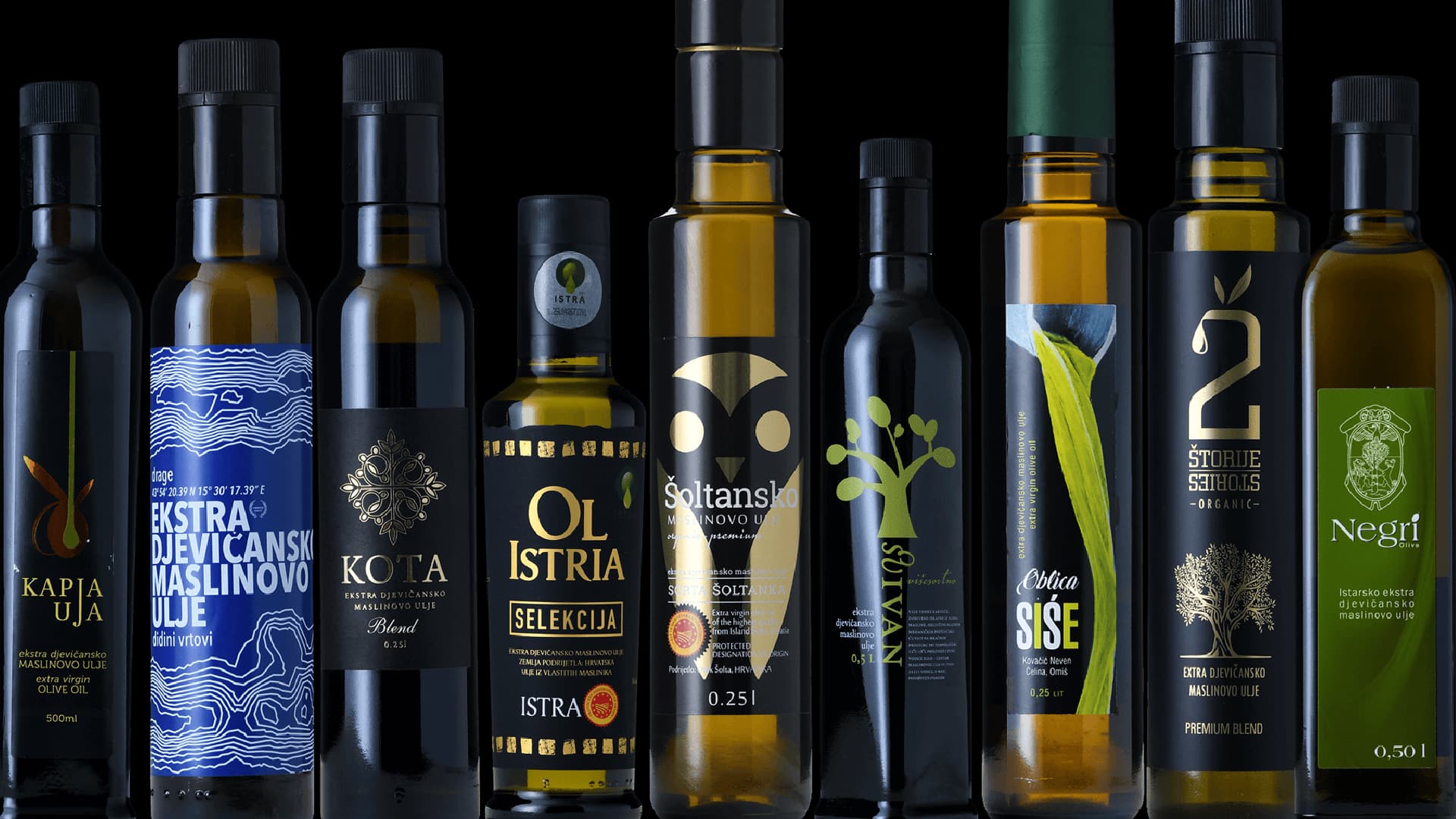
Croatia has built an outsized reputation for high-quality olive oil, but it produces less than half the amount consumed in its domestic market.
Croatian producers earned 128 awards from 144 entries at the 2026 NYIOOC World Olive Oil Competition, including 103 Gold and 25 Silver Awards, continuing a remarkable run of international recognition.
Yet European Commission figures estimate Croatian production at just 4,226 tons for the 2025/26 crop year, compared with domestic consumption of 8,600 tons. The shortfall illustrates the contrast between the country’s success in premium olive oil and its limited production capacity.
According to an analysis published by Financije.hr, Croatian olive oil production fell approximately 27 percent in 2025, from about 63,000 hectoliters to less than 46,000 hectoliters. Imports approached 60,000 hectoliters, an increase of 62 percent from the previous year, exceeding domestic production.
Foreign trade figures show the imbalance continuing into 2026. Citing Croatia’s Ministry of Agriculture, Financije.hr reported that the country imported 1,996 tons of olive oil worth nearly €10 million during the first five months of the year, while exporting just 155 tons worth €1.77 million. The resulting trade deficit exceeded €8.2 million.
The supply gap reflects more than fluctuations between harvests. Croatian olive growing is concentrated largely in Istria and Dalmatia, where many producers cultivate small or fragmented plots and rely heavily on manual labor. Expanding production on such farms presents challenges that larger, more mechanized operations elsewhere in the Mediterranean do not face to the same degree.
OPG Nikolic, a family producer near Šibenik in Dalmatia, offers one example. The family restored neglected groves and now cultivates about 1,000 olive trees, primarily the native Oblica variety, harvesting entirely by hand. During its previous harvest, about 15 family members spent nearly a month gathering approximately 25 tons of olives.
“We want people to understand where high-quality olive oil comes from and how much work and passion are behind it,” Mladena Nikolic, who manages marketing and sales for the farm, told Olive Oil Times.

Ante Nikolic (left) and Hrvoje Nikolic with young Antonio and Leon at the family’s olive farm near Šibenik in Dalmatia, where the Nikolic family has restored neglected groves and built an award-winning olive oil business around small-scale, hand-harvested production.
The labor-intensive approach also has its limits. Nikolic said it is becoming increasingly difficult to find workers willing to perform physically demanding harvests.
Even when yields improve, production costs can substantially reduce growers’ returns. In a recent Olive Oil Times report, a Dalmatian grower calculated direct expenses of €2,040 to harvest and process enough olives to produce approximately 250 liters of oil. Selling the oil at €20 per liter would generate €5,000 in revenue, leaving €2,960 after those expenses but before accounting for the grower’s labor or the work of family members.
Such economics help explain why many Croatian producers focus on earning more from relatively small quantities of oil rather than competing with the world’s largest producers on price or volume. Their approach emphasizes distinctive local varieties, direct sales, premium positioning and olive oil tourism.
Croatian development and branding expert Mira Lepur argued in 2025 that the country needs a more coordinated strategy connecting olive oil with tourism, cultural identity and sustainability.
With millions of international visitors coming to Croatia each year, Lepur sees tourism as a way for small producers to reach consumers they could never supply through conventional export channels alone. A bottle carried home by a visitor, she said, can become an ambassador for Croatian olive oil.
“Croatia will not win with liters, but it can win drop by drop,” Lepur said.
The emphasis on regional identity is also gaining support beyond Croatia. Producers and olive oil experts from Croatia, Slovenia, Bosnia and Herzegovina and Montenegro have proposed a “Jewels of the Adriatic” quality seal for premium extra virgin olive oils. The initiative aims to distinguish oils from the Eastern Adriatic through shared chemical, sensory and traceability standards while preserving their national and producer identities.
Increasing domestic production remains another priority. Regional initiatives have called for restoring abandoned groves, establishing new plantings and expanding precision irrigation and other technologies that could improve yields and resilience. These measures could help narrow Croatia’s supply gap, although their impact would depend on the scale of investment and adoption.
For many producers, however, the more immediate opportunity lies in strengthening the value of the oil they already produce. Years of international recognition have helped establish Croatian olive oil as a premium product, but awards alone do not overcome the costs of cultivation, harvesting and bringing that oil to market.
For the domestic market, imports will remain necessary as long as consumption substantially exceeds production. For Croatian growers, the more consequential question is whether the value attached to quality can rise enough to sustain the farms and families producing it.