In England’s Fens, a Farmer Bets on Olive Trees and A Warmer Climate
On reclaimed marshland in eastern England, farmer David Hoyles is cultivating 18,000 olive trees and producing what may be Britain’s first commercial extra virgin olive oil.
In the lowlands of the Lincolnshire Fens, an unlikely place for growing olives, David Hoyles has created the first commercial olive grove in Britain.
“My grove is in Long Sutton, in south Lincolnshire,” Hoyles told Olive Oil Times.
The Fens, often described as Britain’s breadbasket, is an intensively farmed marshland region on the east coast of England that accounts for a significant share of the country’s vegetable and crop production.
The English weather and plant breeding advances will determine if there is a viable English olive sector in the future
Hoyles’ olive grove lies within the family’s 500-hectare farm. The reclaimed sea land is exceptionally flat and naturally fertile.
A fifth-generation farmer, Hoyles also grows potatoes, peas, sugar beet, wheat, flax and mustard. But he said increasingly warm and dry weather has made vegetable farming more difficult in recent years.
While looking to diversify, he was inspired by a trip to Puglia to consider olive trees as an alternative crop.
“I was visiting some friends in Puglia looking at vegetables, when I saw olives being grown on silt soil very similar to mine,” he said.
“I had always thought that olives needed poor and stony land, so I asked about the olives,” he added. “I was then fortunate to be introduced to a local expert olive grower and olive oil producer, who shared more information with me.”
After further research, Hoyles planted 18,000 young trees in 2023 across 10 hectares using a super high-density system.
The grove includes Italian, Spanish and Greek varieties selected primarily for their tolerance to cold conditions.
“I also had a lot of guidance from Pietro, the Italian producer,” Hoyles said. “I have remained very good friends with him and his family and team, and they have been very kind in knowledge sharing.”
Establishing the grove came with significant challenges. Hoyles said Brexit complicated the importation of trees into the United Kingdom, with customs inspections and paperwork delaying shipments for days.
Wildlife also posed problems. Rabbits and brown hares damaged tree bark, forcing the farm to install fencing around the site.
The greatest challenge, however, remains the British weather.
“We are constantly dictated by the weather here,” Hoyles said. “It goes from being quite cold at nighttime to hot and windy in the afternoon, which is unusual for us.”
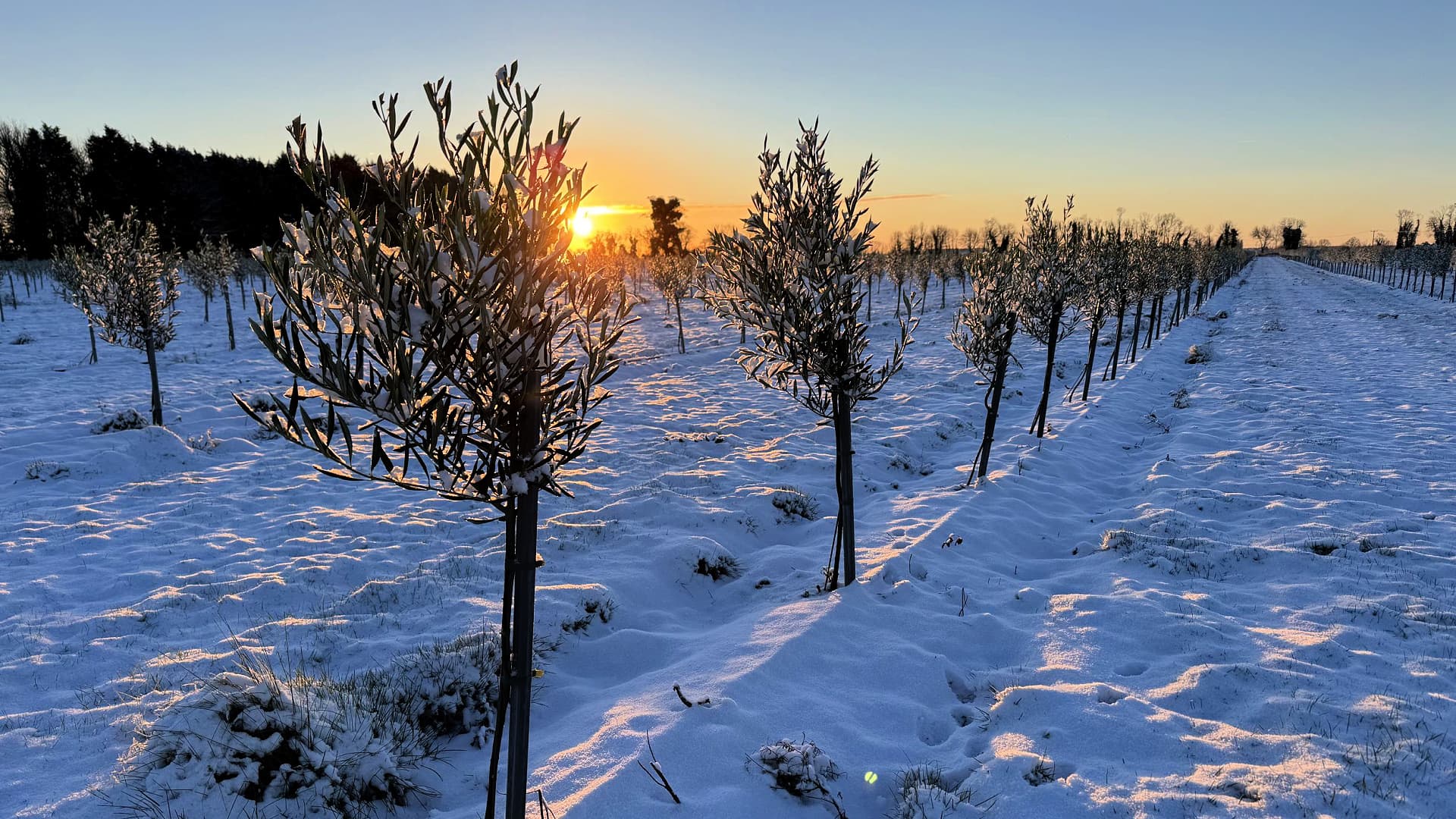
Olive trees covered in snow at Hoyles’ grove
Temperatures as low as minus eight degrees Celsius killed several hundred trees, which have since been replaced.
“We have also had some hot days of around 20 degrees, which have not been too helpful either,” he added.
Another few hundred trees are now showing signs of stress and decay.
“Their leaves are going brown,” Hoyles said. “I have trimmed them back a bit to see if they reshoot, and now I have to wait to see what happens. But I’m afraid that we have lost them.”
Even so, Hoyles expects the trees to adapt better to local conditions as they mature.
Moisture probes installed throughout the grove help monitor soil conditions and guide irrigation decisions.
“We haven’t had any rain on the farm for six weeks, which is very unusual for the area,” Hoyles said. “But we have irrigation on the farm to sort that out.”
Hoyles processes the olives on-site using a small milling line capable of handling 100 kilograms per hour, along with a semi-automatic bottling and labeling system.
His oil, sold under the brand “The English Olive Co.,” is currently available only online due to limited production capacity.
“We will remain a niche product due to the English weather currently being in control of our production,” Hoyles said.
The grove’s first harvest took place last winter, with the first batch of extra virgin olive oil produced in early December.
Despite limited quantities, Hoyles described the initial production as a success.
“We were sold out in two weeks, and next availability will hopefully be after the 2026 harvest,” he said.
“The customers who bought our oil loved it, and we have had many complimentary emails back,” he added. “Our olive oil has a fresh and piney smell to it, and the taste is quite peppery due to the olives not ripening very much in the cold U.K. winter weather.”
Hoyles said he hopes the grove will eventually develop a flavor profile distinctive to English olive oil.
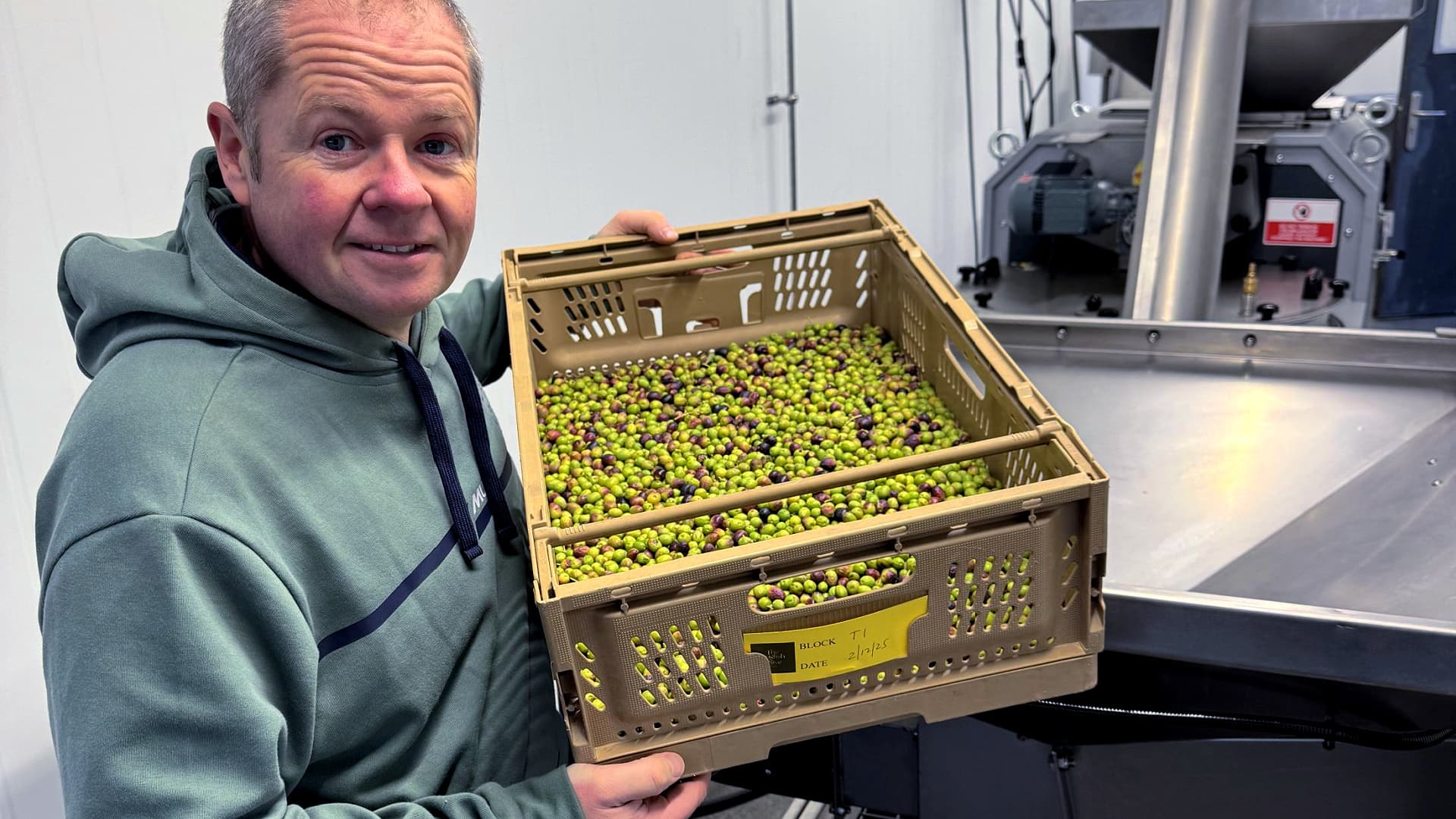
Processing olives at the small milling facility
The farm uses integrated crop management techniques, leaving grass and wildflower strips between rows to encourage beneficial insects and reduce pest pressure.
Hoyles has also avoided fungicides and insecticides, believing British consumers increasingly prefer products grown without such chemicals.
The farmer said shifting weather patterns linked to climate change played a major role in his decision to plant olive trees.
“We were starting to get temperatures up to 35 degrees Celsius and we had the U.K.’s warmest day ever of 41 degrees four years ago,” he said.
Hoyles also credits years spent living and working in Spain and Portugal with shaping his appreciation for the Mediterranean diet and lifestyle.
“I am now realising more and more the many health benefits of this diet, especially with the use of olive oil,” he said.
He also pointed to growing British interest in higher-quality food products.
“Those who can afford it are starting to eat better, leaving aside processed food and opting for whole, natural ingredients that are integral to the Mediterranean diet,” Hoyles said.
Olive oil has been present in Britain since the Roman era, though it has historically played only a limited role in local cuisine.
Over the past two centuries, consumption steadily increased, with olive oil eventually overtaking other cooking oils in Britain by 2004.
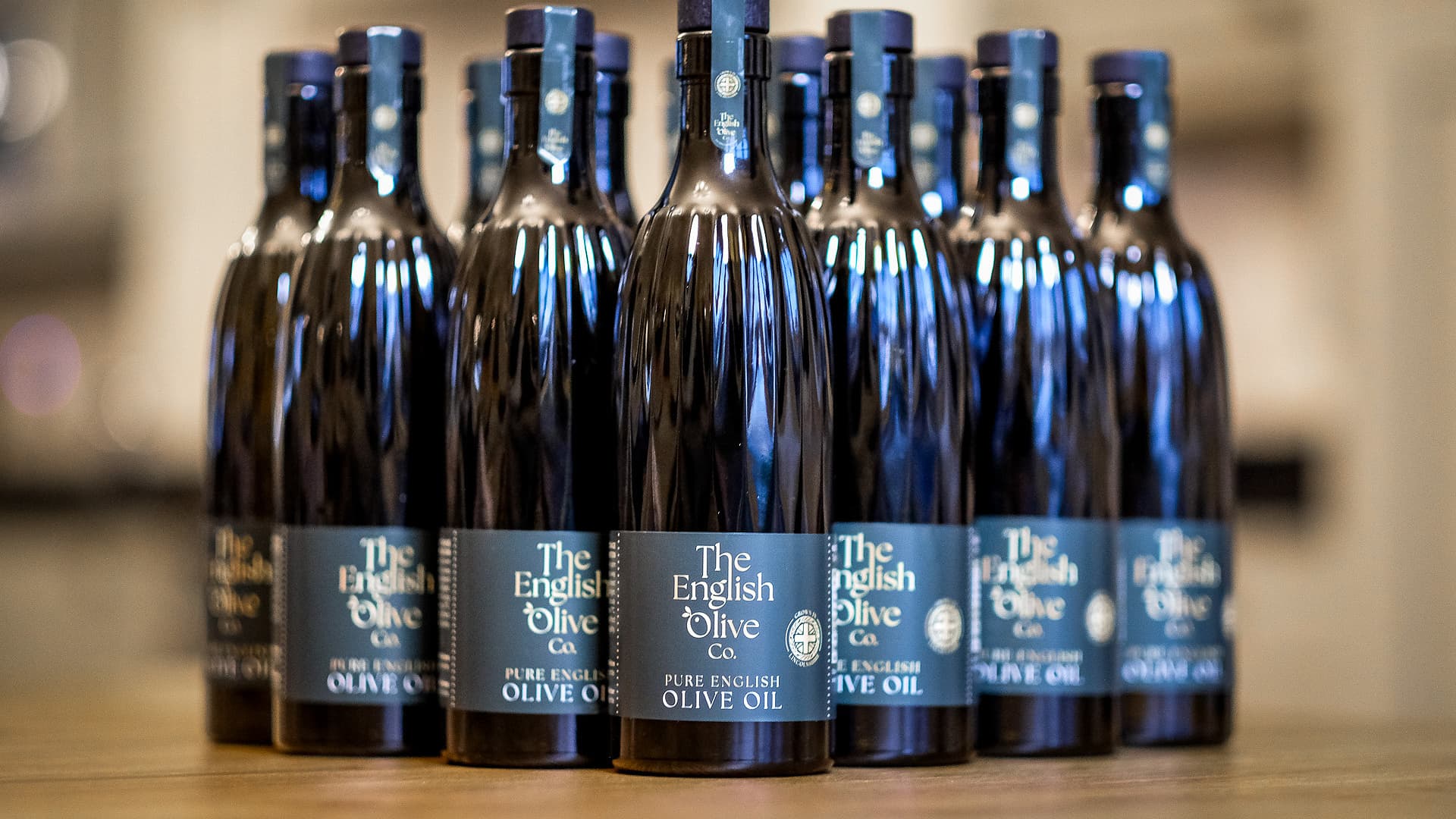
(Photo: The English Olive Co.)
Bringing olive oil to dinner parties as a gift has also become increasingly common in Britain.
Hoyles said it remains too early to know whether commercial olive farming can become viable in England.
“The English weather and plant breeding advances will determine if there is a viable English olive sector in the future,” he said.
“But I have very much enjoyed the challenge of growing olive trees, and then the even bigger challenge of turning the olives into olive oil,” he added.
“I think it is great that we have managed to produce English extra virgin olive oil, and I look forward to having more availability in the future, so we can shout about it more and give others the chance to taste and experience it.”