South Africa’s Kielder Sets Sights on Growth After NYIOOC Gold
In South Africa’s Western Cape, Kielder is combining orchard expansion, modern irrigation and nursery development with a focus on premium olive oil.
A relatively young olive oil venture in South Africa won its first Gold Award on its debut at the 2026 NYIOOC World Olive Oil Competition with its Premium Selection, a blend of Favolosa, Frantoio and Arbequina.
“New York is one of the most prestigious competitions there is. It’s always a nail-biter when the results start coming out. You have to hit that refresh button quite often. The team was really, really happy when we finally saw we got the Gold. It was a relief,” Nicolaas Roodt, estate and general manager at Kielder South Africa, the South African farming operation of Kielder Agro Group, told Olive Oil Times.
At the end of the day, though, the best thing you can do is to have your feet in the orchard.
For Roodt, the award validated the company’s approach. “We are trying to establish a very premium quality of olive oil,” he said.
Roodt said South Africa accounts for only a tiny share of global olive oil production, but believes the country’s leading producers can compete at the highest quality levels.
The recognition comes as Kielder prepares to expand its olive-growing operation in the Nuy Valley, near Worcester along the R60 toward Robertson, in South Africa’s Western Cape.
The farm’s olive groves cover 155 hectares of predominantly lime-rich soils interspersed with pockets of clay. The wider 364-hectare property also includes cherries and wine grapes.
Although many of the olive groves are more than 25 years old, Kielder Agro Group launched its Specialty division in 2025, with South African extra virgin olive oil among the products it plans to develop for domestic and international markets.
Kielder currently grows eight olive cultivars. Roodt said he would eventually prefer to concentrate production on fewer varieties that have proved particularly well adapted to local conditions.
“We want to grow more, but I would like to concentrate on fewer cultivars that can sustainably give us good harvests year after year, as well as the quality of oil that we need,” he said.
The choice of cultivars is closely tied to the Nuy Valley’s climate, which provides relatively few winter chilling hours. Roodt said this limits the suitability of some varieties and can contribute to alternate bearing following particularly warm winters.
Alongside cultivar selection, Kielder is experimenting with different orchard configurations. The farm includes traditional groves and more intensive plantings and is increasing its use of super-high-density systems.
For Roodt, the shift reflects both agronomic considerations and economic pressures. Rising costs for labor, fuel, agricultural inputs and electricity are making efficiency increasingly important to maintaining profitability.
South Africa’s olive industry historically developed around traditional orchards, he said, but growers are increasingly considering super-high-density systems to control costs and mechanize more operations.
The farm’s planned expansion is supported by its olive nursery, which also supplies trees to outside growers.
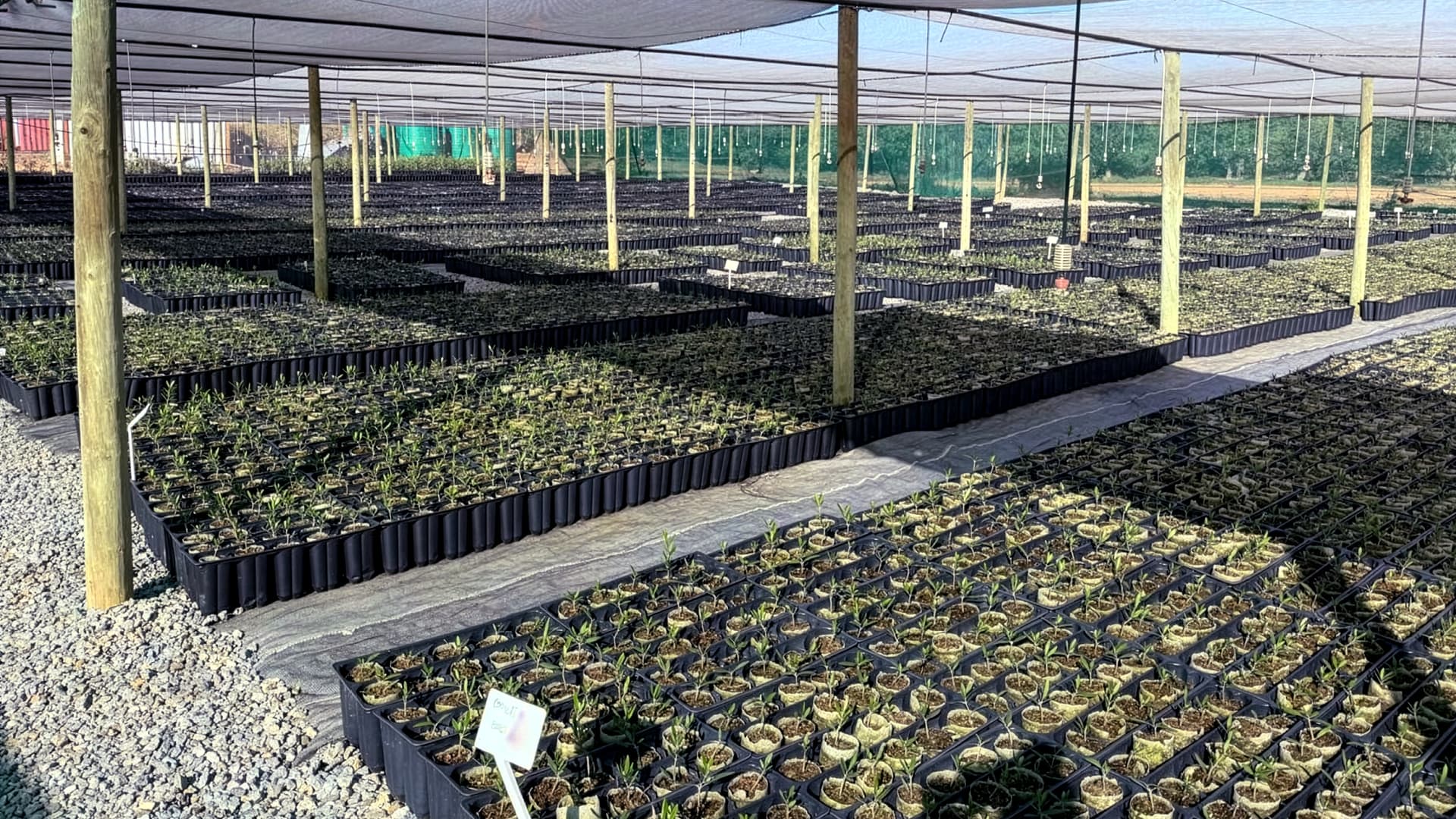
Young olive trees grow in propagation trays under shade netting at Kielder South Africa’s nursery, which supports the company’s expansion and supplies trees to other growers.
However, demand exceeds the nursery’s current production capacity. “We cannot produce enough trees for the public as quickly as South Africa is growing,” Roodt said.
Kielder is investing in propagation techniques and studying how individual cultivars respond in the nursery, aiming to steadily improve propagation success rates.
“We are really pushing to get a standard on what is a quality tree, how we can confirm that it has the proper genetics, and whether we have the harvest history of where the cultivar comes from,” Roodt said.
He is also involved in an SA Olive initiative to improve the quality and traceability of nursery material.
As Kielder expands and establishes more intensive orchards, water availability, irrigation management and operating costs are becoming increasingly important.
The Nuy Valley receives relatively little rainfall, and farmers are contending with changing precipitation patterns. “You have the same amount of rainfall, but it’s much more condensed in a time period,” Roodt said.
The timing and intensity of rainfall affect soil moisture and how effectively irrigation reservoirs can be replenished. For Roodt, water is “the most sacred resource that we have.”
Computerized irrigation systems control water distribution, while variable-speed drives let pumps operate at the pressure needed at any given time rather than running continuously at full capacity.
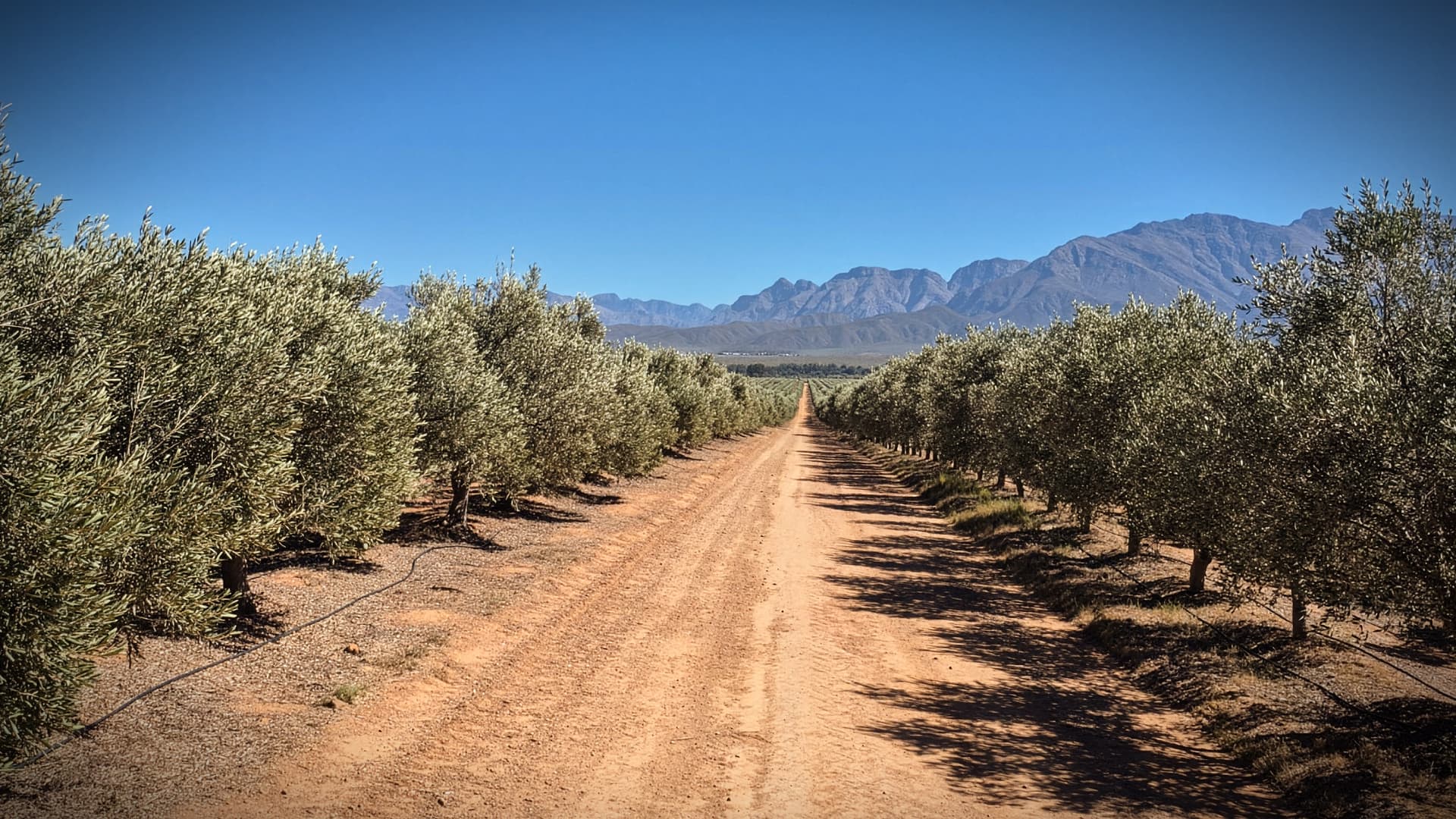
Olive groves at Kielder South Africa in the Nuy Valley of the Western Cape, where the company is expanding production and investing in more efficient cultivation and irrigation systems.
Roodt said the system helps conserve electricity and reduces stress on pipes and other irrigation infrastructure.
The company uses soil-moisture monitoring to determine irrigation needs and satellite-derived Normalized Difference Vegetation Index (NDVI) imagery to assess tree development and identify potential problems in the groves.
NDVI measures differences in red and near-infrared light reflected by vegetation to indicate plant density and vigor.
Technology is also being incorporated into agricultural machinery. Roodt cited the importance of matching spraying equipment to orchard density to ensure treatments penetrate the canopy and provide adequate coverage.
Still, he emphasized that technology cannot replace firsthand observation and practical farming experience.
“At the end of the day, though, the best thing you can do is to have your feet in the orchard,” he said. “You look at your trees and understand where the problems are. Technology can help you a long way, but there are a few things it cannot do. If you know how to farm, you know what’s the right thing to do. You have to see it yourself,” he added.
Kielder’s sustainability efforts also include exploring higher-value uses for olive milling by-products, although that initiative remains in the planning stage.
Olive milling residues are already composted and returned to the orchards, recycling nutrients back into the soil.
“Making compost of it and putting it back into the orchard has got very big value to me,” Roodt said.
Developing the domestic market presents another challenge. South Africa imports roughly two-thirds of the olive oil it consumes, according to industry estimates, leaving local producers competing with a wide range of imported products.
Roodt believes meeting that challenge requires helping consumers recognize high-quality extra virgin olive oil and understand the value of locally produced oils.
One example is SA Olive’s Commitment to Compliance certification scheme, under which participating olive oils undergo chemical and organoleptic assessment before receiving a recognizable seal on the bottle.
Internationally, Kielder is targeting specific markets where it believes South African olive oil can compete on quality, with an emphasis on establishing lasting commercial relationships rather than pursuing occasional sales.
“We are not looking to sell our oil just here and there or any of the products here and there,” Roodt said. “It’s actually to build long-term relationships so that we can keep on supplying them. We are looking to export more and more of the South African olive oil to target-specific markets.”
Roodt said international recognition can help demonstrate the capabilities of South African producers. For Kielder, the Gold Award in New York provided an early endorsement of its efforts to establish a premium olive oil brand.
“I want to keep that gold color coming on all the way,” he concluded.