How Table Olives Are Prepared, Tasted and Judged for Quality
From fermentation and debittering to crunchiness and aroma, table olive quality depends on far more than appearance. Here is what experts look for.
Table olive consumption surpassed 3 million tons in the 2024/25 crop year, according to the International Olive Council (IOC), representing a 4 percent increase compared with the average of recent years.
This growth is expected to continue, reflecting broader lifestyle changes, from the widespread popularity of happy hours and aperitifs to the growing adoption of vegetarian and vegan diets, where olives offer a convenient, flavorful, nutrient-rich option.
Just as with olive oil, quality table olives can display fresh fruit notes along with floral and herbal nuances, in addition to aromas typical of the processing method.
“The rise in table olive consumption is relatively recent but significant, mainly driven by changing habits and new dietary trends. Olives are a ready-to-eat snack, and their countless styles suit every taste,” said Paola Fioravanti, president of the Mediterranean Union of Olive Oil Tasters UMAO and head of the technical committee of the Monna Oliva competition, now in its 13th edition.

The table olive tasting method is regulated by the International Olive Council and involves a panel of 8-12 trained tasters. (Photo by Monna Oliva)
“The olive is the mother of extra virgin olive oil,” Fioravanti said. “Beyond the pleasure of taste — the hedonistic dimension — many of its nutritional benefits are even greater than those of the oil, considering that oil is an extract of the olive. The main exception is salt, which is added in several preparations.”
“All olive tree derivatives are such valuable products that they should be consumed at their best,” she added. “Therefore, tasting becomes a fundamental part of evaluating table olives.”
The IOC has established a standard method for table olive tasting, defining criteria and procedures for the sensory analysis of odor, taste and texture and providing a framework for commercial classification of “the fruit of the cultivated olive tree (Olea europaea L.) which has been suitably treated or processed.”
According to IOC trade standards, table olives are prepared from sound fruit of varieties particularly suited to processing because of their size, shape, flesh-to-stone ratio, flesh quality, taste, firmness and ease of separation from the stone.
“In an index assessing the suitability of olives for processing, the fruit must be sound, with no lesions or defects, and ideally have a diameter of at least 14 millimeters,” Fioravanti said. “The pulp should account for at least 80 percent of the fruit and must be firm to the touch, turgid, compact, almost crunchy when broken, non-fibrous and have good aroma and flavor. The stone should be smooth and detach easily from the flesh.”
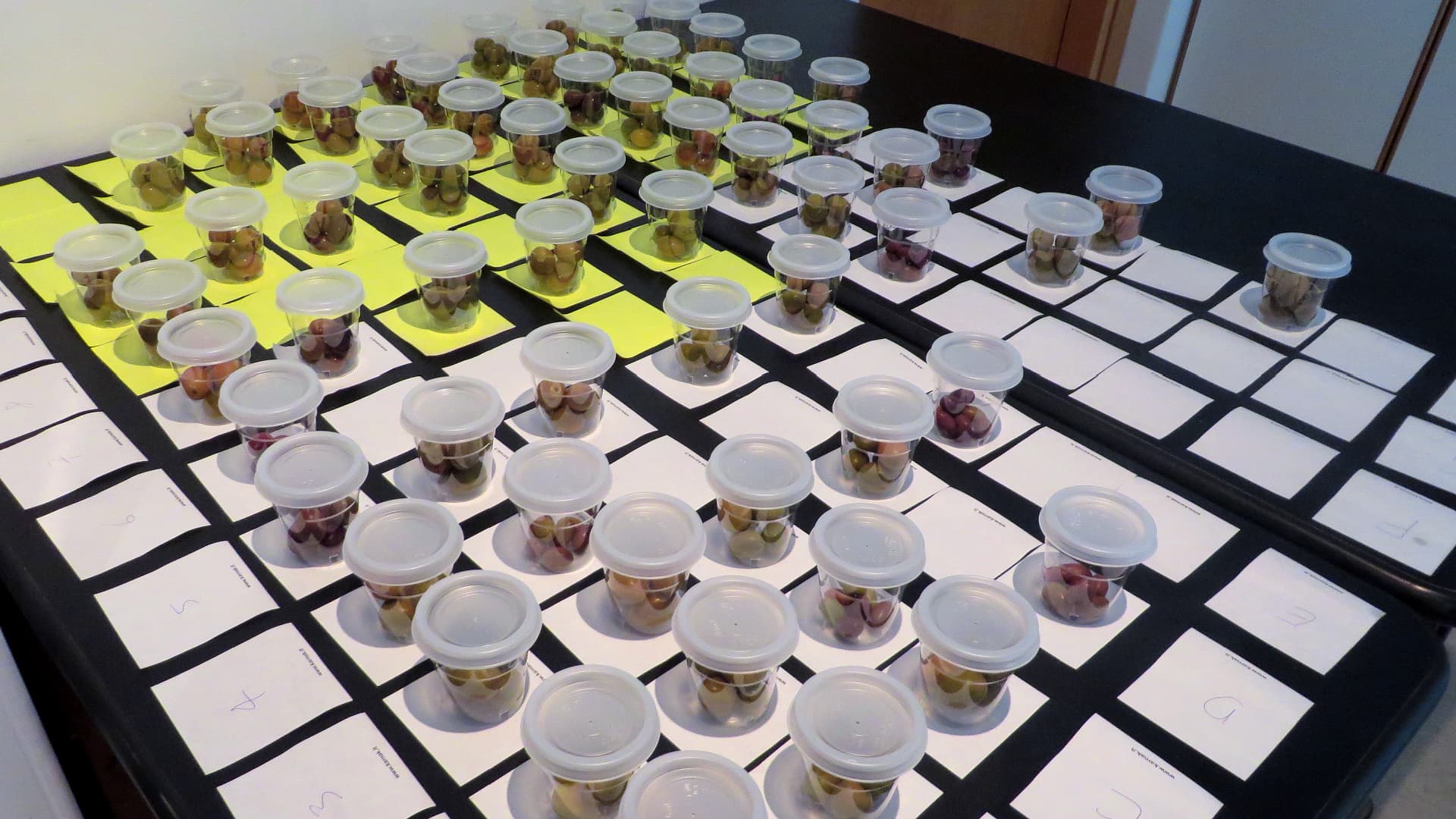
Table olive samples at the Monna Oliva competition. (Photo by Monna Oliva)
From a chemical perspective, Fioravanti said adequate sugar content provides the substrate lactic acid bacteria need to grow and should generally range from 3.5 to 6.5 percent. Relatively low oleuropein content can also improve effectiveness and shorten the debittering period without inhibiting lactic acid bacteria.
“Olives destined for table use must be flawless and unblemished,” Fioravanti said. “That is why they should be carefully hand-picked at the perfect point of ripeness, depending on the processing method, and washed with fresh water before any preparation.”
The fruit is always treated to remove its bitterness, which is largely caused by the phenolic compound oleuropein. It is then preserved through natural fermentation or heat treatment, with or without preservatives, before being packed with or without a covering liquid.
Table olives are classified according to the ripeness of the fresh fruit: green olives are harvested after reaching normal size but before ripening; olives turning color are picked during veraison; and black olives are harvested when fully ripe or shortly before full ripeness.
Table olive preparations and styles
Preparation methods and presentation styles vary widely by local traditions and commercial preferences.
“There are many preparation methods, just as there are many olive varieties used to make them,” Fioravanti said. “Each community has its own way of preparing them and, especially in regions with a long olive-growing tradition such as Italy, which is also one of the countries with the greatest number of cultivars, not only every village but even every family follows a different system for processing olives.”
“This always involves a debittering step that hydrolyzes and then eliminates the phenolic compound responsible for the fruit’s bitterness,” she added.
The following are the main preparation methods, outlined broadly according to IOC trade standards.
Treated olives — The fruit is subjected to an alkaline treatment with a sodium hydroxide solution, commonly known as lye, before being packed in brine, where it undergoes partial or complete fermentation, with or without acidifying agents.
The so-called Sevillian method involves soaking olives in lye, which rapidly hydrolyzes the oleuropein responsible for their bitterness. The olives are then washed several times to remove the lye before being placed in brine for fermentation.
Another technique, known as the Castelvetrano method, involves soaking olives in lye for five to 10 hours. Sea salt is added and gradually dissolves. The process should not involve fermentation. Lactic acid or another edible acid is typically added to ensure adequate acidification, and the olives are stored below 8 °C (46.4 °F).
The French, or Picholine, method also begins by soaking olives in lye. After washing, the fruit is placed in a 5-percent saline solution for several days and then transferred to a final brine containing 8 to 10 percent salt. Because fermentation is limited or absent, acidification is required to ensure an adequate pH and product stability.
Natural olives — The fruit is placed directly in brine, where it undergoes partial or complete fermentation. Acidifying ingredients may also be added for preservation.
The so-called Greek method involves placing olives in brine and leaving them there until they lose their bitterness. Lactic acid bacteria convert the small amount of sugar in the olives into lactic acid, acidifying the brine and creating conditions that promote oleuropein hydrolysis and diffusion.
Dehydrated and shriveled olives — This traditional method uses dehydration to make black olives palatable, reducing bitterness while concentrating flavor. Several variations combine debittering with drying.
Dry-salted: Layer olives in a container, alternating with generous amounts of salt. Through osmosis, the salt draws water from the fruit along with oleuropein.
Dried: Spread olives on a cloth or rack to remove surface moisture. You can also dry them briefly in a low-temperature or recently heated oven, or in a dehydrator for several hours.
Olives darkened by oxidation — Green olives or olives turning color are preserved in brine, fermented or not, and darkened by oxidation in an alkaline medium before being packed in airtight, sterilized containers. The process produces a uniform black color.
The so-called Californian method is applied to green olives or olives turning color to produce this uniform black appearance. The olives are aerated while in lye until they soften. Because the resulting color is unstable, ferrous gluconate is added to fix the black color.
After rinsing, the olives remain non-acidified and must therefore be sterilized to ensure microbiological safety.
Specialties — Olives may also be prepared using methods that differ from, or supplement, those described above.
Styles
Depending on local traditions and market preferences, olives may be presented whole, cracked, split or pitted. They may also be halved, quartered, divided, sliced, chopped, minced or broken.
Olives may be seasoned, flavored or stuffed with ingredients including chili pepper, orange or lemon peel, aromatic herbs, spices, onion, almonds, celery, anchovies, hazelnuts and capers, as well as natural pastes made from such ingredients.
They may also be finely crushed and presented as a paste made exclusively from olive flesh.
Other presentations are permitted provided the product complies with the relevant standards and is adequately described on the label.
Olive tasting
“An important aspect is that olives are tasted in pieces, meaning the experience is not continuous,” Fioravanti said. “Basically, while oil is homogeneous as a sample, olives are not.”
“Thus, every sample must include several pieces — at least a dozen — which, according to the IOC, should be presented in standard olive oil tasting glasses,” she added. “During informal tastings, any other dry and clean glass may be used, along with a fork to pick up the fruit.”
Perception of negative sensations
“Besides defects of biological origin, olives can develop defects during processing, when abnormal fermentations may occur and compromise the product,” Fioravanti said. “We may also find some of the same defects that appear in olive oil.”
Negative attributes caused by abnormal fermentation may be perceived directly through smell or retronasally. The three most common defects are putrid, butyric and zapateria.
Putrid: A sensation reminiscent of decomposing organic matter.
Butyric: A sensation reminiscent of butter or cheese.
Zapateria: A sensation caused by a combination of volatile fatty acids, reminiscent of rotten leather.
Other defects include musty, rancid, cooking effect, soapy, metallic, earthy and winey or vinegary sensations.
Under the IOC method, samples assessed by a panel are classified according to the intensity of the predominantly perceived defect into Extra or Fancy; First, 1st, Choice or Select; Second, 2nd or Standard; or olives that may not be sold as table olives.
Perception of gustatory sensations
The positive gustatory attributes assessed in table olives are saltiness, bitterness and acidity.
“From a gustatory point of view, olives start out bitter, and then salt is added,” Fioravanti said. “Acids develop during fermentation or are added for preservation.”
“To these, I would add tart or acetic sensations, which can be considered a defect in some olives but are also characteristic features of certain processing methods,” she added.
“There are no specific olfactory sensations listed by the IOC, but if we want to describe olives for food pairing, marketing purposes or a competition, just as with olive oil, quality table olives can display fresh fruit notes along with floral and herbal nuances, in addition to aromas typical of the processing method,” Fioravanti said.
Perception of kinesthetic sensations
Olive texture is described through kinesthetic sensations — the term derives from the Greek κινέω (kinéō), meaning “to move,” and αἴσθησις (aísthēsis), meaning “sensation.”
The IOC defines these sensations as rheological properties related to the flow and deformation of matter and structural properties related to geometry and surface that can be perceived by mechanical and tactile receptors and, in some cases, visual and auditory receptors.
Accordingly, three principal textural attributes are assessed in table olives.
Hardness: A mechanical textural attribute evaluated by compressing the product between the teeth or between the tongue and palate.
Fibrousness: A geometric textural attribute evaluated by perceiving fibers between the tongue and palate while chewing the olive.
Crunchiness: An attribute related to the sound produced by friction or fracture between two surfaces. It is associated with the force required to fracture the fruit with the teeth and is assessed by compressing it between the molars.
Additional sensory attributes
“The standardized profile sheet for olive tasting does not include visual characteristics and aromas, in a clear parallel with olive oil, where these attributes are required only for PDOs and PGIs,” Fioravanti said. “Yet this aspect related to the hedonistic dimension has become increasingly important today, especially in food pairing.”
“From this perspective, the taste and aroma of olives must be pleasant and reflect the characteristics of the processing method,” she added.
“Moreover, a quality olive should show no visual defects, including cuticle detachment caused by gas bubbles or stains and bruises resulting from harvesting or other field issues,” Fioravanti said. “That is why, in our profile sheet at the Monna Oliva competition, we also evaluate appearance and color.”
This evaluation includes observing the olive’s external appearance to assess its integrity, including the smoothness and soundness of the skin and the consistency of size across the sample, along with the depth and uniformity of its color, which varies according to variety, ripeness and processing method.
For consumers, Fioravanti said evaluating a good table olive can begin with a few straightforward observations.
“When we consumers, in our daily lives, look for a quality table olive, we should first observe its appearance, then taste it to assess its saltiness, bitterness, acidity and the aromas associated with the processing method, and finally evaluate its texture,” she said.
“In essence, a good table olive should be intact, have a pleasant taste and aroma that match the declared preparation, and have a texture that is enjoyable to chew.”