The Essential Guide to Harvesting Olives
The olive harvest is an essential step in extra virgin olive oil and table olive production. From timing to methodology, every aspect of the harvest makes a difference.
Harvesting olives is a pivotal step in the production of extra virgin olive oil and table olives, playing a decisive role in determining the final product’s quality.
The harvest also marks the moment when producers reap the rewards of a year’s hard work. A season of dedication in the grove deserves a harvest that preserves the best quality features of the fruit.
Just as the process of making olive oil has evolved, so has the way olives are collected. Today, producers can choose from several different collection methods.
Whether one runs a company or produces for personal consumption, method, timing and high cleanliness standards are critical when aiming for high-quality results.
Harvest Preparation
To obtain good products, olives should be harvested at the optimal stage of ripeness, which usually occurs in autumn in the Northern Hemisphere and in spring in the Southern Hemisphere. Nonetheless, each variety reaches its ideal stage at a different time.
Before beginning operations, farmers should ensure they have the proper tools for gathering olives, including ventilated crates and bins, as well as nets made from purpose-designed fabric.
These items are available from specialized agricultural retailers. Furthermore, suitable vehicles with adequate capacity will be needed to transport the olives to the mill efficiently and securely.
See Also: Olive Oil BasicsIt is essential to coordinate with the designated mill in advance to schedule a pressing slot. The chosen harvesting method must allow the farmer to collect the mill’s minimum required quantity – for example, 400 kilograms – in the shortest possible time. An increasing number of mills are lowering their minimum batch requirements to meet the needs of amateur olive growers.
It is worth noting that to produce extra-virgin olive oil and table olives, it is essential to harvest olives directly from the tree, rather than collecting those that have fallen to the ground, as was customary in the past.
Fallen olives can be contaminated with soil, debris and microorganisms that negatively affect the quality of the final product.
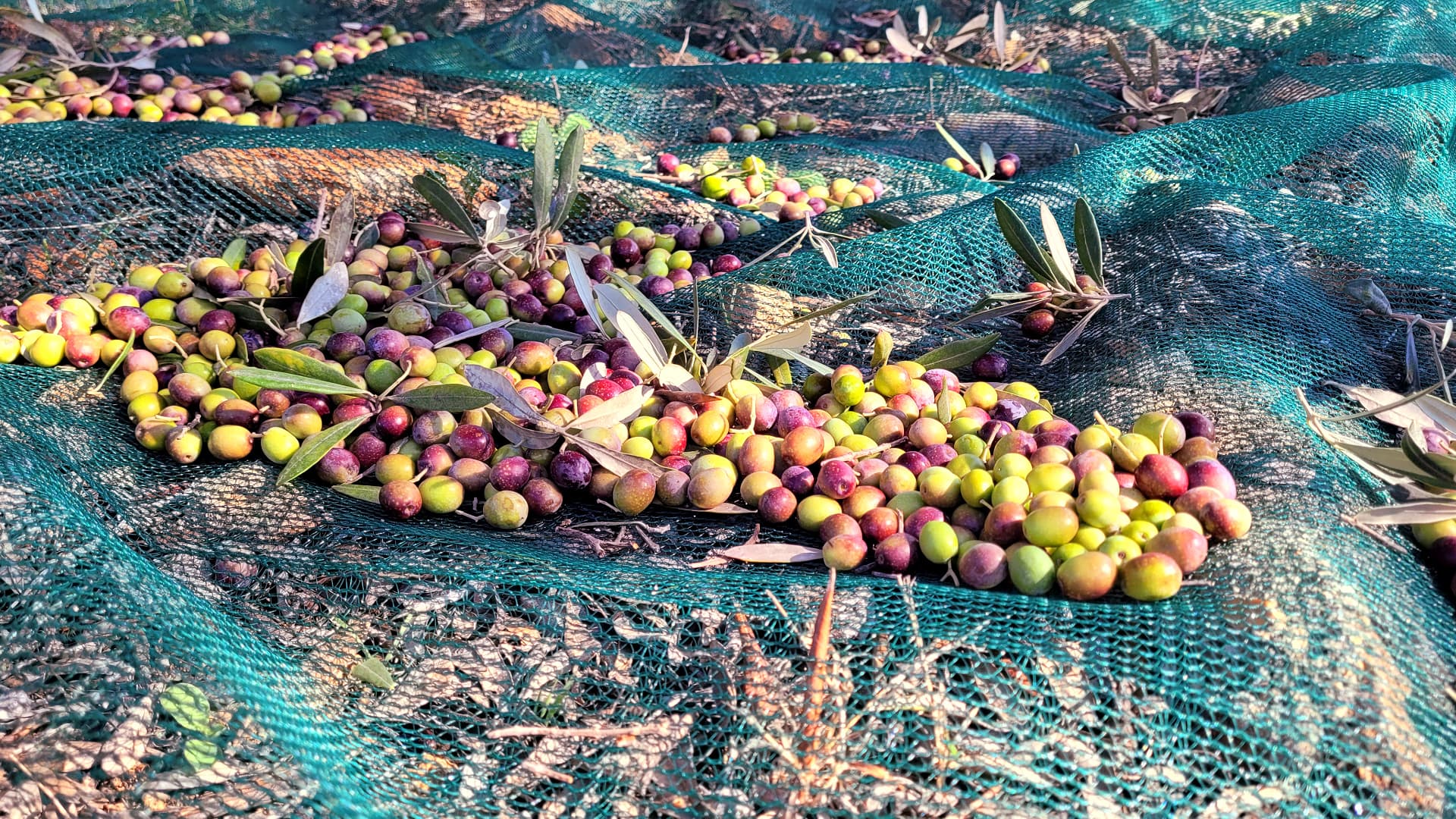
Olives harvested with an electric harvester lie on the net before being delivered to the mill. (Photo: Ylenia Granitto)
Modern olive mills generally refuse fruit that is excessively dirty and damaged. It is common, however, for harvested olives to contain leaves and small twigs, which are removed at the milling facility during the washing and defoliation stages that precede crushing.
During the harvest preparation phase, worker safety should always be a priority in any harvesting operation. A survey conducted by the Italian National Institute for Insurance against Accidents at Work revealed that, in this sector, risk awareness is low and that training activities are often overlooked.
To mitigate potential risks, workers should be equipped with personal protective equipment suited to the specific conditions of the harvest. It is also essential to avoid using unsuitable machinery and to rely on qualified personnel when working with ladders.
Harvesting may be performed manually, with the aid of portable powered tools, or through fully mechanized systems.
“The choice of harvesting method depends on various factors, including production objectives, fruit characteristics, number of trees, planting layout and available budget,” said Angelo Bo, an agronomist specializing in organic olive farming.
Manual Harvest
“The oldest and simplest method of harvesting olives is by hand. Today, this is often combined with the use of small rigid plastic rakes to help detach the fruit from the tree,” Bo said. “Manual harvesting has the advantage of preventing damage to the fruit, which can occur with other harvesting methods.”
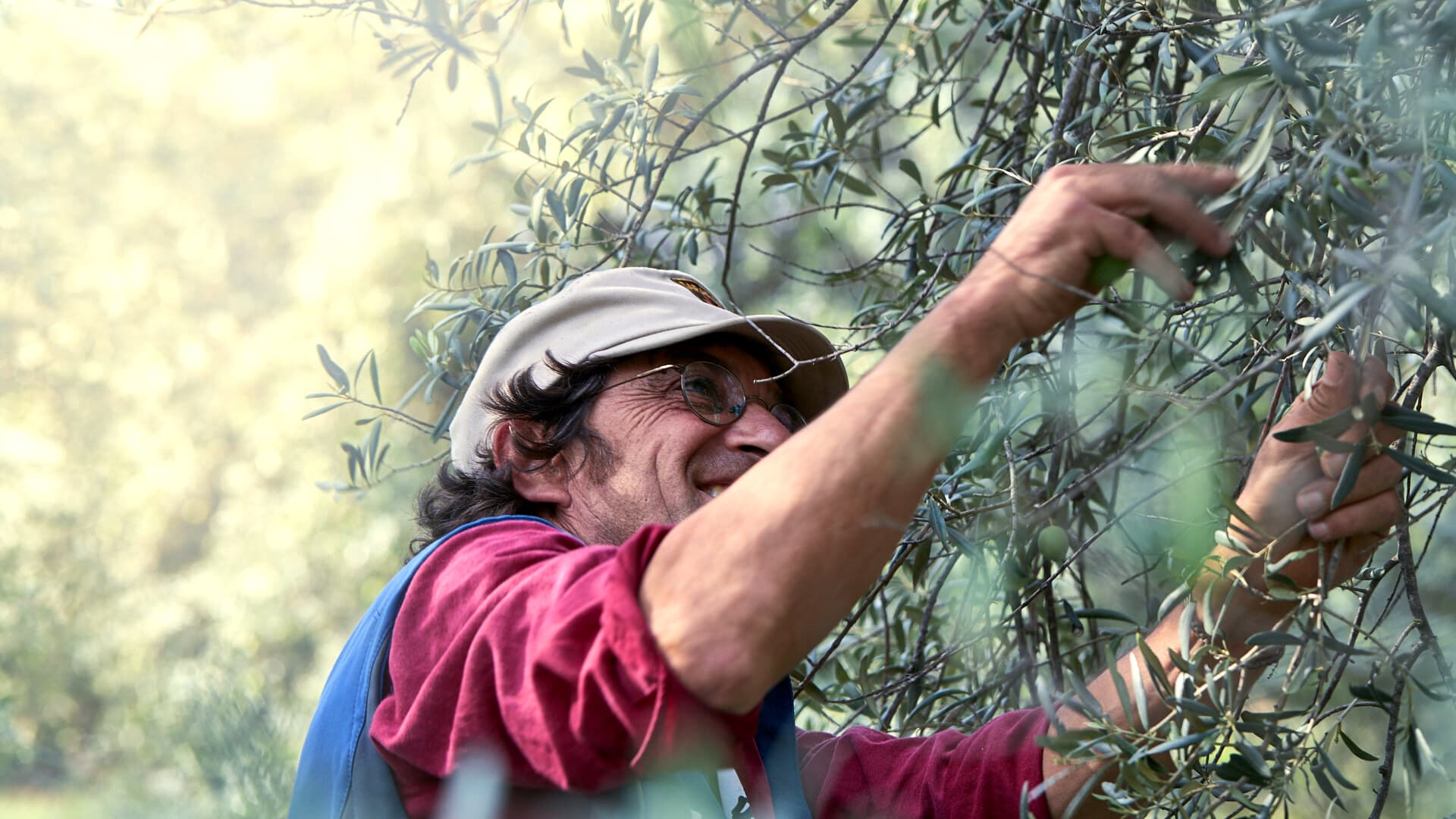
A manual harvest is ideal for small-scale producers seeking to produce high-quality extra virgin olive oil and table olives. (Photo: Agrestis)
“It is common among non-professional and small-scale olive oil producers, and is widely used by producers of table olives, as olives intended for this purpose must be intact and free from bruising,” he added. “Its main disadvantage is the longer time required and, consequently, the higher production cost.”
With this method, the harvested olives are placed in small, ventilated crates that typically hold no more than about 25 kilograms, allowing them to be easily carried from tree to tree.
Assisted Harvest
Assisted harvesting is a widely adopted method, offering an optimal compromise between manual labor, operational time and yield.
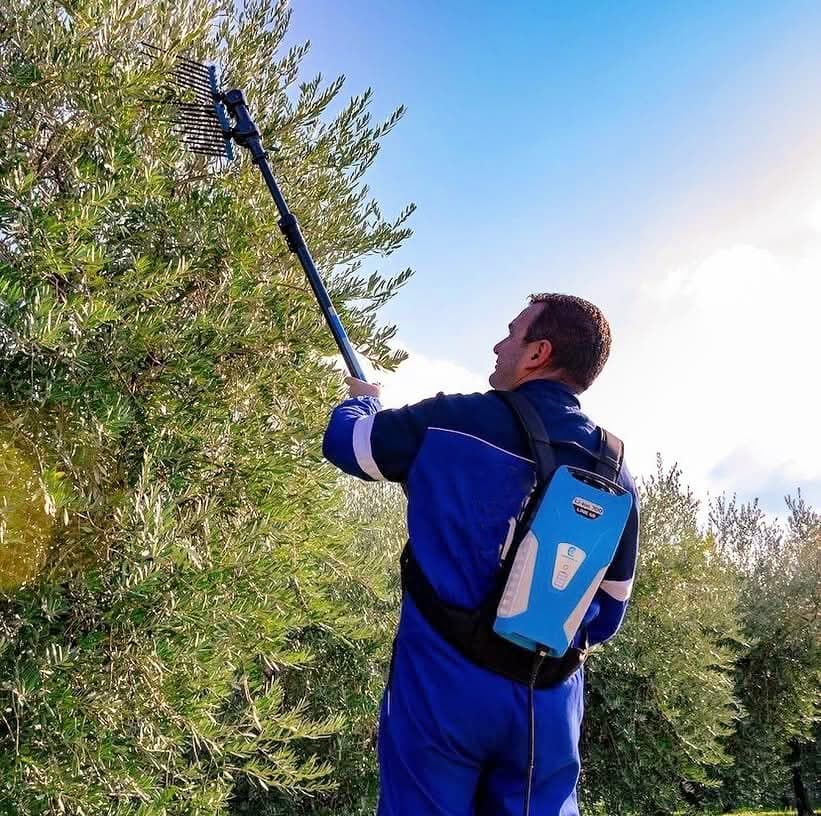
Electric harvester for assisted harvesting with backpack battery (Photo: Agrifarm Cassino)
It involves the use of portable, powered harvesters. These tools consist of a fixed or telescopic handle and a harvesting head equipped with prongs that move in rotary or oscillating patterns to detach the olives efficiently.
The latest models are made from lightweight materials, such as carbon fiber, which makes them lighter and easier to handle.
Harvesters can be electric, pneumatic or engine-driven, with electric tools now being the most widely used. Either integrated or external batteries can power them, the latter generally offering longer operating autonomy.
“This method allows us to double and even triple the quantity of olives harvested per operator per day [compared to manual harvesting],” Bo said. “Therefore, it offers a very good balance between production costs, overall output, and time efficiency.”
See Also: How Olives Are Processed Into Oil“It is widely used in traditional and semi-intensive olive groves,” he added. “One drawback is that when the prongs vibrate the branches, they also bump the olives, causing bruising. This makes it essential to transport the olives to the mill as quickly as possible, preferably within the same day.”
“We must remember that the moment an olive is picked, a series of respiration processes begins within the fruit, leading to the breakdown of certain compounds,” Bo continued. “If the tissues are damaged, causing the rupture of cell walls – as frequently occurs with this type of harvesters – the deterioration processes accelerate and their effects intensify. For this reason, timely delivery to the mill is essential.”
With this method, it is crucial to lay adequately sized nets on the ground to prevent fruit dispersion. As operations progress, the nets are moved from tree to tree, either by hand or with rollers, allowing the operator to work continuously and efficiently to harvest sufficient quantities within a limited timeframe.
The capacity of current batteries allows operators to work comfortably for six to eight hours a day. Recharging can be carried out during non-working hours, ensuring there is no impact on operational capacity.
Mechanical Harvest
A fully mechanical harvesting method involving tree shakers is another key approach used in modern olive cultivation. Commonly employed by large companies, it relies on either trunk or branch shakers, which are typically used on small and large trees, respectively.
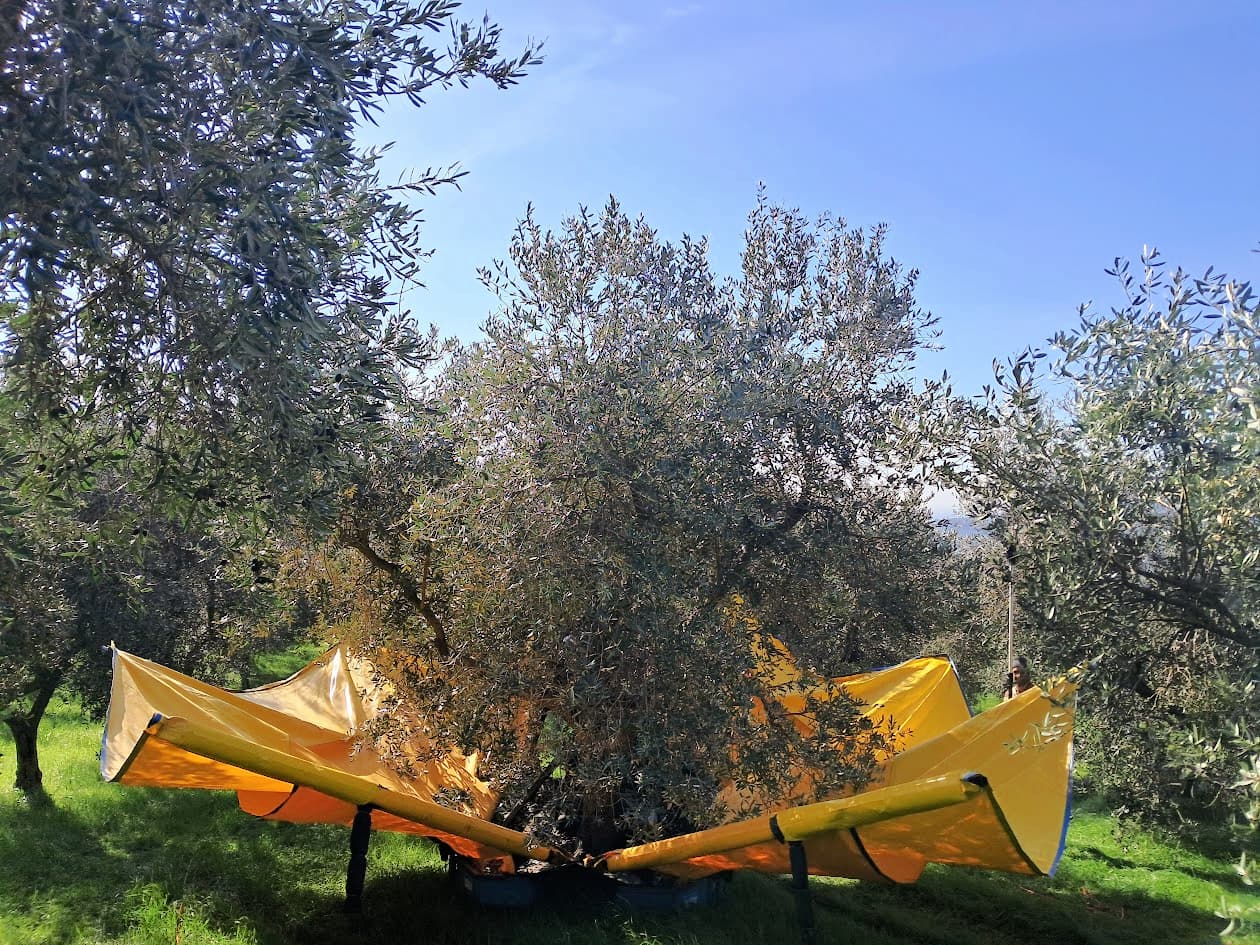
Deploying an olive interceptor umbrella (Photo: Angelo Bo)
“A gripper mounted on a tractor clamps onto the trunk or branches and transmits vibrations through the woody structural elements of the tree to the smaller branches and, ultimately, to the fruit stalks,” Bo said.
“This shaking action detaches the stalks, causing the olives to fall,” he added. “The fruit may drop onto nets, as in more traditional setups, or, at the highest level of mechanization, into interceptor umbrellas. In the latter case, the machine extends an inverted umbrella beneath the tree and the olives fall directly into an integrated container, before being transferred into bins for transport to the mill.”
With this system, each shaker can harvest up to 300 kilograms per hour, making it ideal for large-scale operations. However, adequate spacing between trees is essential to allow machine movement and umbrella deployment. The system can also be used on moderate slopes, but it is unsuitable for very steep terraces.
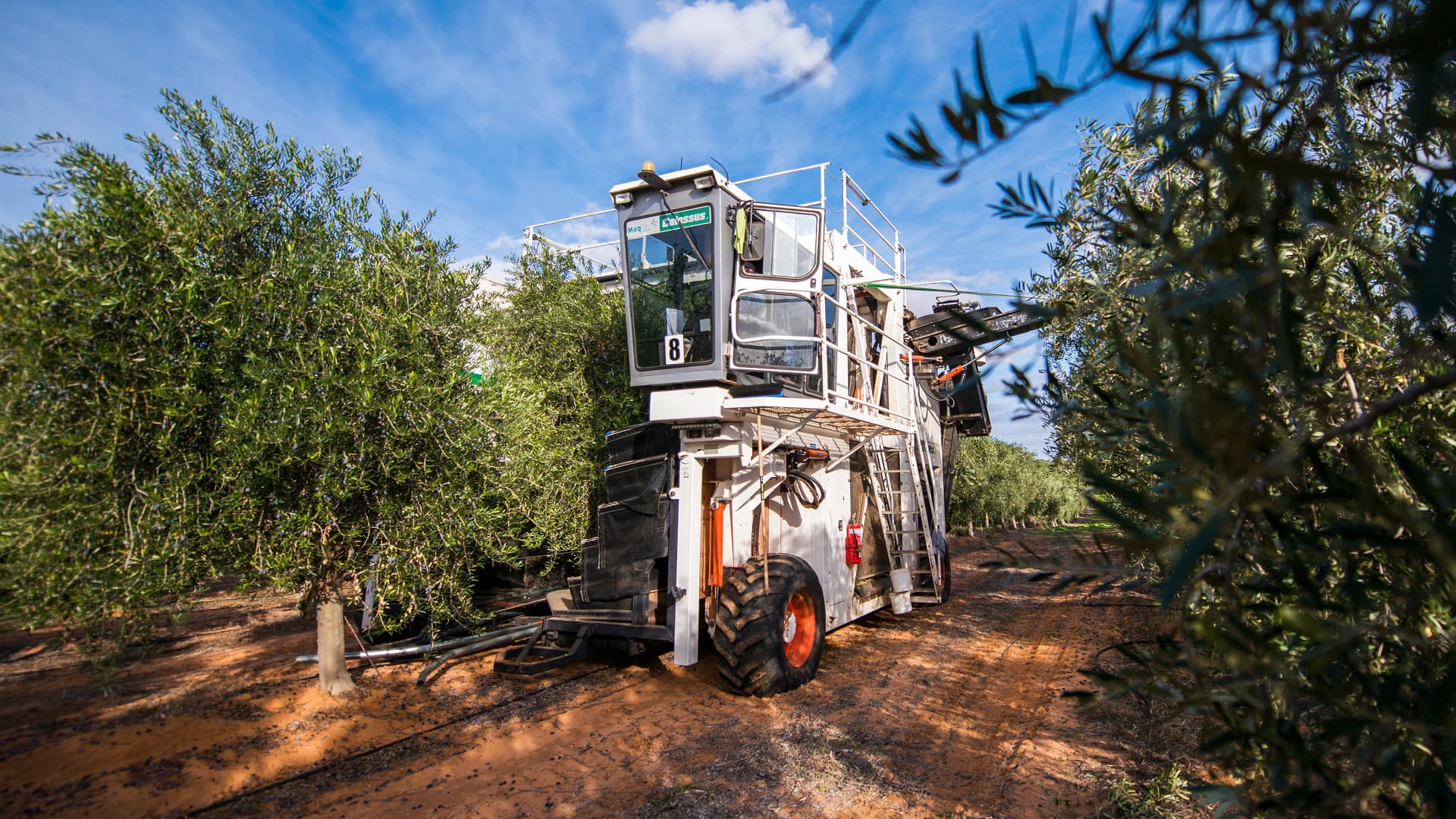
Over-the-row harvesters are used in most super-intensive olive groves to lower production costs and increase harvest speed. (Photo: Cobram Estate)
“Another method used in super-intensive systems is continuous harvesting with over-the-row harvesters,” Bo said. “These machines straddle the tree row and collect fruit in one pass. The planting layout is specifically designed to accommodate the passage and operation of machinery.”
Such systems are typically limited to orchards with very long rows, allowing equipment to operate with minimal downtime due to maneuvering. As a result, they are best suited to flat terrain or very gently sloping hills.
“A critical limitation is that only a few olive varieties can grow in a balanced manner within such a containment and specialized training system. An even greater challenge is that just a few varieties ripen uniformly, which can be harvested so quickly to guarantee a high-quality production,” Bo said. “This implies a strict cultivar selection when planning the establishment of the orchard.”
Key points and challenges
To meet high-quality standards, it is crucial to preserve fruit integrity, as healthy, intact olives produce the highest quality extra-virgin olive oil and table olives.
“Throughout the year, we should act to prevent and treat pests and other problems that may affect the health of the olives, to ensure the olives are in optimal condition,” Bo said. “During harvesting operations, we must continue to take care of the fruit. Olives should not be left exposed to sunlight or piled for too long periods, as this can trigger fermentation and oxidative processes which affect their quality.”
Another key aspect to consider is that harvest planning should align with the ripening timeline, taking into account the specific characteristics of each variety.
“Each olive variety has its own features,” Bo said. “Leccino and Maurino, for example, are early varieties with a very compact ripening (namely, most of the fruit on the tree reaches optimal ripeness at nearly the same time), so within a week or so they risk over-ripening, which may hinder the production of a high-quality product. This means that I must shorten the harvest window.”
“On the other hand, Frantoio is usually a medium-ripening variety and has a gradual ripening process, which allows us to have more days to achieve a good harvest,” he added. “Moraiolo is a medium-late variety, whose ripening process is slightly more concentrated than Frantoio. Operational planning should be carried out carefully to ensure that each olive variety is harvested at its optimal ripeness.”
In this context, a crucial factor to consider is that climate change is altering the ripening process. This necessitates adapting to actual conditions rather than relying on standardized calendars. Over the past decade, a clear trend has emerged among producers to begin harvesting significantly earlier.
“It is well-established that climate change is leading to major shifts in the process. In short, cooler seasons in the past led to later and slower ripening, whereas today’s higher temperatures are causing fruit to ripen earlier and faster,” Bo said.
“So, from one year to the next, in the same area, harvest can begin a week or ten days earlier or later,” he added. “For example, Leccio del Corno is considered a medium-late variety, but in Tuscany, we noted a shift toward earlier maturation in recent years. Frantoio, which once took about six weeks to ripen and gave me even three weeks for harvesting, now may allow barely 15 days.”
“Nonetheless, we must be careful not to harvest too early, as this could reduce oil yield and result in oils that are unbalanced and lacking in complexity,” Bo concluded. “Today, all these factors must be considered to ensure a successful and efficient olive harvest.”
Know the Basics
Things to know about olive oil, from the Olive Oil Times Education Lab.
- Extra virgin olive oil (EVOO) is simply juice extracted from olives without any industrial processing or additives. It must be bitter, fruity and pungent — and free of defects.
- There are hundreds of olive varieties used to make oils with unique sensory profiles, just as many varieties of grapes are used in wines. An EVOO can be made with just one variety (monovarietal) or several (blend).
- Extra virgin olive oil contains healthy phenolic compounds. Substituting a mere two tablespoons of EVOO per day instead of less healthy fats has been shown to improve health.
- Producing high-quality extra virgin olive oil is an exceptionally difficult and costly task. Harvesting olives earlier retains more nutrients and extends shelf life, but the yield is far less than that of fully ripe olives that have lost much of their healthy compounds.