Then and Now: When Olive Oil Was Stored for Seven Years Underground
An 1853 account of olive oil production praised fully ripe fruit, stone mills and years of underground storage — practices that stand in sharp contrast to the modern pursuit of freshness.
In June 1853, Scientific American offered its readers a concise explanation of how olive oil was made, traded and used around the Mediterranean.
The account is recognizable in its essentials. Olives were harvested, crushed with a stone mill and pressed to separate the oil. The best portion was reserved for the table, while lower-quality oil was used for soapmaking and other industrial purposes.
Yet much of what the magazine presented as good practice would be foreign to a modern extra virgin olive oil producer.
The oil is kept for seven years in these caverns, without becoming rancid.
The article described Italy as one of the great centers of olive oil production and focused particularly on Gallipoli, in the southern region then known as Terra d’Otranto.
According to the magazine, olives intended for the best oil were allowed to become “fully ripe,” gathered mostly by hand and crushed beneath a single stone revolving in a circular bed.
The resulting pulp was packed into sacks and subjected initially to “very low pressure.” The first oil to emerge was described as “beautiful and sweet,” the finest quality for table use and known simply as “salad oil.”
There was no extra virgin category. Today, virgin olive oils are formally classified according to chemical and sensory criteria, and extra virgin olive oil must be obtained solely by mechanical or physical means under conditions that do not alter the oil.
Harvesting practices have changed as well. While maturity decisions vary by cultivar, climate and the style of oil a producer wants to make, many quality-focused growers harvest before olives reach full ripeness to preserve fresh aromas, bitterness, pungency and phenolic compounds.
The differences become even greater after the first extraction.
Scientific American reported that once the finest oil had been removed, the sacks of olive pulp were opened and a small quantity of boiling water was poured into each one. The heat caused the pulp to swell and facilitated the flow of additional oil from the mass.
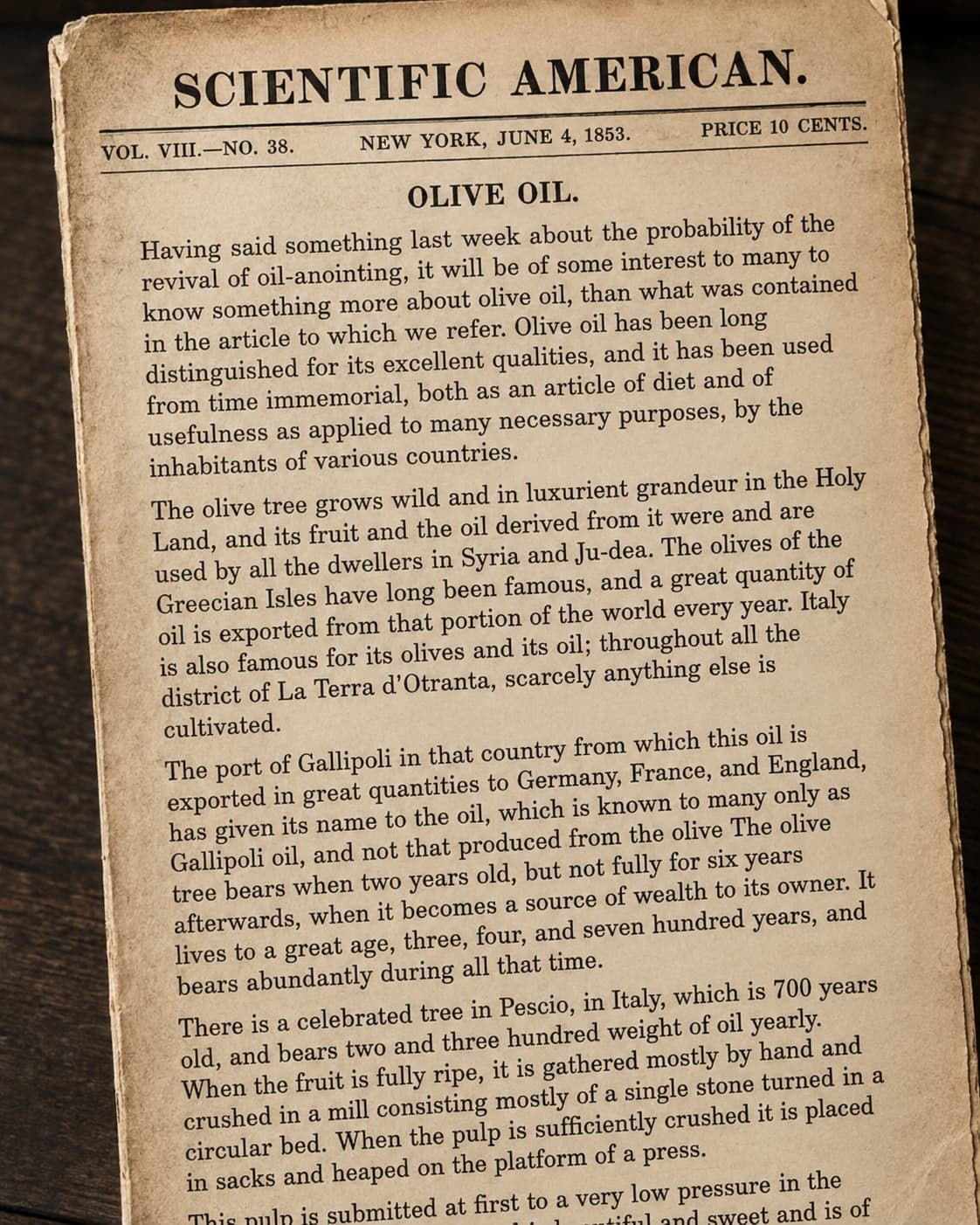
AI-generated reconstruction of a June 4, 1853, Scientific American article “Olive Oil.”
Modern olive oil mills bear little resemblance to that operation. Crushers, malaxers and centrifuges have largely replaced stone mills and presses, while producers seeking extra virgin quality carefully manage processing temperatures. Lower malaxation temperatures and shorter times generally preserve more of an oil’s aromatic complexity, even when doing so can reduce extraction yield.
Perhaps the greatest contrast, however, comes after the oil leaves the mill.
The magazine wrote that the first-run oil was transported “in skins” to reservoirs beneath Gallipoli. The town’s underground caverns were celebrated for storing oil as it naturally clarified.
There, according to the article, olive oil could remain for seven years “without becoming rancid.” When it was eventually sold, it was carried from the caverns in skins and transferred into casks for shipment; sometimes it was shipped in the skins themselves.
Today, time is considered an enemy rather than an aid to olive oil quality.
Extra virgin olive oil begins to change from the moment it is produced. Oxidation gradually diminishes aromas, flavors and antioxidants, and inadequate storage quickly causes an oil to lose quality. Modern best practices emphasize stainless steel tanks, controlled temperatures and protection from oxygen and light, often with an inert gas, such as nitrogen, blanketing the oil.
Packaging follows the same principle. Dark glass, metal containers and other light-resistant formats are favored over packaging that exposes the oil to light, while limiting oxygen in the headspace helps slow oxidation. Consumers looking for quality are increasingly encouraged to seek recent harvest dates rather than wrongly assuming olive oil improves with age.
In other respects, the world described in 1853 seems surprisingly familiar.
Scientific American complained that the popularity of olive oil in the United States had created ample opportunity for deception.
“Owing to the great quantity of oil sold in our country as olive oil,” the magazine wrote, “there is much deception employed by the sellers of it,” adding that some products sold as pure olive oil were not olive oil at all.
The analytical methods and regulatory systems available today would have been unimaginable to its editors. Current standards define multiple grades of olive oil based on chemical parameters and sensory evaluation, while increasingly sophisticated methods are used to detect adulteration and verify authenticity.
The problem they are intended to solve, however, was already familiar 173 years ago.
The article ended with another prediction that partly anticipated the industry’s future.
“We believe that the olive could be cultivated with profit in our southern States,” the editors wrote, expressing hope that American growers would take up the crop.
The center of the modern United States olive oil industry would eventually emerge farther west, particularly in California, where mechanized harvesting, rapid milling and modern storage technology transformed a crop once processed with stone wheels and presses. Commercial olive oil production has also developed in other parts of the country, including Texas, Arizona, Georgia and Florida.
The objectives have changed less than the machinery.
Producers in 1853 were trying to extract the most desirable oil from the fruit, preserve it until it reached consumers and distinguish the genuine article from imitation.
They would recognize all three challenges today. What might surprise them most is that the oil they believed could improve during years beneath Gallipoli is now prized above all for something far more fleeting: its freshness.
Archive: “Olive Oil,” Scientific American, June 4, 1853.