Ancient Olive Grafting Techniques Gain New Relevance Amid Climate and Disease Pressures
Once used mainly to domesticate wild trees, grafting is re-emerging as a key tool for fighting disease, adapting to climate change and preserving rare olive varieties.
Grafting is an ancestral horticultural technique that enables plant propagation, domestication of wild varieties and replacement of cultivars. It involves inserting a plant’s scion onto the trunk, branch or root of another related plant, known as the rootstock, so that the two unite and grow as a single plant.
Grafting is one of the foundational techniques that shaped the evolution of agriculture over the millennia
Olive tree grafting has long been used to domesticate wild plants and establish new varieties. Shared primarily through oral tradition and largely unchanged over time, the practice is now re-emerging as a tool to tackle phytosanitary problems, improve agronomic traits and production quality, and safeguard biodiversity threatened by genetic erosion.
“Grafting is one of the foundational techniques that shaped the evolution of agriculture over the millennia. In fruit growing in particular, it has been widely used to propagate woody species like the olive tree,” said Felice Suma, a Puglia-based agronomist specializing in organic farming.
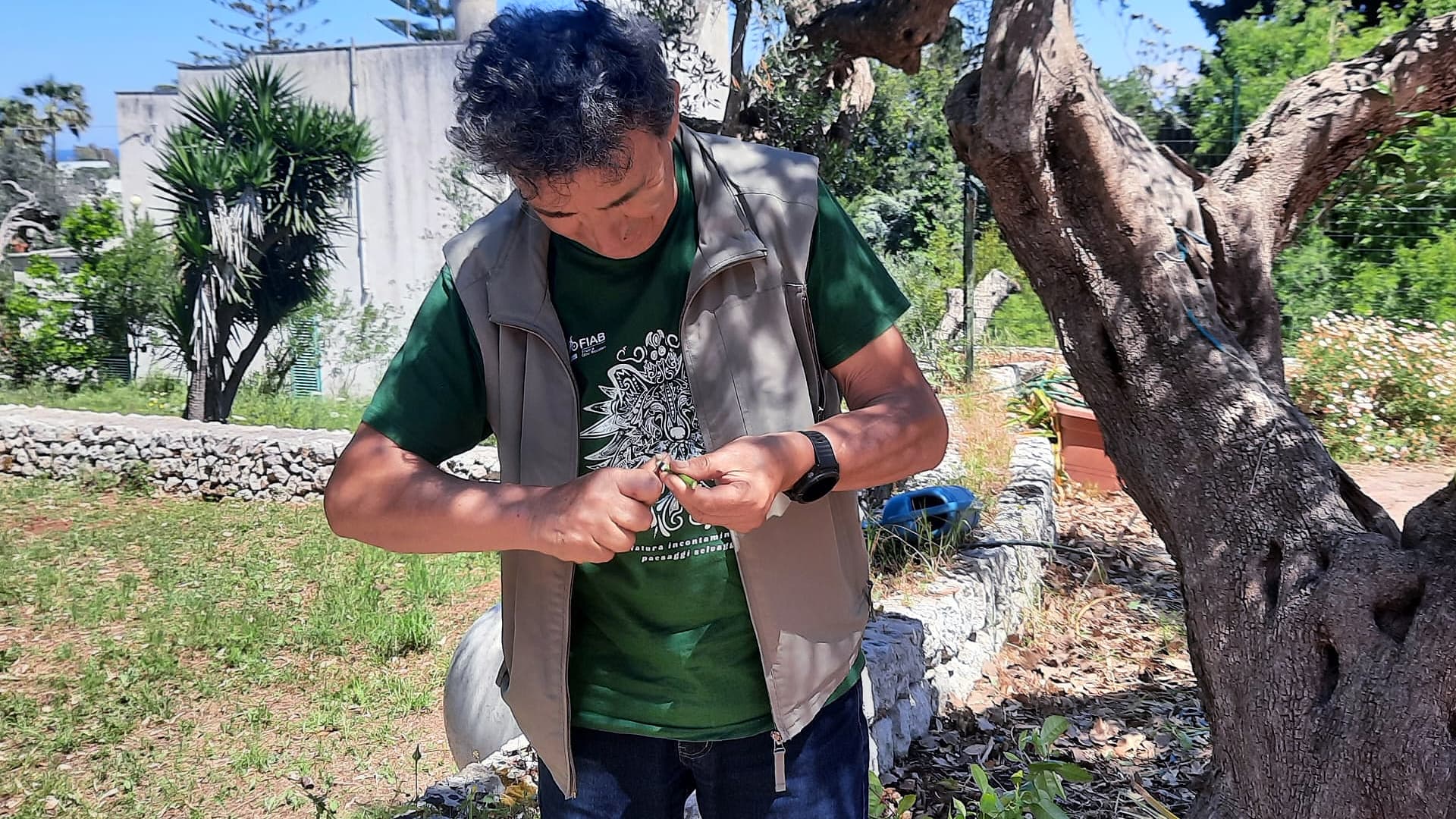
Felice Suma prepares a scion to graft a centuries-old olive tree in Puglia.
“In the past, farmers grafted oleasters that have become today’s monumental olive trees,” he said. “They also observed in the field which varieties were best suited to their needs, considering factors such as cold, drought and disease resistance, as well as fruit traits such as ripening time, size and flavor, and grafted those trees with the most suitable varieties, many of which have persisted to the present. Today this practice is as relevant as ever, as it helps improve production, introduce varieties tolerant or resistant to disease, and save local varieties that would otherwise be lost.”
Olive tree grafting: preparation and key methods
The following is a broad outline of the preparatory steps and grafts most commonly applied, though the practice has countless variations shaped by different agronomic approaches and regional traditions.
The best time for grafting is during the first warm days of the season, when the tree is in active sap flow and can immediately nourish the newly introduced buds.
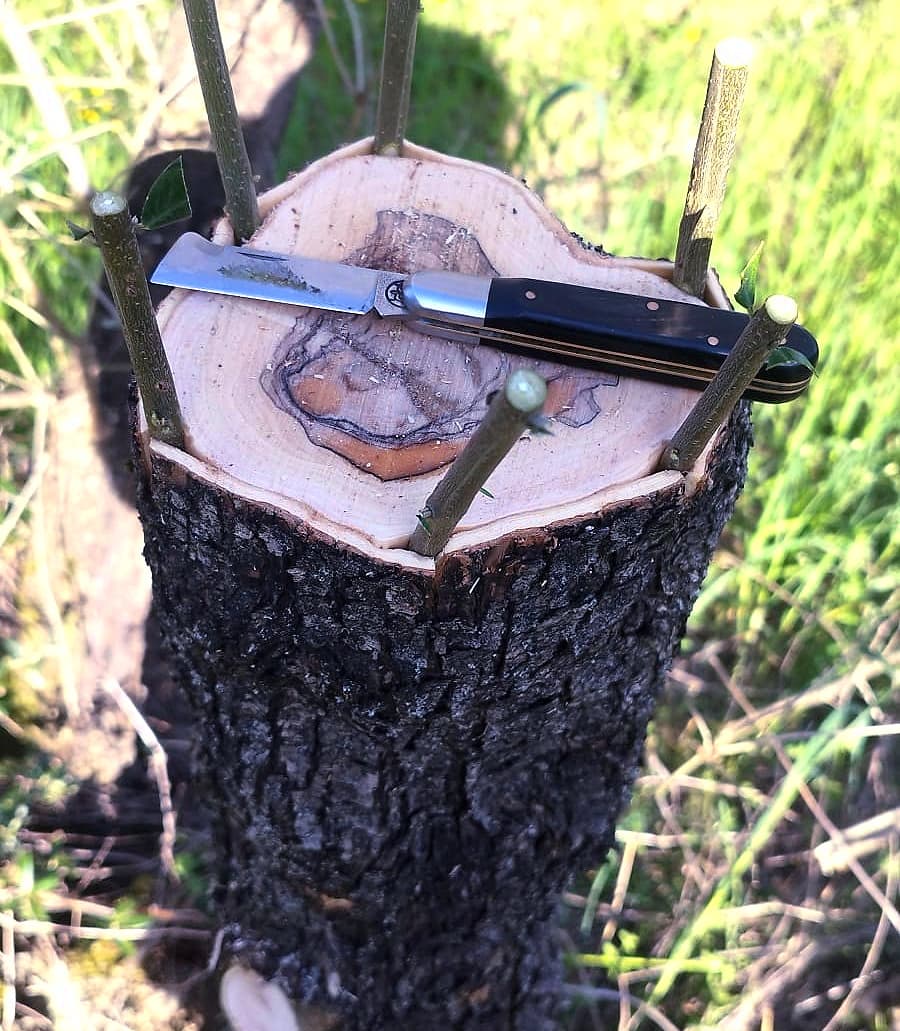
Sharp knives are essential tools for making clean incisions and shaping scions. Photo by Simone Atzori.
Scions may be collected right before grafting. They consist of portions of the previous season’s shoots, or bark bearing non-flowering buds, taken from the outer part of the tree. If leaves are present, they must be removed or partially cut to reduce transpiration.
Sharp knives are essential for shaping scions and making clean incisions in the rootstock. For a few types of grafts, a small hatchet may also be useful.
Binding materials such as tape, parafilm, rubber bands or twine are required for tying the graft, along with protective sealing compounds such as grafting wax or mastic, which prevent dehydration and infection.
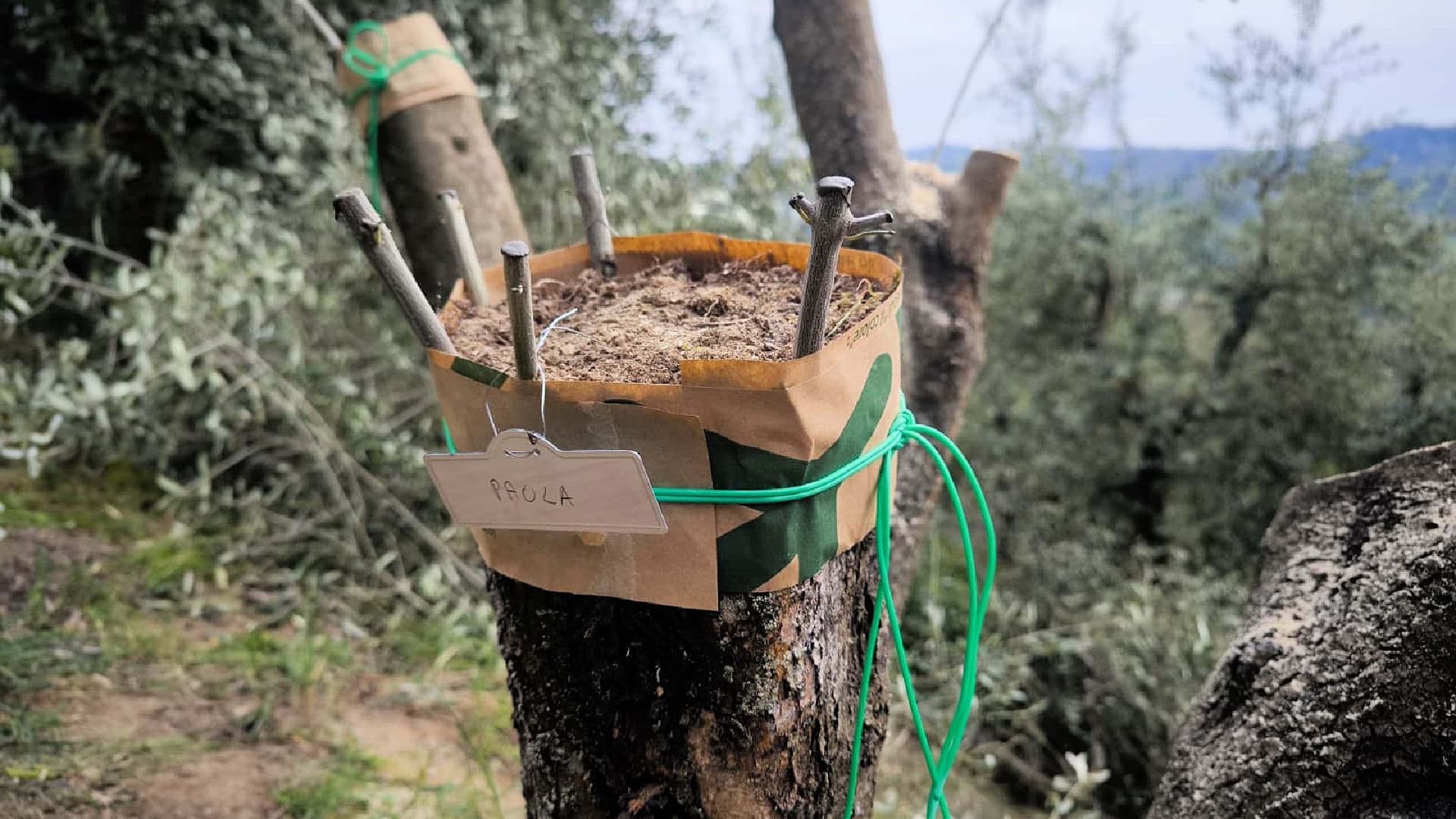
A crown graft performed by a participant in a course led by Simone Atzori.
“A critical point in grafting is matching the cambial layers of the two subjects,” Suma stressed. “The scion and the rootstock must align perfectly so they can unite and share their vascular systems. That is why it is essential to make clean cuts and ensure the rootstock and scion adhere tightly.”
Located between the xylem and phloem, cambium tissue is composed of young cells that divide at the start of the growing season and differentiate to form new xylem and phloem. This process underlies wood formation and, therefore, the radial growth of the trunk, branches and roots.
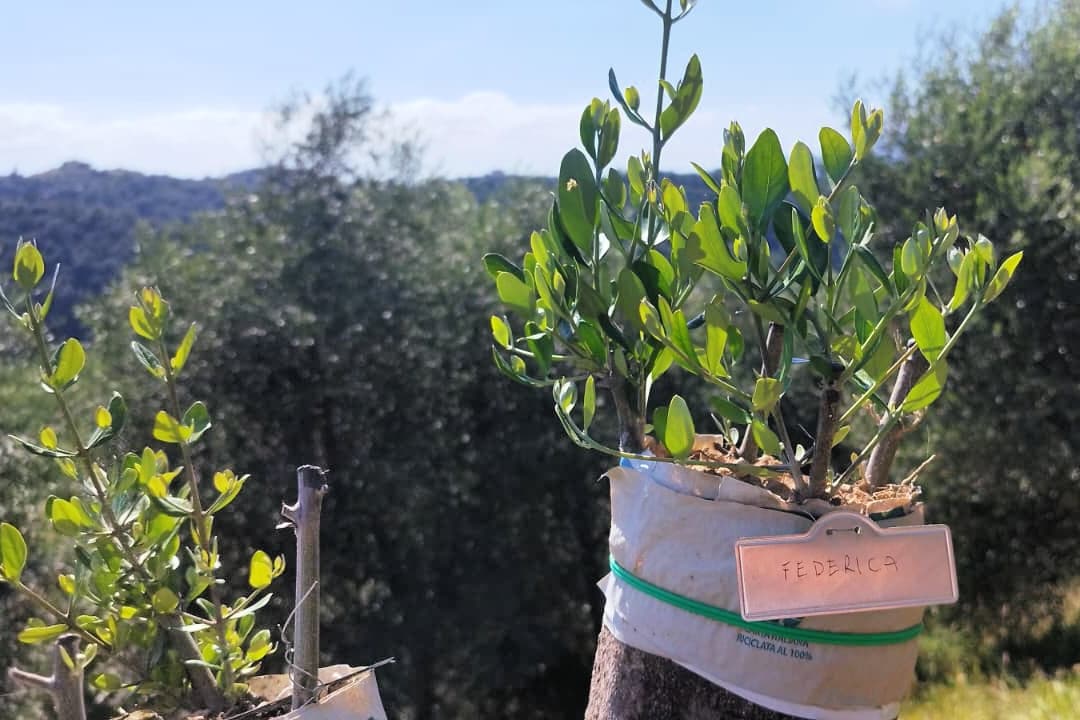
A crown graft two months after its application, performed by a participant in a course led by of Simone Atzori.
“The polarity of the scion must always be respected, placing it on the rootstock according to its original growing orientation,” Suma pointed out. “If the union is successful, after about thirty days the bud begins to develop and a new shoot emerges.”
Crown grafting
In crown grafting, the rootstock’s trunk or secondary branches are cut horizontally, and incisions are made at four or five points between the bark and the sapwood. Scions with no more than two nodes are then inserted into these incisions; each is cut beforehand into a flute-shaped bevel. The graft must be tied firmly with binding material and covered with a sealant.
Using multiple scions prevents large bare areas from drying out. Once the new shoots have grown, growers can choose which one to keep and remove the rest.
Shield budding (or T-budding)
Shield budding is best suited to young plants and branches. It is named after the scion piece, which is reduced to a small, shield-shaped section of bark containing a bud, usually taken from the axil of a leaf.
A T-shaped incision is made along the rootstock’s trunk or branch, and the bark is lifted so the shield can be inserted. The graft is then tied tightly and sealed. Once the new shoot begins to grow, the portion of the branch above the graft can be cut back.
This method carries fewer risks than crown grafting. If the graft fails, there is no danger of losing the tree or its production, unlike with a pollarded tree.
Patch grafting
Patch grafting is another low-impact, low-cost method particularly well suited to centuries-old trees, since it avoids the risk of losing the plant or its production. It involves removing a square of bark several centimeters wide from the rootstock, exposing the sapwood beneath. This is done at three different points on the trunk where new branches are desired.
The patch is then replaced with an equal-sized patch cut from the cultivar to be grafted, containing viable buds. It is secured with four nails and binding wire, then sealed. As the new shoot develops, the portion of the branch above the graft can be cut back.
Other methods
Among the less commonly used methods is cleft grafting, in which a young trunk or straight branch is cut and split down the center to receive one or two wedge-shaped scions bearing a bud. Double cleft English grafting, best suited to thin branches measuring one to three centimeters, is another less common method that requires a scion and rootstock of the same diameter. A three- to five-centimeter diagonal cut is made on the rootstock, and midway along it, a tab is created with a downward incision about one centimeter deep. A mirror cut is made on the scion, which bears two or three buds, so that the barks match.
Other methods rely on drills or dedicated tools to bore a hole and insert a scion of matching diameter. As is customary, all these grafts must be tied firmly and sealed.
Application of grafting to tackle disease, improve agronomic traits and production quality
“Grafting can be key to tackling today’s challenges such as Xylella fastidiosa,” Suma said.
He highlighted the importance of protecting the Plain of Monumental Olive Trees in Puglia. The area stretches between Carovigno, Ostuni, Fasano and Monopoli and hosts the highest density of centuries-old and millenary olive trees in the Mediterranean, with around 250,000 registered monumental specimens and more than 2.5 million plants overall.
“Many trees are already compromised, but those not yet infected can still be saved through grafting, using scions of varieties recognized by the scientific community as tolerant to Xylella, such as Leccino, Favolosa, Lecciana and Leccio del Corno,” Suma said. “It is not simple, and it is costly, since grafting a single monumental tree can take hours. Ordinary farmers often lack the financial means to do it, but it would be feasible with stronger public support.”
An initiative aimed at varietal change through grafting is underway in Tuscany. Simone Atzori, a producer and expert in grafting techniques, is co-managing the graft-based restoration of an olive grove on the Villa Corsini a Mezzomonte estate in Impruneta, near Florence.
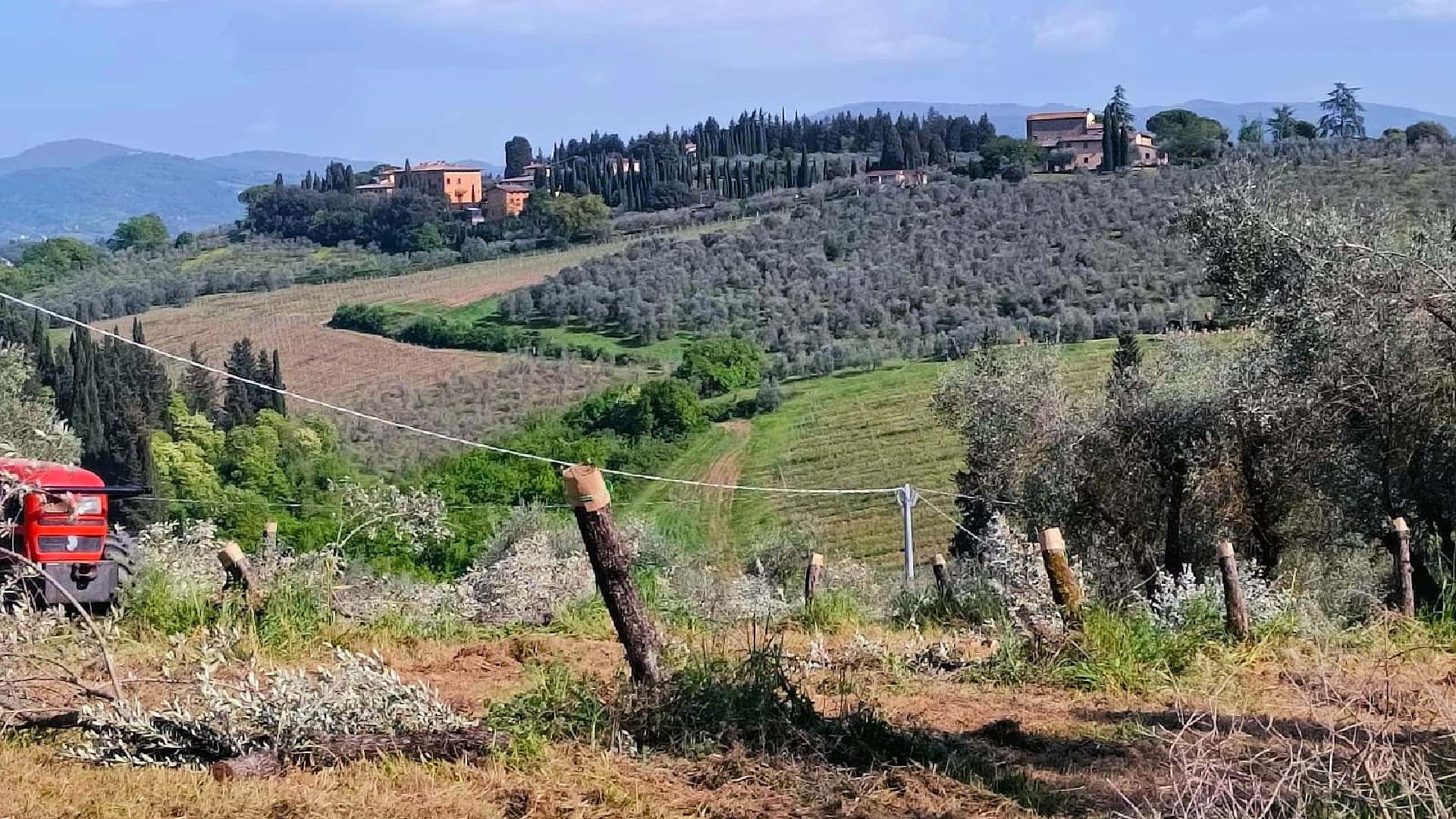
At the Villa Corsini a Mezzomonte estate, the olive grove was restored using crown grafting. Photo by Simone Atzori.
“A good part of these five thousand olive trees are multi-stemmed. They were destroyed by the historic 1985 frost and subsequently regrew, developing several branches,” Atzori explained. “This type of multi-trunk tree, widespread in central Italy, can create difficulties during harvest and pruning. The trunks are often very upright and tall, and the trees are not planted in regular rows.”
Atzori explained that it is not easy to reform these specimens, as they were most likely grown from seed. This implies a risk that the tree will revert to a juvenile, multi-stemmed form and remain unproductive for several years.
“Many of these plants are Moraiolo, an excellent variety, but in this area it has serious problems with olive knot and peacock spot,” Atzori said. “We should consider that climatic conditions have changed since these orchards were planted, and not all these varieties perform as well as they once did.”
“Furthermore, most of the trees lost to the 1985 frost were replaced with the commercially dominant varieties of the time, like Leccino, Frantoio, Pendolino and Moraiolo,” he added. “Yet today there are many other minor varieties to rediscover that perform well in today’s climate conditions.”
Matteo Alamanni, an agricultural expert who oversees the estate’s farm at Villa Corsini, identified a Frantoio ecotype in the grove that has not yet been genetically characterized. It is highly productive and shows no susceptibility to the diseases mentioned above. After producing an extra virgin olive oil from it and being satisfied with the result, he decided to introduce the cultivar.
In early May, Atzori and Alamanni applied crown grafting to 80 plants on the property, and the plants are now growing well.
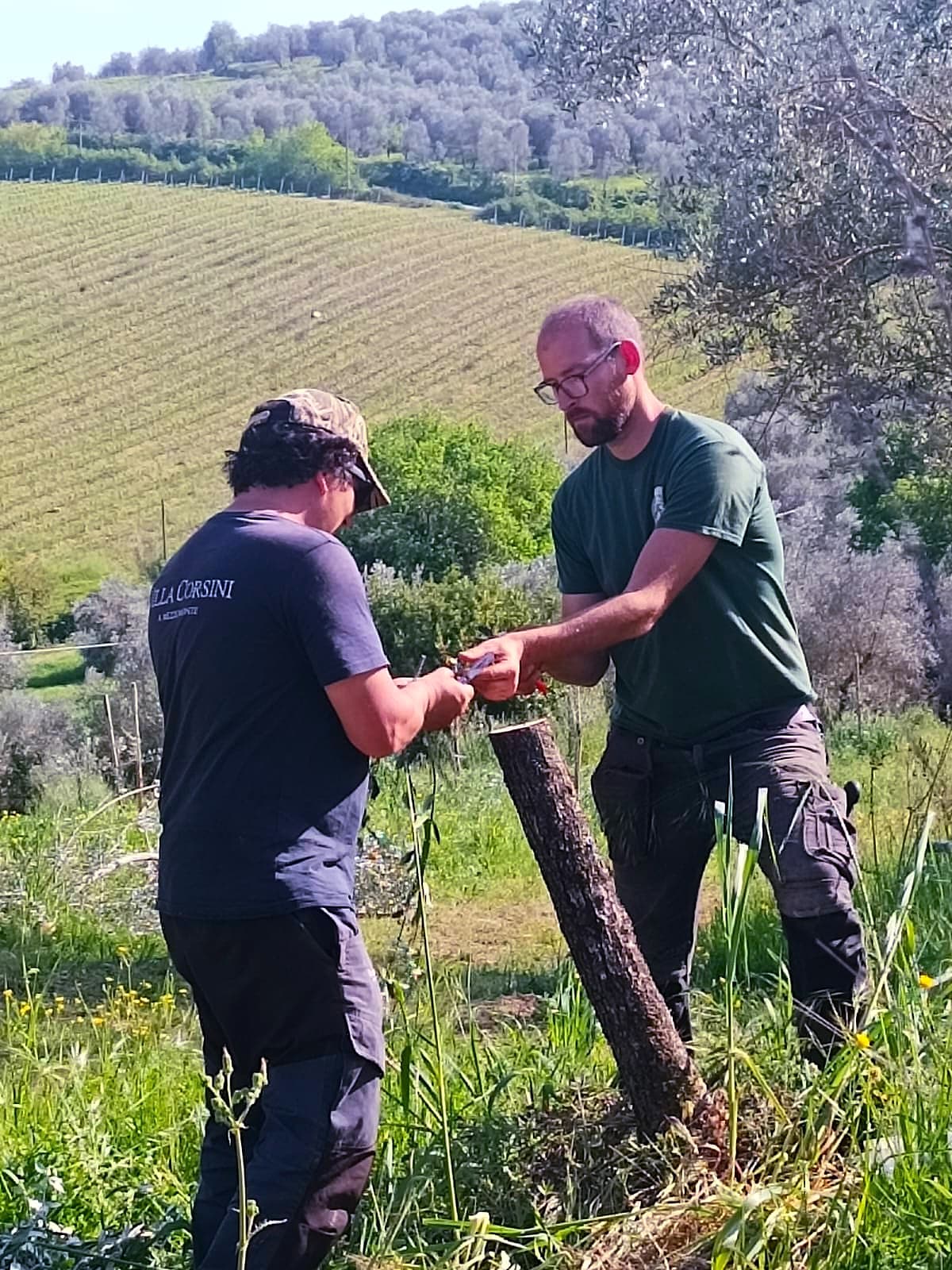
At Villa Corsini a Mezzomonte, near Florence, Simone Atzori and Matteo Alamanni grafted dozens of olive trees using the crown-grafting method. Photo by Simone Atzori.
“In the same grove we found centuries-old Leccio del Corno trees, a cold-resistant variety that survived the great frost and today hold significant landscape and biodiversity value,” Atzori said. “It is important to enhance local biodiversity, and for this reason I used an ancient local cultivar that I recently rediscovered, Madre Mignola, to graft one of my groves in Montopoli in Val d’Arno, near Pisa, and I produced an excellent monovarietal oil from it.”
Atzori said he inherited a terraced orchard containing a mix of olive varieties. Here, too, the trees were destroyed by the 1985 frost and regrew as multi-trunk forms. After finding that only a few trees of this variety remained, he propagated it by dedicating specific stretches of his orchard to it.
“In my olive grove, we grafted about one hundred olive trees a few years ago, which have already entered full production,” Atzori said. “Madre Mignola is a very delicate fruit, yet offers an excellent organoleptic profile, and the tree is very productive. Although sensitive to cold, it is highly resistant to drought, one of today’s most pressing challenges. Also, it grows more slowly than other varieties such as Frantoio, which makes it ideal for limited-space areas like terraces.”
“We should also note that many less commercial varieties are disappearing and are no longer available in nurseries,” he added. “This is why grafting can be key to preserving local varietal biodiversity. It really is a strategic tool for today’s agriculture.”