The mill-on-wheels can be brought directly to Texas groves, providing farmers and producers with an on-site solution to a very narrow timeline.
Timing is crucial in producing high-quality extra virgin olive oil, with fast processing required from tree to mill. Texas Mobile Mill offers a solution for fledging producers in Texas by bringing a 45-foot trailer directly to groves to process two tons of olives per hour, producing approximately 40 to 50 gallons of oil using compression without heat.
When it comes to the production of authentic extra virgin olive oil, timing is everything. Since high-quality olive oil production requires fast processing from the moment the fruit leaves the tree, it’s a race to the mill.
It takes approximately 100 lbs. of olives to make just one gallon of oil. For fledging producer states like Texas, add the challenge of transporting the olives to the mill, and common, harvest-time temperatures that can reach north of 100 degrees Fahrenheit, and the requirements for this finicky, heat intolerant commodity can become insurmountable. The state currently has just six brick-and-mortar mills.
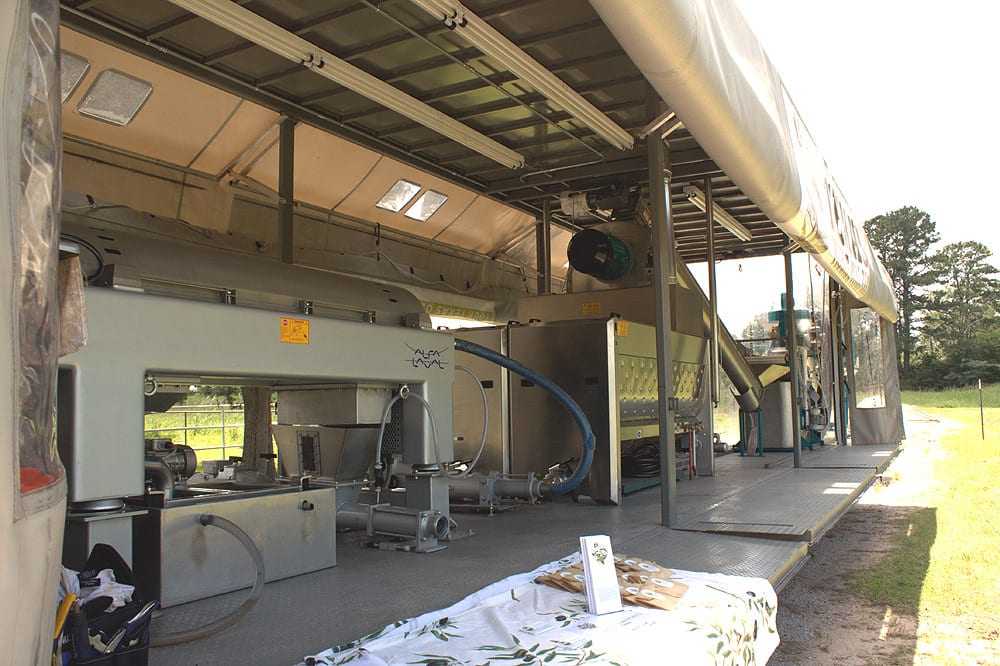
Enter Texas Mobile Mill and its tricked-out, 45-foot trailer. The mill-on-wheels can be brought directly to the groves, providing farmers and producers with an on-site solution to a very narrow timeline.
The mobile mill uses only compression and no heat, as prescribed by the guidelines for processing EVOO, and it can process two tons of olives at a rate of 65 pounds per minute, yielding approximately 40 to 50 gallons of oil. By turns, it sorts, rinses, and crushes the olives into a paste. Then, while maintaining a cool temperature, the mill uses a centrifuge to separate the oil from the paste, and the oil is deposited into a vertical decanter for final clarification and treatment. Here, all water is removed, resulting in an extra virgin product to be bottled and sealed.
Powered by a generator, the machine weighs nine tons and costs farmers $75 to $100 per hour for hauling, fuel, and labor. With parts designed and imported from Italy, the mobile mill was custom-made in California, home to the only larger machine of this kind in the country.
More articles on: production, Texas olive oil production
Mar. 19, 2025
Italy Unveils Plan to Revitalize Olive Oil Sector
A plan for thousands of new groves, funding initiatives and an interprofessional association proposes a fresh course for Italian olive oils.
Dec. 31, 2025
The 10 Most-Read Olive Oil Times Articles of the Year
From climate pressures and scientific breakthroughs to shifting consumer habits and historic milestones, these were the Olive Oil Times stories that readers returned to the most in 2025.
Feb. 10, 2026
Weeks of Rain and Flooding Slow Spain’s Olive Harvest, Threatening Output Targets
Spain’s olive harvest has been disrupted by weeks of rain and storms, prompting AEMO to trim its 2025/26 production outlook to about 1.2 million tons and warn of a lower share of extra virgin olive oil.
Mar. 10, 2026
New Olive Groves Take Root in Italy’s Northern Regions of Piedmont, Trentino
Olive cultivation is expanding across northern Italy, driven by a mix of shifting climate conditions, farm diversification and renewed interest in local production.
Feb. 23, 2026
Sustainable, Low-Cost Process Turns Olive Pomace Into Nutrient-Rich Sheep Feed
Researchers and farmers in Tuscany are testing a low-cost process that pairs moist olive pomace with absorbent brewer’s grain to create digestible silage for sheep.
Dec. 15, 2025
China’s Olive Oil Production Climbs, but Harvest Outlook Remains Uneven
China’s olive oil production reached new highs in 2024/25, but growers across key regions report sharply differing outcomes as the 2025/26 harvest unfolds.
Mar. 16, 2026
E.U. Adopts 2040 Climate Target
European Union member states have approved a 2040 climate target requiring emissions to fall 90 percent from 1990 levels, with most of the cuts expected to come from within the bloc.
May. 1, 2025
How Farmers in Peru and Chile Work Together to Stop the Fruit Fly
Twin towns Tacna and Arica share family ties and trade dynamics, but face challenges with a recent fruit fly outbreak. Efforts are being made to prevent further damage and protect olive producers.