Sustainability Takes Root in the Hills Above Florence
Fattoria Poggio di Fiesole, a Tuscan estate with a rich history and dedication to sustainability, produces an award-winning organic olive oil.
Nestled in the Florentine Hills, just north of the Tuscan capital of Florence, Fattoria Poggio di Fiesole boasts a longstanding tradition of olive growing, guided by a vision of sustainability that predates the trend.
The estate’s organic blend of Frantoio, Leccino, Moraiolo, and Pendolino earned a Gold Award at the NYIOOC World Olive Oil Competition, recognized for an expertly balanced profile with vibrant notes of artichoke, herbs, arugula, and pepper.
“The Etruscans were most likely already cultivating olive trees on these slopes,” Pietro Hebel told Olive Oil Times. “In 1400, the property was home to a convent of nuns who made oil and raised sheep for wool. Later, it later passed to a feudal lord, before eventually entering my cousins’ family.”
The farm was acquired in 1931 by Alberto Passigli, hailed as a visionary entrepreneur and among the founders of the renowned Maggio Musicale Fiorentino festival. He welcomed musicians and global thinkers to the estate, which evolved into a lively cultural retreat. His daughter, Vanda, became a student of Eastern philosophy and yoga under the guidance of renowned masters, who regularly visited the farm.
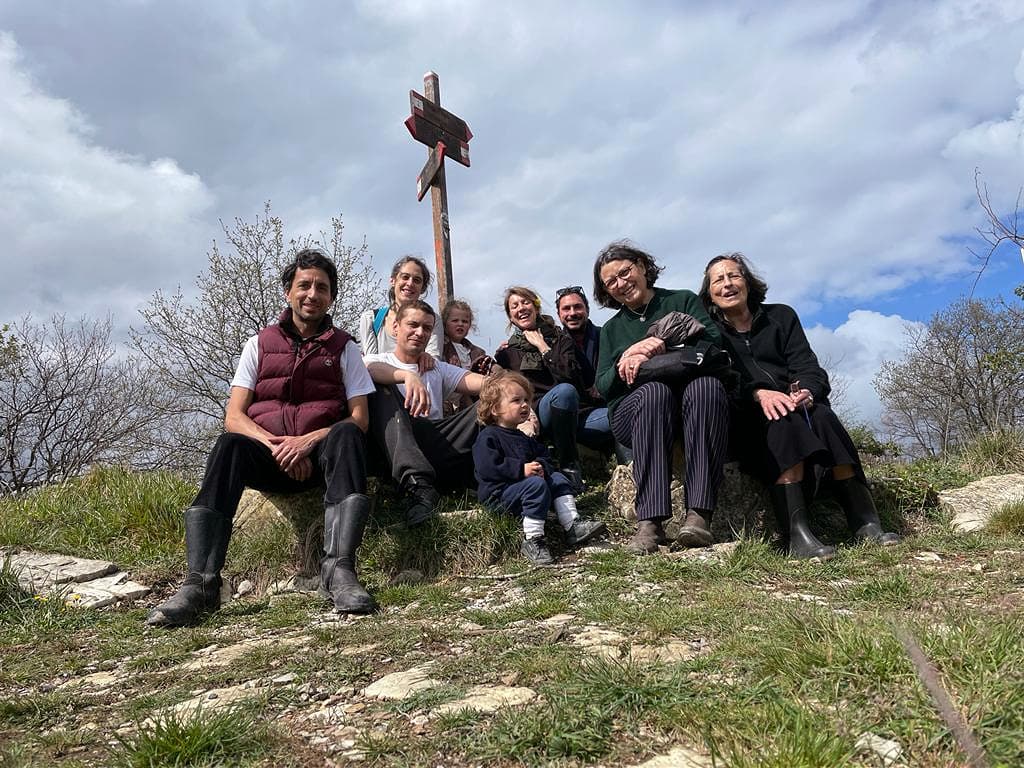
Gabriella, Enrico and Diego Scaravelli, Pietro and Anna Hebel, with the rest of the family at Fattoria Poggio di Fiesole
Vanda’s son, Alberto Scaravelli, carried forward her legacy of openness while forging a deep bond with the land. He listened to the lessons of local farmers. He immersed himself in pioneering research on sustainable cultivation, transforming these insights into the guiding principles of the estate once he took it under his care.
“My uncle Alberto embraced local knowledge while also engaging with the earliest studies on permaculture emerging from Australia,” Hebel pointed out. “When he managed the farm, in the 1960s and 1970s, chemical fertilizers and pesticides began arriving in our area, but he chose never to use them, preserving the purity of this land and revealing a forward-thinking vision.”

A view of Fattoria Poggio di Fiesole
“Back then, during the era of the rural exodus, when many people were leaving the countryside, many relied on chemicals and new machinery to offset for the growing labor shortage,” Hebel added. “My uncle made a countercultural choice, and for a while he was mistaken for a conservative, though in fact he was profoundly ahead of his time. He adopted organic principles intuitively, and today, science has confirmed that his approach was sound.”
Scaravelli’s wife, Gabriella, succeeded him in running the company from the 1990s and guided it until the 2000s, when their sons Enrico and Dario took over the reins. Soon after, Hebel and his wife Anna joined in support of their cousins, dedicating themselves to olive oil production and overseeing the company’s communications.
“Anna and I had a completely different life until five years ago,” Hebel recalled. “We lived in New York, where I worked in restaurants and she pursued a career in academia. It was there that we learned the importance of the NYIOOC. Then, Anna took the initiative to enter our oil. Winning a Gold Award affirmed not only the company’s dedication to quality but also that our decision to move was the right one.”
The company manages 17 hectares of orchards with 3,300 olive trees of native varieties, planted at altitudes ranging from 450 to 650 meters. Bordered by woodland, the ancient groves flourish in alkaline clay soil.
Having survived the devastating frost of 1985, some centuries-old trees still stand defiant. Other sections of the orchards, however, were severely damaged and have since regrown, carrying the traces of that impact in their new forms.
“Scattered here and there in the plots are ancient trees with imposing trunks that withstood that winter,” Hebel explained. “Those that were struck down sprout again from their stumps, reshaping themselves and branching into three or even five.”
“With that extreme event, my uncle already sensed that the climate could be starting to change,” he added. “So he decided to cultivate higher, planting 700 olive trees of the same local varieties at 650 meters. Today, they enjoy favorable growing conditions, being spared from many of the problems climate change has brought to other areas.”
The groves, which preserve their traditional planting layout, are fertilized with natural manure from organically raised sheep, cattle, and chickens.
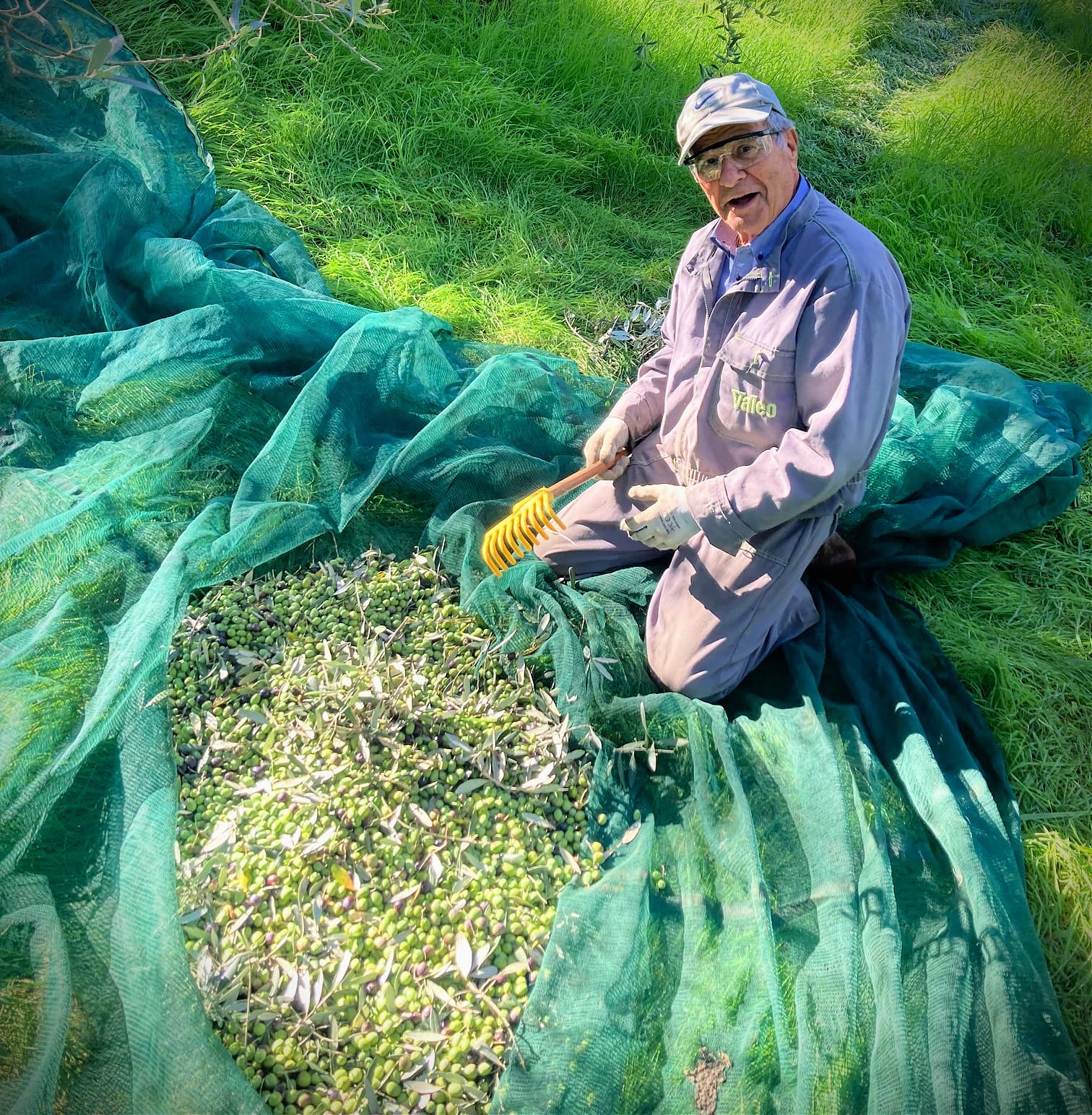
A harvester at work at Fattoria Poggio di Fiesole
“We have always practiced no tillage, a method that avoids turning the soil to protect its structure, reduce the risk of erosion, and improve water absorption,” Hebel specified. “We cut the grass only once during the hottest days of the summer, maximizing water retention and supporting biodiversity. Our groves are alive with beneficial insects. During pruning, we shred the cuttings and leave them on the ground to serve both as an additional source of organic matter and as mulch.”
Sustained by these practices and by their own maturity, the olive trees flourish without the need for irrigation. Still, after challenging years of drought, the return of more frequent rains during the warm months in the last two years has proved especially beneficial.
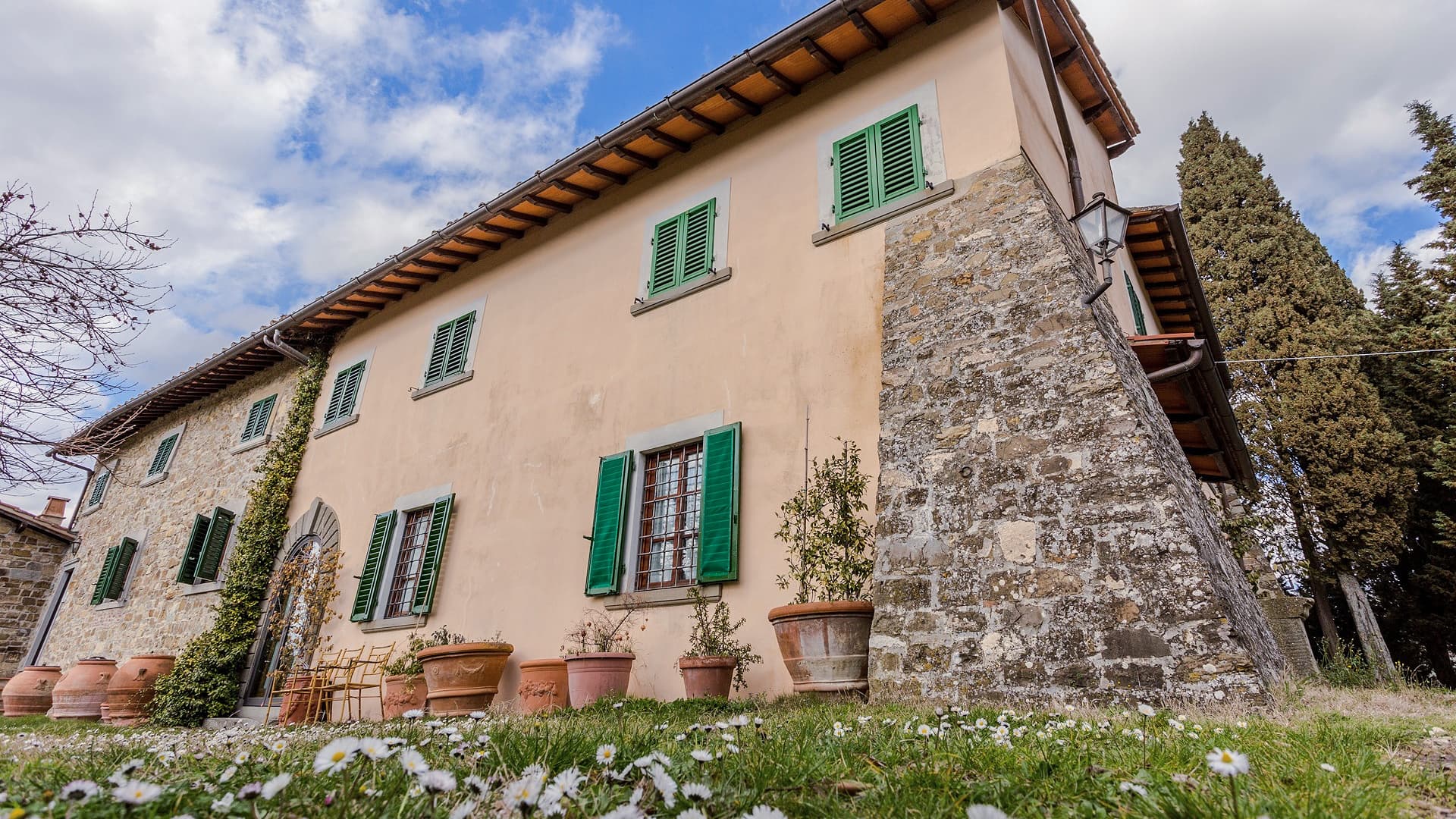
A farmhouse at Fattoria Poggio di Fiesole
“We have witnessed how climate change can bring unexpected shifts, along with the growing threat of extreme events, like sudden cloudburst that can be a real threat,” Hebel added. “In all conditions, we always strive to achieve the highest quality. Considering that olive trees have different exposures and develop at slightly different times, one variety may prevail over another depending on the year. Still, they always come together to form a perfect harmony in our blend.”
The olives are crushed at a local mill that boasts state-of-the-art technology. The harvest usually begins in early October and continues through November. The company has relied on the same local harvesters for the past thirty years, honoring their expertise and strengthening community bonds.
The company organizes tours, inviting guests to explore the property’s culture and history. The farmhouse, once home to nuns and later a celebrated meeting place for yogis and thinkers, now stands as a refined hospitality retreat. Guests can take part in guided tastings of olive oil and honey produced from hives on the estate.
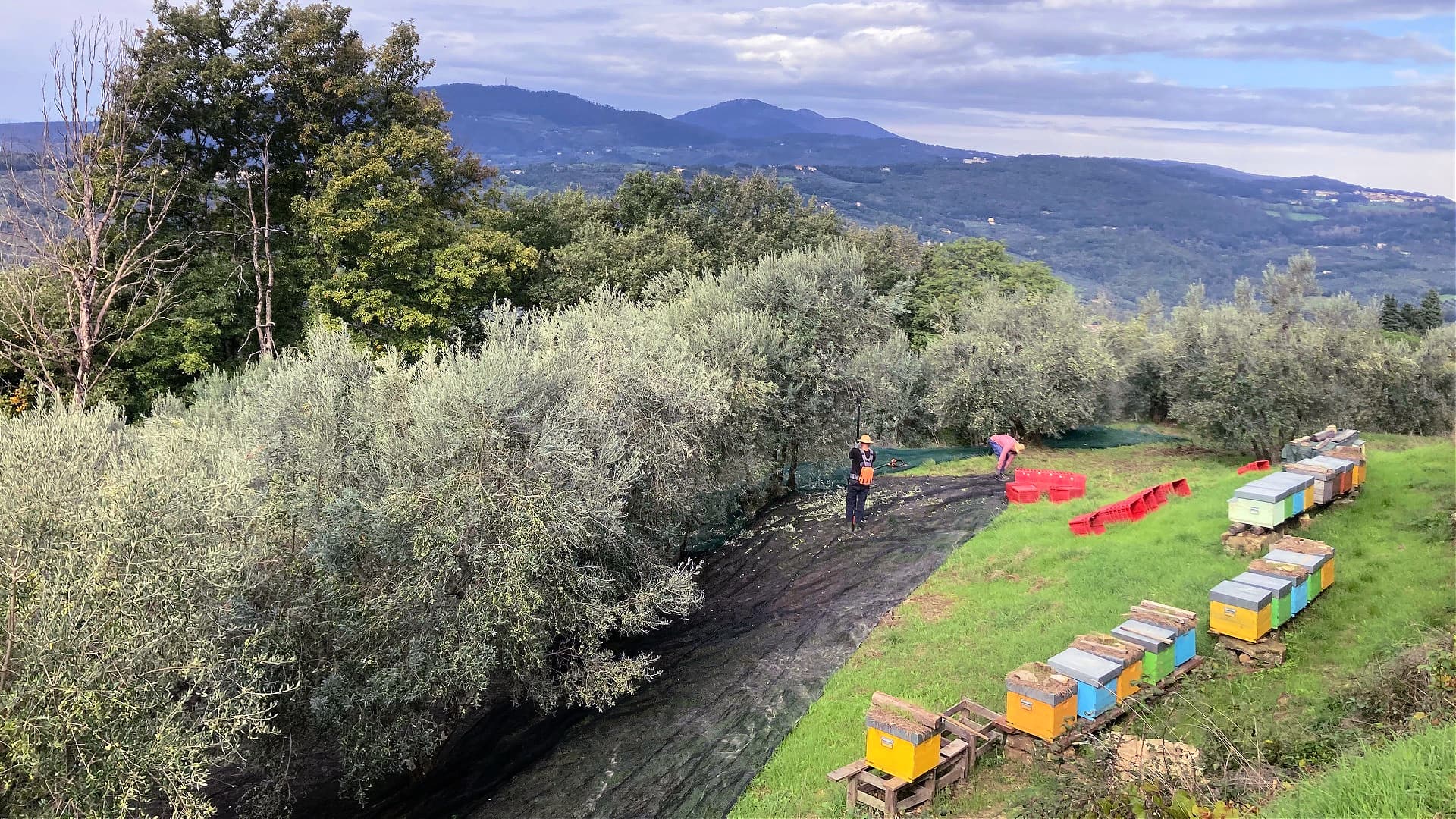
Hives bordering an olive grove at Fattoria Poggio di Fiesole
“We would like to gradually reintroduce sheep, as in the estate’s original tradition, since their presence would benefit the olive grove,” Hebel said. “We are currently evaluating how to organize a small herd, among the many projects we are nurturing.”
“My uncle had the patience to carry his choices forward despite the skeptics, having the vision to see beyond his time,” Hebel added. “Today, as we live and work on this pure land, we recognize the gift he gave us, and we are proud to continue his path, aiming for the highest quality while safeguarding the beauty and health of this treasured territory.”