An Aleppo Tradition is Revived in Paris as France’s Own Soapmakers Duel
When the ongoing war put an end to Samir Constantini’s plan to open his own factory in Aleppo, he began to make soap in the Syrian tradition on the outskirts of Paris. Is it still Syrian? France has its own bubbling controversy.
Syrian soapmaker Hassan Harastani was forced out off Aleppo by years of brutal war during which the city’s famous Aleppo soap became one of the casualties.
The maze of alleyways which once made up the ancient city of Aleppo used to house some 60 soap factories before it was reduced to rubble. The distinctive fragrance of olives and laurel which once wafted from the soap factories producing ‘Aleppo’s Green Gold’ have long been overpowered by the stench of smoke and rotting rubbish.
We make it here the same way we make it at home: there’s olive oil, laurel leaves, water-only natural ingredients.
Samir Constantini a Franco-Syrian doctor and businessman began importing Aleppo soap to France in 2004. His plan had been to open a soap factory on the outskirts of Aleppo with Harastani. When the ongoing war prevented this Constantini resorted to opening a factory in Santeny, 30 km from Paris. The Syrian soap makers sell their Aleppo Green Gold under the brand name Alepia online and from a shop in Angers.
Constantini is adamant that Aleppo soap produced in France is still Syrian. “If a top French chef opens a French restaurant in New York it remains French cuisine, not New York cuisine. It’s the same for the soap. It is made by the master soapmaker Harastani and is, therefore, proper Aleppo soap,” he insisted.
Harastani agreed: “We’ve been making Aleppo soap for 3,500 years — well before Jesus Christ. We make it here the same way we make it at home: there’s olive oil, laurel leaves, water-only natural ingredients.”
“We could no longer go to the factory because of the shelling and kidnappings,” said Harastani, who is determined to keep the Aleppo soapmaking tradition alive. Harastani now pours the traditional soap making secrets passed down by his father, into bubbling cauldrons of olive oil and laurel oil which morph into Aleppo soap on French soil.
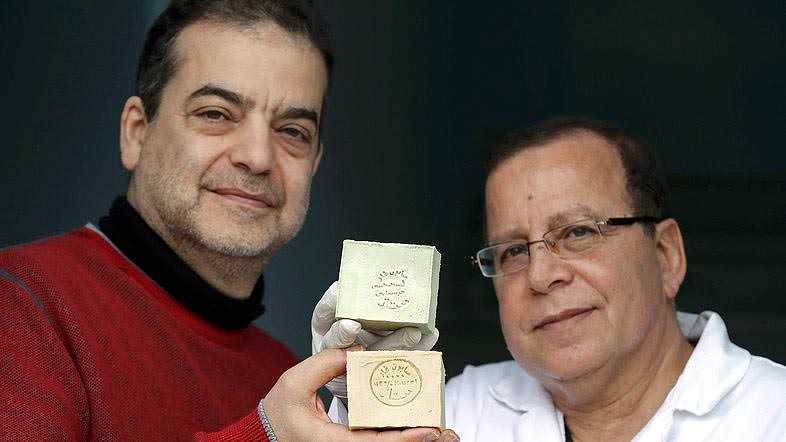
Samir Constantini and Hassan Harastani
The Syrian soap industry was already under threat before Aleppo’s soap factories were destroyed by shelling. According to Syrian businessman Safouh-al Deiri who has exported Aleppo soap to France since the 1980’s, cheap imitations were being passed off as genuine Aleppo soap as long ago as 2010.
France’s own iconic olive oil soap, Savon de Marseille, is currently embroiled in its own bitter battle. Two rival groups of Marseille soapmakers are in a legal fight over what constitutes genuine Marseille soap. Relations between the warring soapmakers have disintegrated to the point that the rivals will only communicate through a third party.
The Association of Makers of Savon de Marseille (AFSM) led by luxury cosmetics company L’Occitane is demanding the right to add perfumes to the soap and insisting the soap is given a geographical indication (GI), as is granted to wines and cheeses to distinguish them from cheap imports.
Traditionalists have formed their own association, the Union of Professionals of Savon de Marseille (UPSM). Their aim is to protect the original recipe and they insist that true Savon de Marseille can only be produced by artisanal soapmakers from the Bouches-du-Rhone region of France.

Savon de Marseille
In true ‘soap opera’ style the fate of Savon de Marseille will be decided by the French government. If granted a GI, Savon de Marseille will become the first manufactured item to obtain the stamp which is currently exclusive to food and drinks.
One French cosmetics company not getting into a froth over the controversy is La Maison de Savon de Marseilles. The company’s range includes traditional Marseille soap, scented soaps and Aleppo soap. They credit Aleppo soap as being the predecessor of Savon de Marseille, stating on their website ‘Originally Marseille soap was inspired by a soap that had existed in Syria for thousands of years, Aleppo soap, which is a mix of olive oil and laurels.’
Aleppo soap which is believed to be the world’s oldest soap is attributed with keeping Cleopatra’s skin clean and silky. Europe was introduced to Aleppo soap in the 11th century by The Crusaders.