



7th-Grader Finds Cancer-Fighting Chemical in Green Tea
A middle-schooler's intellectual curiosity led to a home lab experiment that showed an antioxidant in green tea holds promise for cancer prevention.
 Stephen Litt
Twelve-year-old Stephen Litt discovered a compound in green tea that prevented cancer in flatworms, winning him local and state science awards. Stephen’s project was motivated by a desire to help two family friends diagnosed with breast cancer and may lead to further research involving human breast cancer cells.
The world may be one step closer to having a cure for cancer — thanks to the work of a 12-year-old’s science project. Seventh-grader Stephen Litt from Georgia discovered a compound in green tea prevented cancer in a type of flatworm.
The scientific community knows about EGCG, but no one has been able to obtain these results in any kind of living system.
Stephen’s project began when two family friends were diagnosed with breast cancer. After reading about the disease, he found that a reduced incidence of malignancy in Japan is associated with the antioxidants in green tea.
This knowledge served as the motivating force behind his experiment to test the hypothesis that a polyphenol in the tea could suppress the development of tumors in worms exposed to carcinogens.
First, Stephen and his dad, Lesley Litt, purchased the materials online to construct a makeshift home laboratory. Next, the teen started the four-week project by dividing 100 planaria, a type of flatworm, into four groups.
One group received exposure to only a compound called epigallocatechin-3-gallate (EGCG), while a second group received exposure to EGCG for 24 hours followed by contact with two carcinogens for the remainder of the study. The third group underwent exposure to the two carcinogens without the EGCG, and the fourth group was the control group, receiving exposure only to spring water.
The carcinogens chosen for the project were Cadmium Sulfate and 12-O-Tetradecanoylphorbol-13-acetate, or TPA. Stephen’s dad, a chemist, mixed them himself to prevent his son from having contact with the dangerous agents.
Planaria were selected because they contain neoblasts, a variety of stem cells that act similarly to cancer cells. Stephen theorized that hindering the normal functioning of the neoblasts could lead to a possible cure for cancer.
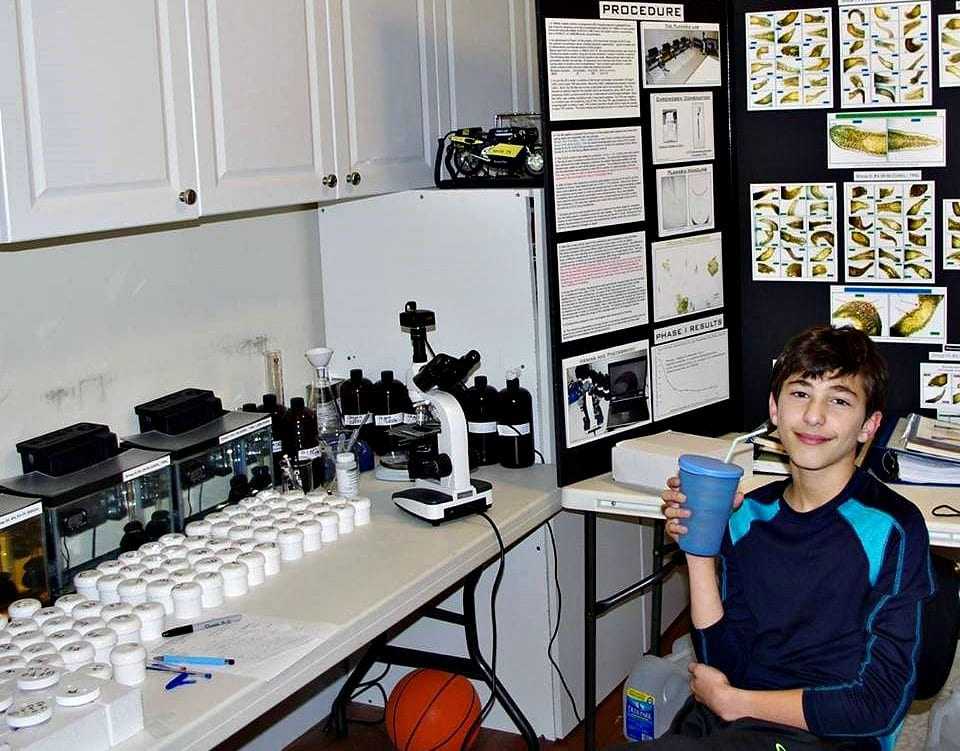
Stephen Litt
Using a microscope given to him by his grandparents, Stephen carefully documented the results and found the planaria exposed to both EGCG and the carcinogens didn’t develop any tumors during the intervention period. Conversely, all the planaria exposed to the carcinogens alone did develop tumors. The project won local and state science awards.
In an interview with Olive Oil Times, Stephen and his dad shared their thoughts about the experience. “I didn’t expect my original hypothesis to work, so the results made me feel relieved and amazingly good,” Stephen said.
“I was a little skeptical of the findings at first. It’s very rare to get a slam-dunk in a study,” the elder Litt said. “He did something nobody else has ever done. The scientific community knows about EGCG, but no one has been able to obtain these results in any kind of living system.
“Because the study was confined to four weeks, we don’t know if the planaria would have developed tumors later. However, the fact that no tumor formation occurred within that timeframe is remarkable.”
So just what makes this aspiring scientist tick? He is a well-rounded teen who is active in the Boy Scouts and is accomplished in karate, tennis and playing the oboe. Yet perhaps it is his intellectual curiosity that most sets him apart. This attribute will undoubtedly equip him for a bright future in research if he chooses to enter it.
“Stephen reads up on things and wants to figure out how things work. That’s pretty much what research is,” Lesley Litt said.
What is next on the teen’s agenda? “He wants to transplant human breast cancer cells or pieces of tumors into worms and test the effects of EGCG on them,” Litt said. We eagerly await the results of Stephen’s next research project.
Related Articles
Oct. 1, 2025
Swiss Psychiatric Hospital Adopts Olive Oil for Patient Health
Extra virgin olive oil is replacing other fats in the PDAG in Switzerland, in a decision driven by scientific evidence.

Aug. 25, 2025
Compound Found in Olive Oil Boosts mRNA Vaccine Effectiveness and Safety
Incorporating a phenol group found in olive oil into the mRNA vaccine delivery mechanism mitigated the most common side effects of the vaccine while improving efficiency.
Jun. 28, 2025
Oleacein: The Promising Phenolic Compound in Extra Virgin Olive Oil
Oleacein, a phenolic compound found in extra virgin olive oil, has antioxidant, anti-inflammatory, and potential anti-atherosclerotic properties with significant impacts on human health.

Oct. 9, 2025
Olive Tree Emerges as Symbol of Interconnected Health and Sustainability
A new review led by Yale researchers highlights the olive tree’s unique role in connecting human, animal, and environmental health — a living model of the “One Health” approach to sustainability.
Mar. 17, 2026
New Research Suggests Olives May Reveal Oil Quality Before Milling
A new study suggests that analyzing the metabolic profile of olives before extraction could help predict some of the chemical and sensory characteristics of the oil they will produce.

Feb. 2, 2026
Study Finds Virgin Olive Oil Linked to Better Gut Health and Slower Cognitive Decline
New research suggests that virgin and extra virgin olive oil may support brain health by shaping the gut microbiota, while refined oils show weaker effects.
Jun. 11, 2025
EFSA Panel Rejects Some Olive Oil Polyphenol Health Claims
The panel rejected two submissions from Italy and Spain, stating that the scientific evidence fell short of the requirements.
Apr. 14, 2025
Study Shows Potential Health Benefits of Hydroxytyrosol
Hydroxytyrosol, a phenolic compound found in extra virgin olive oil, can lower levels of oxidized LDL cholesterol and may have potential cardiovascular and neuroprotective benefits.