Archaeologists Uncover Massive Roman Olive Oil Complex in Tunisia
Archaeologists excavating Henchir el-Begar in central Tunisia have uncovered one of the largest olive-oil production complexes of the Roman world, complete with monumental beam presses.
Ancient monumental machines capable of pressing tons of olives — and possibly wine — are being unearthed in Tunisia.
Real wealth came from large agricultural estates like Henchir el-Begar, where olive oil was produced on an industrial scale for export.
A new archeological project is focusing on the excavation at Henchir el-Begar in Tunisia’s Kasserine province.
The thirty-three-hectare site is believed to have housed the largest, or one of the largest, olive oil production districts in the Mediterranean. Remains of a rural vicus, including houses and trackways, have been identified.
Active between the third and sixth centuries CE, the estate produced far more olive oil than was needed locally, supporting a vast export network across the Mediterranean.
“The site itself has been known for some time. In the mid-19th century, a really important inscription was found there, which identifies the site as a senatorial estate,” David Mattingly, professor of Roman Archeology at the University of Leicester in the U.K., told Olive Oil Times.
Mattingly, who is not involved in the current excavations, has authored numerous studies on ancient olive oil production at Henchir el-Begar and across North Africa.
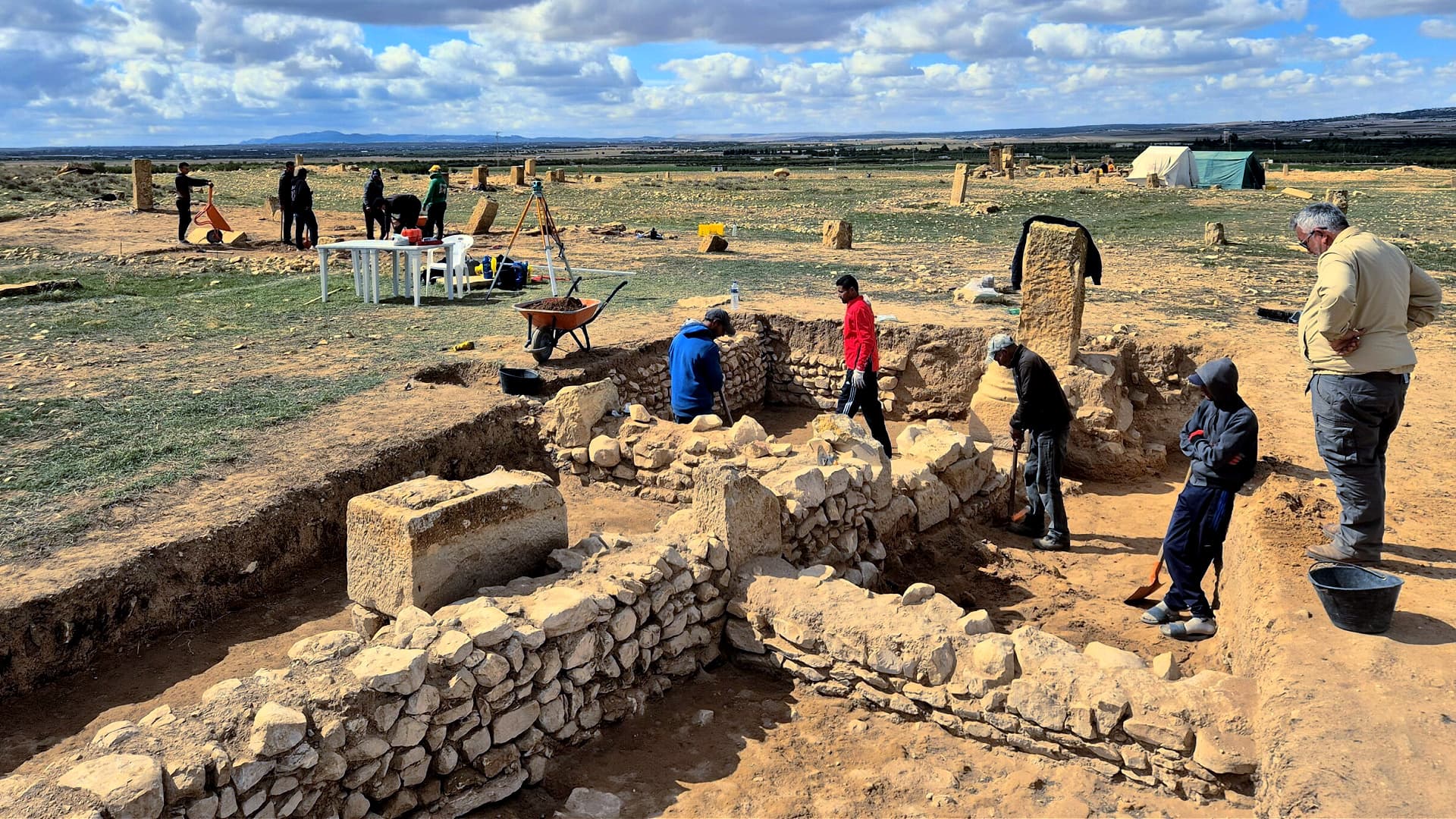
(Photo courtesy of Ca’ Foscari University of Venice)
The new project began in 2023 and has since expanded through a collaboration among the University of La Manouba in Tunisia, the Complutense University of Madrid in Spain, and Università Ca’ Foscari in Venice, supported by the Italian Ministry of Foreign Affairs.
“The co-investigator of the new excavation project, the Tunisian archeologist Samira Sehili, in the 1990s did some initial survey where she recorded the basic plan of those great olive oil production buildings,” Mattingly noted.
The estate lies in the steppes of the Jebel Semmama massif, where olives thrive despite limited rainfall.
It includes two large industrial buildings housing at least twenty beam presses — likely among the largest in the ancient world.
“The size and scale of these devices is impressive,” Mattingly said. “As the excavations go on, we can hope for many more details to emerge.”
“Up to this moment, we can estimate that each one of those devices could process something like 12,000 to 18,000 kilos of olive oil a year,” he added.
According to decades of research by Mattingly and others, the beam presses at Henchir el-Begar were massive wooden lever machines built for industrial output.
“The beam press is also known as a lever press, because it functions on the basic principle of the lever,” he explained. “In North Africa, some of the largest presses have a beam of nine to ten meters in length, which is enormous in scale.”
The long tree-trunk beam was anchored between tall stone uprights. A massive counterweight block, equipped with a windlass, was attached to the free end to generate immense pressure.
“Stone uprights such as those in North Africa are one of the most outstanding visual impressions of the presence of presses,” Mattingly said. “We get these pairs of monoliths with a capstone. They look a little bit like prehistoric monuments. One’s mind could go to Stonehenge. But they are very clearly parts of these beam presses.”
Workers raised the beam using ropes and pulleys, then stacked large baskets of crushed olives on a stone base beneath the fixed end.
“On top of that press bed, they piled up baskets of pulped olives,” Mattingly said. Each basket could be one meter wide — far larger than modern pressing mats.
The gap between the beam and the base reveals the volume being pressed. “We can calculate, within certain margins, the height to which these baskets were stacked up,” Mattingly noted.
“The highest height beneath the press beam that I’ve recorded is over two meters. So, if you think about a stack of one-meter-wide baskets that goes up to about two meters in height, you’ve got almost a ton of olives in a single pressing.”
As the beam was lowered, a massive counterweight increased pressure, slowly squeezing oil into nearby channels and vats. “The beam itself could weigh tons. That contributed to the pressure within the press,” Mattingly noted.
The system allowed adjustments during pressing to keep the stack stable and maximize extraction.
“Often they have a number of square holes pierced in these uprights, which allow that end of the press beam to be adjusted … for different volumes of olives under the press beam,” Mattingly said.
Such a large press may have completed one pressing per day. “It would take most of the day and possibly the night to extract the maximum,” he noted.
Excavation may clarify how the presses connected to various receptacles. “They could have been storing different qualities of olive oil,” Mattingly explained.
Channels leading to storage vats and evidence of olive mills point to substantial local cultivation — and possibly wine production.
The presses may not have been limited to olives. “The same type of presses could have also been used for wine production,” Mattingly said, noting future excavations may reveal grape-processing installations.
Ground-penetrating surveys indicate a sizeable settlement, likely housing tenant farmers and seasonal laborers who sustain large-scale export agriculture.
“What’s really crucial here is the excavation now taking place. Given the importance of archaeology in Tunisia and of olive oil in the economy of the country, both ancient and modern, it is a paradox that so little investigation has been made of rural sites,” Mattingly remarked.
The ancient agro-industrial hub known as Saltus Beguensis was a prestigious senatorial estate with economic reach far beyond its rural surroundings.
Moving oil from Henchir el-Begar to the coast required a demanding overland journey. “One can imagine literally hundreds of greasy-back donkeys going backwards and forwards,” Mattingly said.
The site’s importance is underscored by a mid-second-century inscription that records imperial authorization for a twice-monthly market — a privilege that required a formal application to the emperor.
“You couldn’t just say: I’ll have a market on my estate. You have to apply for permission to the Roman Emperor,” Mattingly explained.
These markets supported trade and helped attract seasonal labor, which was essential for large-scale production.
According to Mattingly, visitors to Roman North Africa often admire the monumental architecture but rarely grasp the agricultural engine behind it.
“Real wealth came from large agricultural estates like Henchir el-Begar, where olive oil was produced on an industrial scale for export,” he said.
“It is really fantastic that we now have a project that seems to be starting this investigation,” Mattingly added, suggesting the site could one day support oleotourism.