Among Brazil’s Rocky Hills, Azeite Pedregais Cultivates Award-Winning Olive Oils
In Brazil’s rugged Serra do Sudeste, Azeite Pedregais transforms rocky terrain and relentless winds into award-winning extra virgin olive oils.
Some of the finest olive oils in the world are crafted in Brazil among the pedregais—the distinctive rocky outcrops rising from the landscape of the beautiful Serra do Sudeste in the southernmost part of Rio Grande do Sul.
This ancient plateau, more than 400 meters above sea level, is home to Azeite Pedregais’ award-winning extra virgin olive oils.
The company’s extra virgin olive oils earned two more awards at the 2025 NYIOOC World Olive Oil Competition, Southern Hemisphere edition. In just the past four years, Azeite Pedregais has received eleven awards in New York—nine of them Gold.
“Ours is a wonderful landscape; its formation dates back to the Precambrian period, 4.6 billion years ago. It used to be a plateau that has been eroded over time,” said Flavo Fernandes, co-owner of Azeite Pedregais, in an interview with Olive Oil Times.
“Therefore, our soil is stony and granitic, which favors drainage. Our planting areas are located on gently sloping hillsides, and we still preserve many forested areas surrounding the olive groves,” he added.

Nestled among the rocky outcrops of Brazil’s Serra do Sudeste, Azeite Pedregais crafts award-winning olive oils shaped by stony soils, steady winds, and passion for nature.
Fernandes and his wife, Mirella Meirelles—both physicians—came to olive farming out of a desire to reconnect with nature after an internship in Salamanca, Spain, where they learned more about olive oil.
In 2017, the couple found a suitable area to plant their olive trees, selecting varieties known for resilience and production quality. “We also took a chance on two cultivars that were not very common, Frantoio and Manzanilla, and did not plant Arbosana, which here requires a lot of care and suffers from humidity,” Fernandes explained. “In this area, humidity can become quite intense at certain times of the year.”
Over time, their olive farming activities expanded across three distinct areas, each requiring a specific approach to cultivation and enriching the diversity of production. Some of those groves are still in early stages of development.
“The first, main grove, which we call Pioneiro (‘Pioneer’ in Portuguese), was planted using a ridge system where the trees are raised above ground level,” Fernandes said. This system improves drainage but can also worsen the effects of extreme drought. “We have gone through some of them too,” he noted.
The main grove produces most of the farm’s olives, with cultivars such as Koroneiki, Arbequina, Picual, Frantoio, Pendolino, and Manzanilla.
The other two groves were planted in 2020, after several seasons of experience. “In June 2020, when we planted the other two groves, we did not use the ridge technique, as we learned it wasn’t necessary,” Fernandes said.
One grove was named Tapera, a Portuguese word that nostalgically evokes the restoration of an old farm, recalling the countryside’s past. There—and in the third plot, Poente (“West”)—the team planted other well-known cultivars such as Galega and Coratina. “We expect our first Coratina olives to be ready in 2026,” Fernandes added.
One of the defining features of the region is the wind, which can at times become extreme. “Wind is a constant feature of our region, sometimes blowing continuously for several days,” Fernandes said. Maintenance practices must be adapted accordingly.
“With some cultivars, such as Manzanilla and Coratina, we tie the branches of the trees to the ground to achieve the ideal productive shape and prevent the branches and trunks from getting too damaged from constant rubbing,” he explained. This practice continues for several years during the trees’ maturation and has proven essential for their proper development.
Because of the wind, pruning is also designed with airflow in mind. “We always direct the branches sideways, not upwards, so they do not constantly suffer from the sail effect. Branches with less leaf volume and length are also less affected by the wind,” he said.
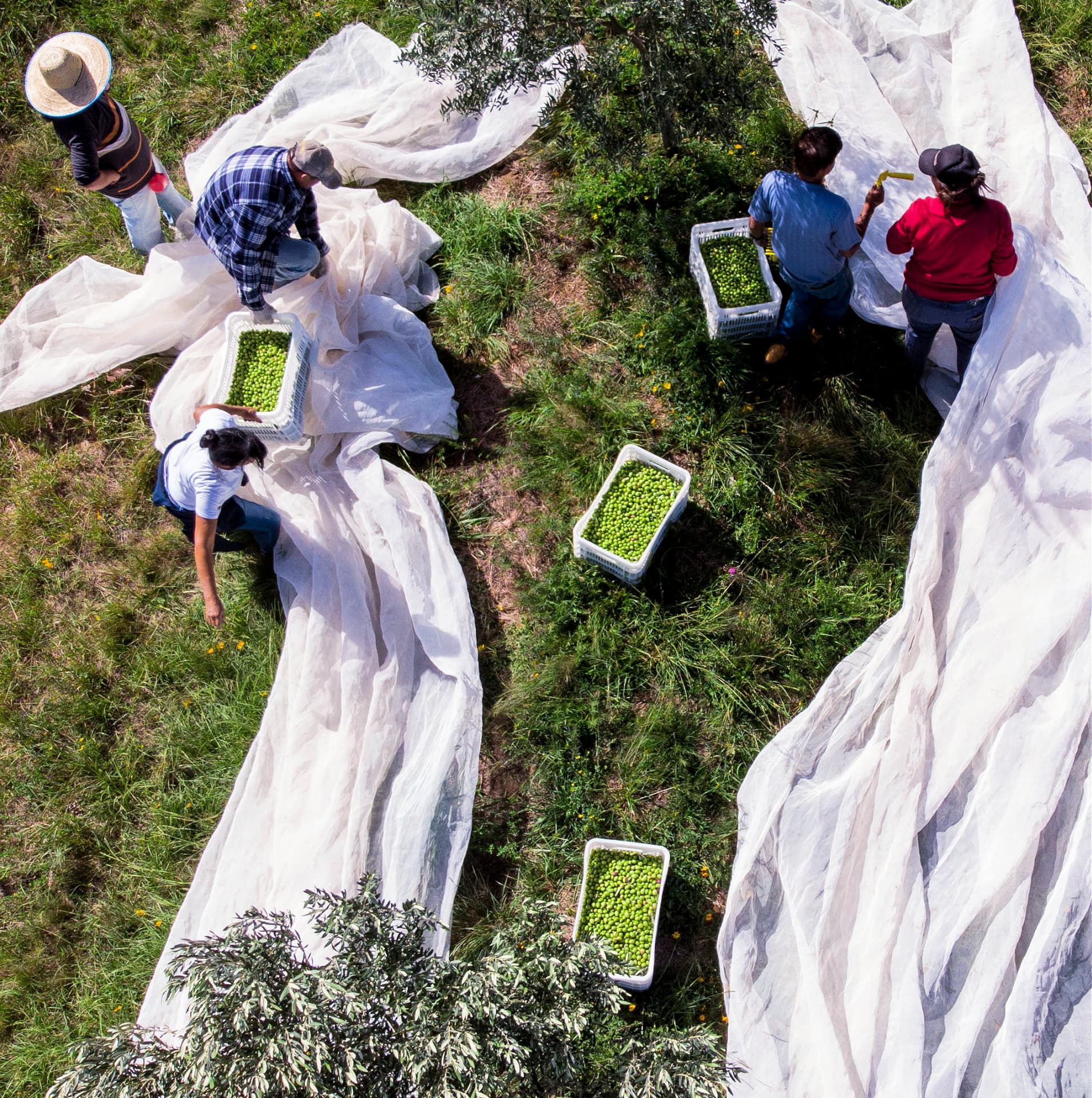
Harvesting olives among the rocky hills of Brazil’s Serra do Sudeste, Azeite Pedregais combines careful cultivation and respect for nature.
The farm also raises sheep of prized local breeds, whose manure serves as a natural fertilizer. “Adding to that, quite picturesquely, there are many wild capybaras in our groves. They keep the vegetation low and fertilize large areas of the plantation,” Fernandes explained. “These capybaras settled by the ponds, reproduced, and stayed. They’re quite an unusual sight in the olive landscape—groups of capybaras walking up and down with their young.”
For milling, Azeite Pedregais partners with Fazenda Sabiá, a renowned producer whose olive oils have also won Gold Awards in New York. “They have been our partners since the beginning, and we know how important it is to have the support of such a recognized brand,” Fernandes said.
In Brazil, not all producers are located near olive mills. “Ours is just a short distance away, which allows pressing to take place almost immediately after harvesting,” he noted.
According to Fernandes, olive oil production and culture are still relatively new in the region. “The challenges keep evolving,” he said. “We rely on the experience of local farmers, other South American growers, and European ones.” That knowledge must then be adapted to local climatic, rainfall, and soil conditions.
“For these reasons, we can’t simply hire a fully trained professional—we have to develop our own,” he added. “Fortunately, our city has a technical agricultural school that provides young people with training in olive growing, which is very important.”
For this high-quality Brazilian producer, the next step is investing in oleotourism—both to promote extra virgin olive oil, still new to most consumers, and to diversify income sources. “We will soon offer visits and tastings at Fazenda Santa Joana D’Arc, where we have our olive groves, stainless steel storage tanks, and a shop,” Fernandes said.
“Other properties in our region, along the same road, will also offer oleotourism experiences, which will be very important for everyone,” he added. “It’s a development area that should always be collaborative, involving not only olive oil producers but also makers of other local goods from our region.”