Officials Outline China’s Olive Oil Future at Hubei Conference
Officials and experts expressed optimism about the olive oil sector, touting new varieties and government support while acknowledging the need for innovation, coordinated policy, and consumer-focused production.
This is the first in a series of reports on the evolution of China’s olive oil industry.
YUNYANG, China – Chinese officials struck an optimistic tone at an olive industry conference in Yunyang, which hosted more than 200 politicians, Communist Party officials, local and international researchers and journalists.
The district, located in northwestern Hubei province about 930 kilometers southwest of Beijing, is at the center of a strategic effort in China to promote olive cultivation and olive oil production as part of the country’s broader food security initiative.
Our agriculture system is transforming from a traditional to a next-generation one, but in our industry, this is not the case. If we don’t start on this road, we will fall behind.
Yunyang was one of a few places in China where olive cultivation took root after Albanian leader Enver Hoxha gifted the country 10,000 seedlings in 1964.
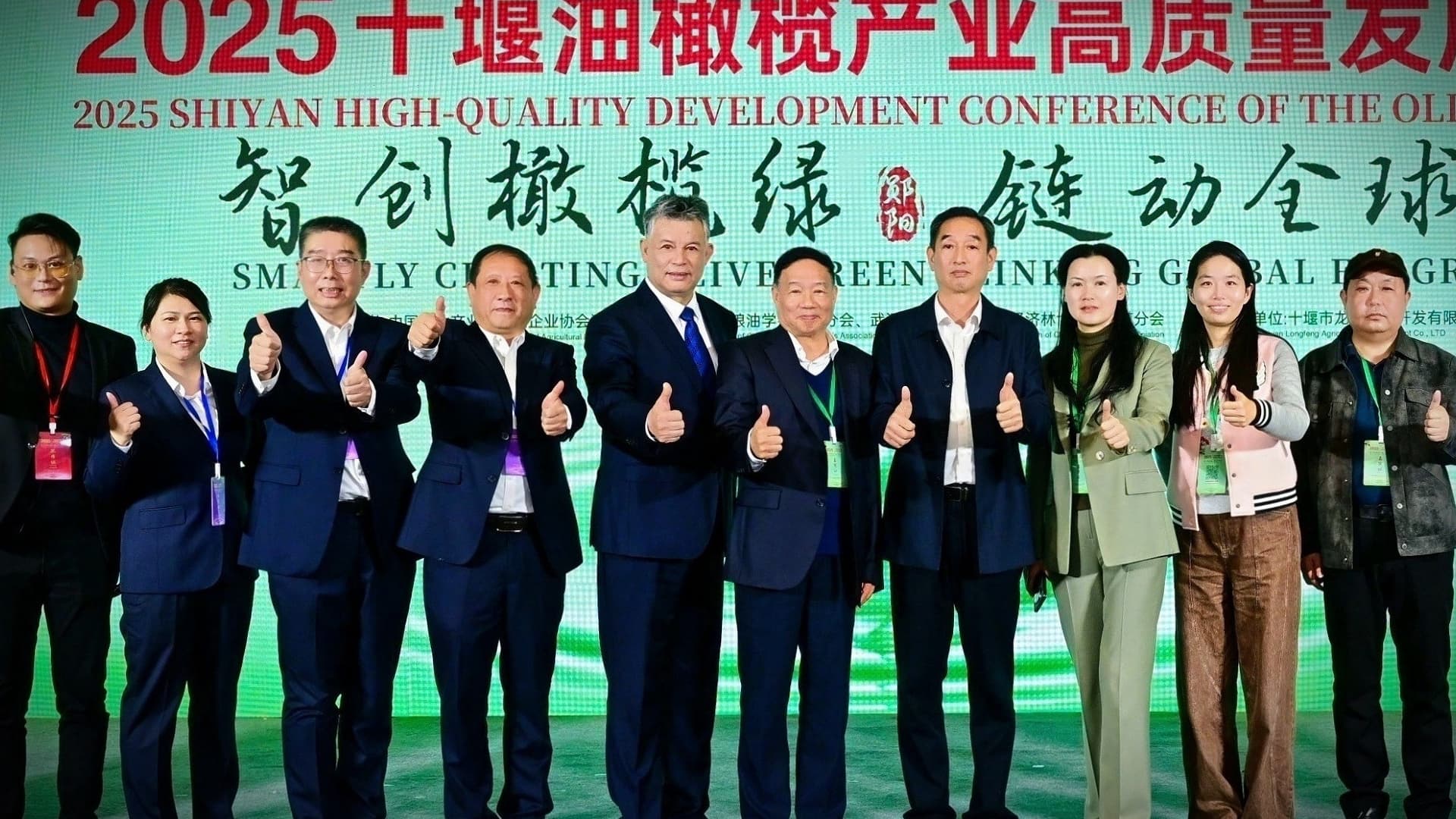
A two-day conference in Yunyang, China brought together local politicians, researchers and olive oil producers to discuss the sector.
However, Chinese and international researchers identified and discussed the hurdles that still face the sector, ranging from agronomic practices to consumer habits.
According to Ender Gündüz, the former head of the International Olive Council’s economy and promotion unit, who has spent decades studying the Chinese olive oil market, the country boasts “huge potential” as consumers become more aware of the health benefits of olive oil.
See Also: Postira Hosts International Olive Oil Symposium Highlighting Regional ExcellenceHe estimates there are 250 million potential consumers, primarily concentrated in urban areas, in the world’s second most populous country. However, he called on local producers and exporters to meet the expectations of Chinese consumers for the product.
As is customary in China, the conference followed a carefully coordinated protocol, including praise for the accomplishments already made and the announcement of ambitious targets moving forward.
Liu Shuren, an advisor to the Chinese Forestry Industry Federation, under whose auspices olive cultivation falls, praised the progress made in variety breeding research, pointing to 11 new Chinese varieties tailored to the climate and local taste preferences.
“The olive industry should always prioritize research and innovation, including the incorporation of olive oil tourism and poverty alleviation,” he added.
Shuren further emphasized the need for the sector’s continued momentum, including investment from both the public and private sectors, as well as coherent government policy.
Striking a more bullish note, Liu Shenli, the president of the Chinese Association of Business Leaders in the agriculture industry, said the domestic edible oil industry, including olive oil, could follow the path of wind and solar in the country.
International Energy Agency data show that electricity production from wind and solar in China increased by more than 8,000 percent from 2000 to 2023, spurred on by a previous strategic objective to reduce the country’s reliance on fossil fuel imports.
Shenli added that 30 percent of domestic edible oil consumption meets domestic demand, with a strategic goal announced for the next Five-Year Plan to increase this total.
According to He Dongping, president of the oils and fats section of the Chinese Grain and Oils Association, China consumed 40 million tons of edible oil in 2024, equivalent to approximately 29 kilograms per capita.

He Dongping has spent decades working to promote China’s olive oil industry, including the establishment of national standards.
“If each Chinese person were to consume 0.5 kilograms of olive oil per annum, this would be a tremendous figure,” added Wang Ruiyuan, the chairman of the expert committee of the China Grain and Oil Industry Association.
He called on China’s world-leading industrial sector to meet the needs of its olive oil producers, including manufacturing olive milling equipment domestically to compete with well-known brands mainly sourced from Italy and Turkey, and utilizing its massive network of researchers to provide the necessary knowledge base.
While China, which imports 78 percent of the olive oil it consumes, will be reliant on foreign olive oil for the foreseeable future, Dongping indicated that local producers have the opportunity to produce oils tailored to the tastes of the Chinese consumer.
“By optimizing cultivation, harvesting, and pressing processes, we aim to produce olive oil that better suits Chinese-style cooking—capable of withstanding light stir-frying while enhancing the flavor of cold dishes,” he told Olive Oil Times.
“This approach not only aligns with local culinary habits but also achieves product differentiation, making ‘local flavor’ a distinctive and compelling selling point,” Dongping added.
While no China watcher will be surprised at the effusive praise for the sector’s progress and government efforts to promote olive cultivation, Li Peiwu from the Chinese Academy of Science’s edible oil cultivation research institute highlighted the challenges facing the sector.
“The core support of the olive seedling industry needs to be strengthened,” he said. “The special seedling selection and breeding promotion system suitable for the local environment, high yield and high quality is not perfect.”
“The planting and cultivation management technology needs to be upgraded urgently, standardized, accurate and intelligent,” Peiwu added. “The integration of the industrial value chain needs to be improved… In the future, the olive industry urgently needs to strengthen scientific and technological breakthroughs and break through industrial bottlenecks.”

Yu Ning told attendees that China must make the most of its late starter advantage.
Yu Ning, vice president of the olive section of China’s Forestry Economics Association, said the Chinese olive oil sector has the potential to benefit from the late starter advantage, provided it finds a unique point of leverage to achieve this.
He advised the conference to capitalize on the successes and lessons learned from so-called Old World producers, specifically adopting a “comprehensive industrial system” as its point of leverage while maintaining a balance among the needs of growers, millers, and sellers.
Ning cited China’s dominance in the field of applied industrial robotics as one potential source of leverage that could lower production costs while maintaining quality.
He added that research and development, another area of strength in China, would be necessary to determine the best place to start.
“Our agriculture system is transforming from a traditional to a next-generation one, but in our industry, this is not the case,” he said. “If we don’t start on this road, we will fall behind.”
Dongping further highlighted the role of olive farmers and olive oil producers in achieving this transformation.
“Farmers and millers are not merely passive recipients of research outcomes; they are our ‘frontline scientists’ and indispensable partners in research, playing an irreplaceable role,” he said.
“Every new planting technique, improved seedling variety, or piece of processing equipment must be tested in real production settings,” Dongping concluded. “Farmers and millers provide us with vast living laboratories, and their feedback directly determines whether a technology can be effectively promoted across the industry.”