Meet the Retailers Working to Grow Oleotourism Sales After the Vacation Ends
Alicia and Vijay Shroff, co-owners of an olive oil specialty store, have launched a project to deepen the connection between oleotourism operators and visitors.
Two years of poor harvests across the Mediterranean, soaring production costs and a global cost of living crisis have squeezed the margins of many of the world’s small-scale olive oil producers.
These farmers and millers are seen as the guardians of local olive oil traditions and cultivars, so finding alternative revenue streams to keep their operations profitable is critical to the success and health of the wider sector. (Deoleo chief executive Ignacio Silva certainly thinks so.)
While selling carbon credits and olive oil production waste products are among the ideas frequently floated at conferences and industry association gatherings, tourism remains a significant source of revenue for producers, many of whose groves are located amid spectacular scenery.
See Also: Croatian County Recognizes the Role of Award-Winning Producers in Promoting TourismHowever, Alicia and Vijay Shroff, co-owners of the St Louis, Missouri-based specialty store Extra Virgin an Olive Ovation, have identified a problem many international visitors to Mediterranean olive groves experience and are working on a solution.
“The problem that I suspect most oleotourism producers have is what I call the ‘checked baggage problem,’” Vijay said. “When you’re abroad, you probably don’t want to come home with multiple bottles of olive oil in your checked bag, which limits the sales for the producers on site to one or two bottles.”
The Shroffs encountered this issue when visiting the groves and mill of Andalusia-based Basilippo. Unlike many oleotourism enthusiasts, however, they were well placed as wine, extra virgin olive oil and specialty food retailers to solve the issue.
“We will be their sales fulfillment outfit for their American visitors,” Vijay said. “That accomplishes a lot of things. It solves the check baggage issue, and it should solve the shipping cost issue.”
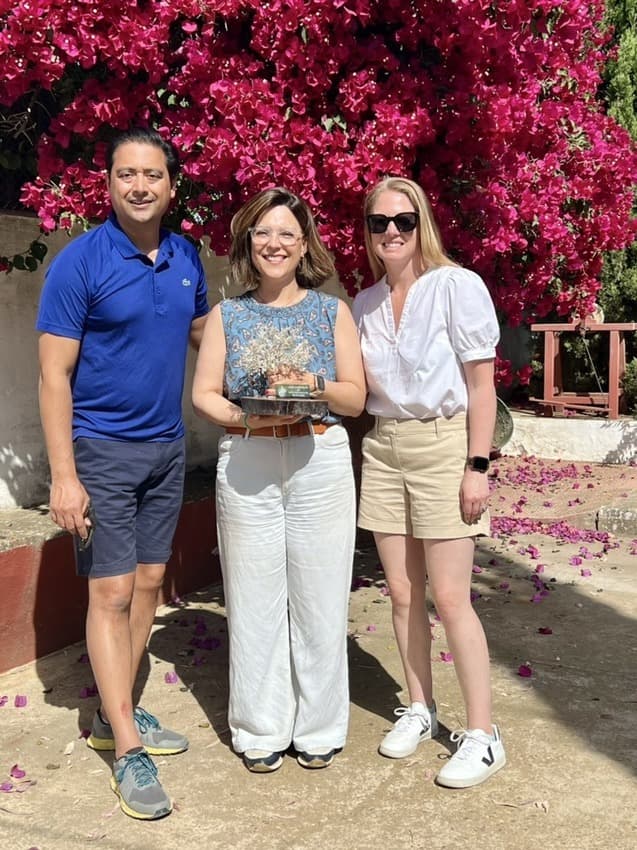
Vijay (left) and Alicia (right) Shroff import Juana Roldán’s Basilippo extra virgin olive oil, so the farm’s American visitors can continue the experience.
“It’s a lot more efficient to import by the pallet and then use domestic fulfillment services [to reach the end customer] than for someone to ship six bottles from southern Spain to their home,” he added.
Along with lowering production costs, the Shroffs believe that this method better preserves the quality of the extra virgin olive oil. They use their well-established logistics route instead of consumers hoping that fulfillment services use climate-controlled shipping containers and warehouses.
“It’s a win for the customers, too, because they can stay engaged post-vacation with the producer,” Vijay said. “Now, they have a domestic source of the new harvest or different varietal that might be released.”
Citing the company’s anecdotal experience, Alicia said she sees a strong tendency for customers to seek out extra virgin olive oil brands from places they have visited and forged a strong connection.
“We do see pretty strong resale, so customers coming back for the new harvest, looking for their favorite producer,” she said. “Basilippo has developed quite a following in the U.S. because of that.”
Along with connecting vacationers to their favorite producers after their trip, Alicia said she believes forging these relationships between specialty shops and producers creates a symbiotic relationship for both parties.
While the specialty shop owners receive an eclectic array of extra virgin olive oils from lesser-known varieties and regions, allowing them to stand out from the typical offering of grocery store chains, producers will benefit from their customer databases and marketing efforts.
“When the new harvest comes out, we’ll email everybody who’s bought your olive oils in the past to try to encourage those kinds of transactions,” Alicia said.
“In addition to the importing and the customs and fulfillment, there’s also a marketing piece that I think many producers outside the U.S. struggle with,” she added.
One of the main challenges that Alicia and Vijay face in bringing their project to fruition is creating relationships with producers invested in oleotourism to get their olive oils to the U.S. and sell them to former visitors and new customers.
“As much as I’d like to be on permanent olive grove vacation, I can’t,” Vijay said. “We’ve found that a lot of these people get to these groves via tour companies, so it’s not always the case that they’re easily found.”
Since launching their website and beginning this initiative, the Shroffs have contacted oleotourism operators to pitch the idea.
“We’re just going to have to prove the use case,” Vijay said. “We’re going to have to talk to people and make sure that there’s an opportunity for people to discover what we do.”
Taking a broader view, Vijay and Alicia agreed that connecting the retail shopping experience with oleotourism could also reinforce the facts about olive oil production and dispel common myths and disinformation, especially those surrounding cooking with olive oil.
“In addition to cultivating lesser-known varieties, what I think these oleotourism growers do is cultivate awareness and knowledge,” Vijay said. “There’s a lot of disinformation and misunderstanding about extra virgin olive oil.”
“When people see that olive oil is like the juice of a fruit, much like orange juice and not a processed food, like every other edible oil, that helps,” he added. “Their stories need to be told by growers, retailers and everyone in the value chain.”