Diversification Drives Olitalia’s Global Success as Italy’s Olive Oil Sector Evolves
Olitalia, one of Italy’s largest olive oil bottlers and exporters, credits diversification and international partnerships for its success over four decades.
Diversification has been key to the success of one of Italy’s largest olive oil bottlers and exporters over its four-decade experience.
As the 2025/26 harvest gets underway, chief executive Angelo Cremonini said the company’s product portfolio, diverse range of customers and international producing partners have helped Olitalia overcome myriad challenges from the Covid-19 pandemic to tariffs.
“We are very much diversified, selling olive oil and seed oils to restaurants and supermarkets,” Cremonini told Olive Oil Times. “This diversification helped us very much during Covid-19, when one channel went to zero and the other compensated for it. Diversification is costly, but it allows us to grow.”
In Italy, we lack investment compared with Spain. There is a need to invest in the sector and change the model completely.
That flexibility has been central to Olitalia’s evolution from a regional supplier into a global brand.
Founded more than 40 years ago, Olitalia began supplying seed and olive oils to restaurants on Italy’s Adriatic coast before expanding nationwide and into consumer sales. The company now sells about 30,000 tons of olive oil, mostly extra virgin sourced from Italy, Spain, Greece and Tunisia, in 120 countries.
“ Each year is a different story, especially because of the change in the climate,” Cremonini said.
See Also: Filippo Berio Execs See Equilibrium Returning to The Global Olive Oil MarketThroughout the year, Olitalia’s agronomists visit the company’s producing partners across the Mediterranean to check precipitation levels in the groves, the blossoming of the trees and how the fruit set evolves.

Olitalia, headquartered in Forlì, expects to increase its purchases from Italian producers ahead of a bumper harvest. (Photo: Olitalia)
“We try to obtain the whole picture of the crop in terms of quantity and quality, and choose the best extra virgin olive oil for our objectives, such as taste profile,” he said.
As the harvest begins, Cremonini, his brother and a team of five others also travel to the partner mills to take samples and make deals.
This year, he expects to purchase much more Italian olive oil, confirming that production in the country is expected to reach 300,000 metric tons, buoyed by a strong harvest in the south.
“ Puglia, which accounts for about 50 percent of the total production, has a very good crop compared to last year, as do Calabria and Sicily,” he said. “Puglia will produce about 150,000 tons, Sicily will produce about 30,000 tons, and Calabria will yield 40,000 tons.”
Despite the anticipated production rebound, Cremonini believes Italy’s olive oil sector must adapt to remain competitive with Spain and other major producers.

Olitalia takes samples from all of its milling partners before making deals to purchase extra virgin olive oil. (Photo: Olitalia)
“In Italy, we lack investment compared with Spain,” which has dramatically improved productivity in its olive groves and mills over the past 30 years, he said. “There is a need to invest in the sector and change the model completely.”
Cremonini argued that authorities should encourage farmers to plant Xylella fastidiosa-resistant varieties in the areas of Puglia impacted by the deadly olive tree pathogen.
He added that adopting high-density and super-high-density groves where possible would also make Italian production more efficient, noting that a mechanized harvest can save an average of €1 per kilogram of oil produced.
Cremonini believes that priority should be given to adapting Italian cultivars to this system, such as Maurino, which has shown promise.
However, one of the limiting factors for planting more intensive olive groves in Italy is the relatively fragmented nature of the sector, which is mainly composed of small, family-run farms.
Cremonini said this structure limits their ability to invest in technology and buy inputs at competitive prices.
“They have high costs because when they have to buy equipment and fertilizer, they have to buy them alone,” he said. “The government should do something to unite these producers, like the cooperatives in Spain, where farmers have much better buying power and can share equipment for pruning and harvesting.”
While Italy’s production rebound, along with expectations of fruitful harvests in Spain and Tunisia, means that record-high prices at origin will likely continue to fall, Cremonini warned that tariffs imposed by the United States on European Union imports would raise prices for consumers.
“If we talk about the restaurant and food service sector in the United States, there is going to be an impact on the final consumer,” Cremonini said. “Our importers, distributors and company have small margins, so we cannot afford to absorb these costs. The restaurant owner will have to increase prices or change the menu.”
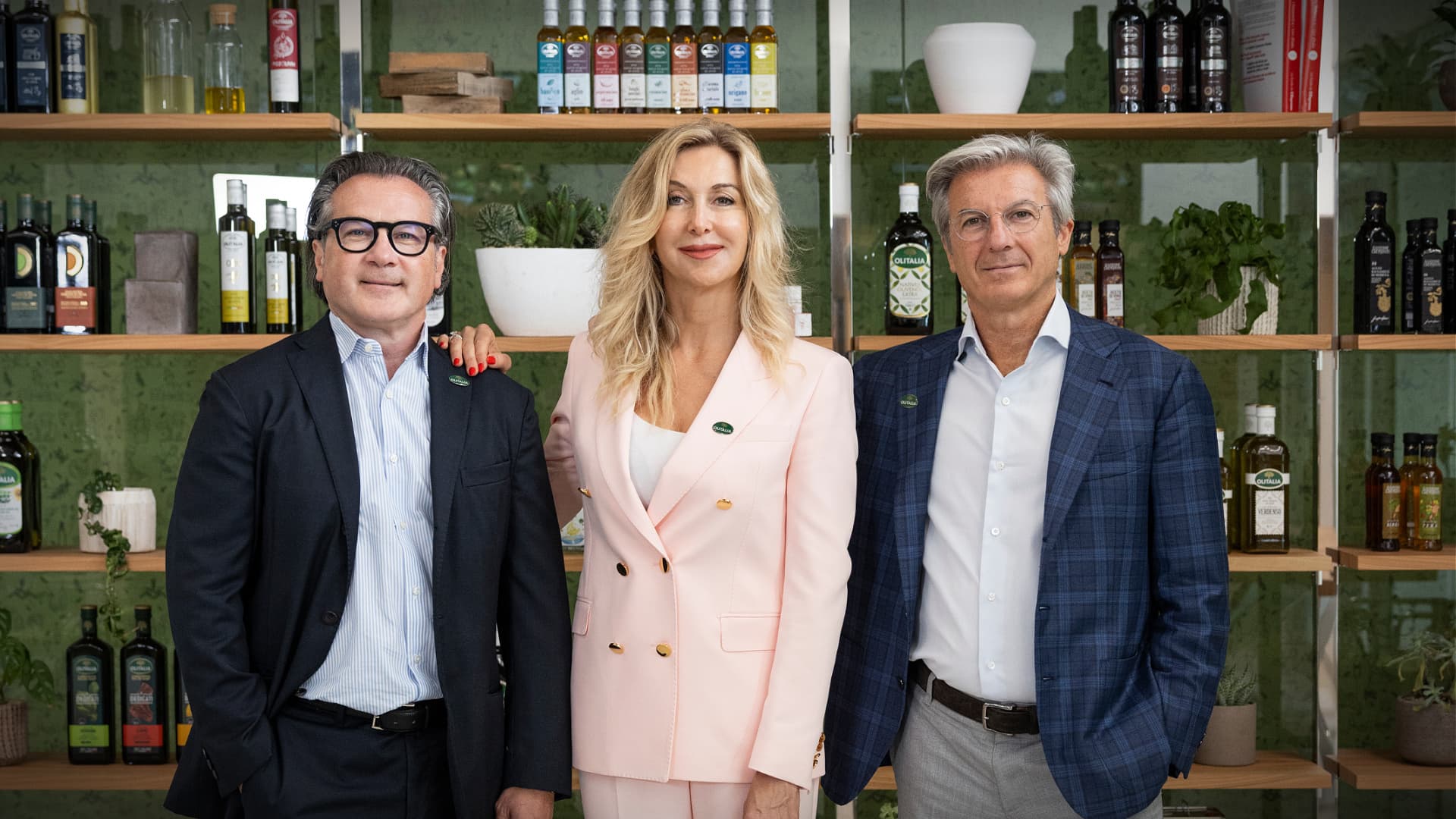
Camillo, Elisabetta and Angelo Cremonini have led Olitalia for more than 40 years. (Photo: Olitalia)
The tariffs, which currently sit at 15 percent after being raised from the initial rate of ten percent, will also raise prices in supermarkets in the coming months. Still, Cremonini does not expect demand to weaken.
“When prices were at a record high, we saw that consumption did not decrease in the United States,” he said. “The American consumer knows it’s a very healthy product. Olive oil demand in the U.S. is inelastic.”
Along with the U.S. and Brazil, Cremonini said East Asia has become one of the company’s core markets, underscoring the role of education and awareness in driving consumption growth.
According to Cremonini, Olitalia holds 70 percent of the Italian extra virgin olive oil market share in South Korea and 24 percent of the total olive oil market there.
“Korean consumers love Italian food and appreciate pairing oils with dishes,” he said. “We see a shift from basic to high-end extra virgin olive oil.”
Taiwan has shown similar growth after years of education campaigns. “We started with five shipping containers and now sell 250. It was only a matter of explaining the product’s benefits,” Cremonini added.
By contrast, China remains a challenging market. “Even the mildest extra virgin olive oils are considered too strong,” he said. “They are used to peanut and other seed oils, so it’s not easy to grow there.”
Cremonini believes education is key to expanding global consumption, which he agreed could, along with production, reach four million tons as more consumers learn about olive oil’s health benefits.
“Olive oil accounts for only two percent of global vegetable fats,” he said. “There’s huge potential to grow.”
Cremonini added that guided tasting is the most effective way to get consumers to appreciate extra virgin olive oil.
Indeed, some of the company’s 2025/26 harvest will be sold in cobalt-blue glass bottles, which he said were inspired by the blue tasting glasses used by professional olive oil judges to avoid color bias.
Beyond markets and education, Cremonini highlighted Olitalia’s commitment to lowering the company’s environmental footprint. However, he emphasized that sustainability begins with economic viability.
“It has to be sustainable from the economic point of view,” he said, noting that the company continues to use some plastic packaging to meet market demand.
Still, Cremonini added that since 2018, Olitalia has shifted to bottles made entirely from recycled food-grade plastic.
The company also powers its operations exclusively with renewable energy, with half generated by on-site solar panels and the other half through power purchase agreements, even producing its own glass bottles at a renewable-powered facility.
“We decided to take small steps toward sustainability not just because consumers appreciate it, but because it’s the right thing to do,” Cremonini said. “We can help the planet and still run a healthy business.”
“Sometimes it’s simply a matter of rethinking how we do things, asking if there’s a better way to help the planet and our community,” he concluded.