Sustainable, Low-Cost Process Turns Olive Pomace Into Nutrient-Rich Sheep Feed
Researchers and farmers in Tuscany are testing a low-cost process that pairs moist olive pomace with absorbent brewer’s grain to create digestible silage for sheep.
Olive pomace combined with brewer’s grain can be transformed into a nutrient-rich livestock feed through an accessible, rapid and cost-effective process that relies on the complementary properties of the two byproducts.
A key advantage is that these byproducts can be either generated in-house or sourced from neighboring farms, helping offset both logistical and feed costs for all the producers involved.
The circular approach was developed through the Sans3bbie project, funded by the Tuscany Region and carried out with the University of Pisa and the multifunctional farm Azienda Agricola Spinelli – La Dispensa in Lamporecchio.
Within the European Union-funded Thematic European Rural Bioeconomy Network project (thERBN), the non-profit organization Deafal and the Agency for the Promotion of European Research (APRE) presented the method as a good practice for small- and medium-scale farms.
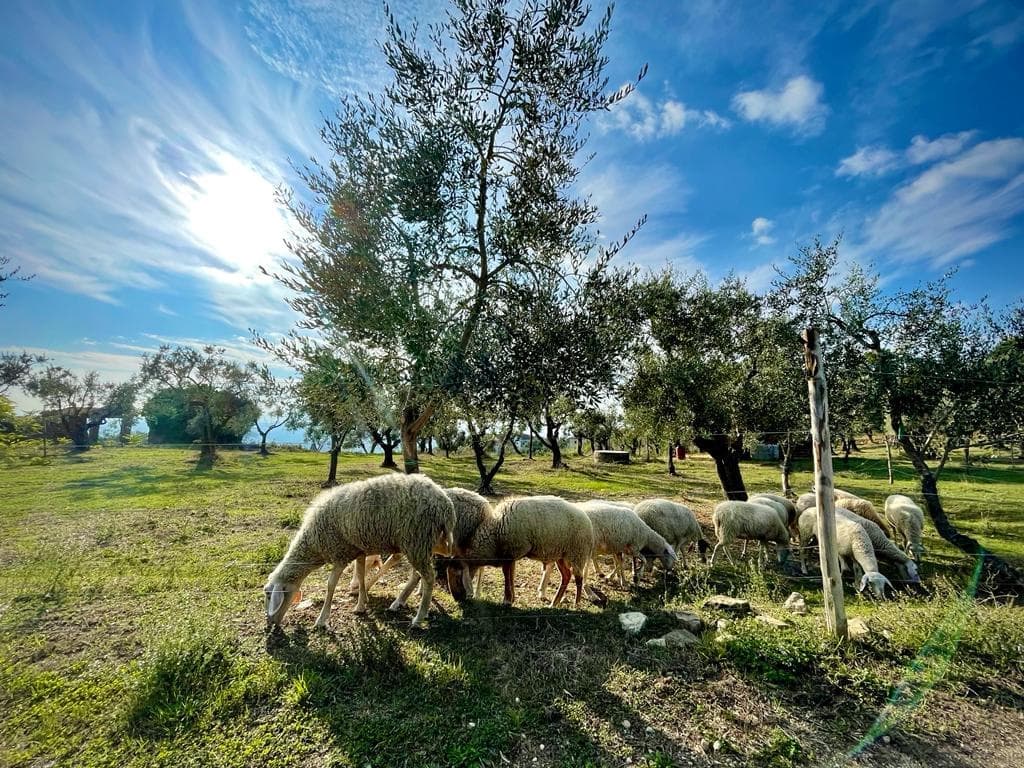
Sheep grazing in the olive grove at Azienda Agricola Spinelli – La Dispensa in Lamporecchio, in the province of Pistoia.
“One of the key aspects of this project is the possibility to use and valorize locally available byproducts,” said Paola Cassiano, a training and dissemination officer in thERBN’s Italian working group on circular bioeconomy, which also includes Laura Silici, Maurizia Castellari, Flavia Fusconi and Susanna Debenedetti.
“We identified a strategy consisting of an integrated co-ensiling process that leverages the properties of the grains to regulate the moisture content of the pomace and promote stable fermentation,” Cassiano said. “This process yields a preserved mixed silage with balanced moisture content and complementary nutritional properties. The innovation lies not in the invention of a new technology, but in the intelligent and integrated use of already known practices applied to these biomasses, which are usually treated differently.”
Composed of olive pulp and pit fragments, olive pomace is a residue of olive oil production that requires proper disposal. Brewer’s grains are a solid residue of beer production, with annual output in Italy reaching about 320,000 tons. Both byproducts require costly handling, transportation and storage, with high seasonality and short shelf life compounding the challenge.
“The idea of combining olive pomace and brewer’s grains, which are already used individually as low-nutrient feed, stems from a very concrete logic of complementarity,” Cassiano said. “Pomace is an abundant byproduct but difficult to manage due to its high moisture content and seasonality; brewer’s grains, on the other hand, have good absorbency and nutritional properties that complement those of pomace. The resulting ensiled feed can be easily incorporated into sheep rations without altering production performance.”
The system begins with a simple pre-treatment of both byproducts before ensiling. Olive pomace is separated from the pits, which are recovered and reused as biomass for heat and energy production.
Brewer’s grains are dried to prevent unwanted fermentation, extend shelf life and simplify storage and transportation. A portion of the dried grains can also be used as an energy source.
The two components are then mixed and ensiled. A portable concrete mixer, not traditionally used for ensiling, can be adapted as a low-cost mixing device.
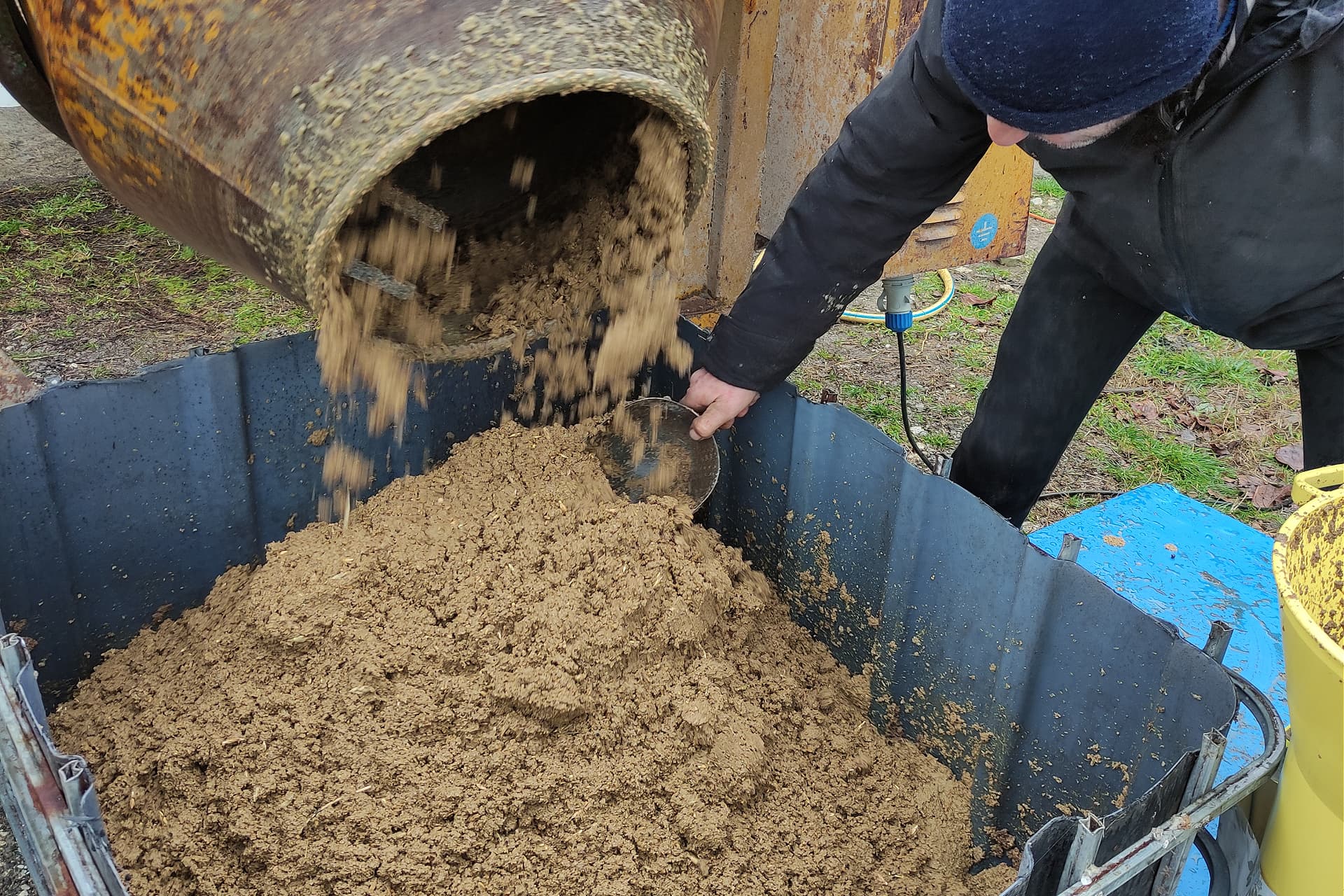
Mixed and ensiled, olive pomace and brewer’s grains produce a feed that can be incorporated into sheep rations, providing fiber, bioactive compounds, protein and readily available energy. (Photo: Paola Cassiano)
During this phase, the grains act as an absorbent substrate, promoting lactic fermentation and helping regulate the silage’s overall moisture content.
Trials conducted by the working group found the resulting feed had a balanced nutritional profile and high digestibility. It was also palatable and well accepted by animals, with no negative effects on milk quality or sheep growth compared with conventional feed.
Nutritionally, pomace provides fiber and bioactive compounds, while grains supply protein and readily available energy.
“This solution has a low economic and environmental impact,” said Stefano Spinelli of La Dispensa, who collaborated on the project and is now using the feed for his sheep. “We have obtained a well-balanced feed that provides valuable nutrients, which are then passed on to the cheese we produce from their milk.”
Spinelli said he integrates the feed with molasses, whey from cheesemaking, bran, middlings and mixed cereal residues.
“This type of feed is particularly suited to sheep because they are efficient at digesting fibrous matrices and, especially in Mediterranean systems, are already accustomed to the use of unconventional ingredients,” Cassiano said.
She added that a key feature of the process is replicability. Designed for small- and medium-scale farms, it is compatible with existing silage facilities at the farm or cooperative level and does not require complex or large-scale equipment.
“A key advantage is that these byproducts can be either generated in-house or sourced from neighboring farms, helping offset both logistical and feed costs for all the producers involved,” Spinelli noted.
Reducing feed costs is one of the most significant outcomes. Preliminary data show that introducing the mixed silage into sheep rations at 25 to 30 percent, alongside other feeds, results in an average cost reduction of about 27 percent.
The ecological footprint is also reduced thanks to limited logistics and because ensiled pomace has a lower environmental impact than conventional lipid and fiber concentrates such as corn and soy, which also compete with human nutrition.
A group of producers in the Lazio region has recently joined the effort, adopting the ensiling process. A Tuscan region-funded follow-up program, BY-LAGE, was recently approved to expand trials and strengthen integration with local supply chains, including halal meat production.
“This approach, which turns two critical waste management issues into productive and sustainable inputs, fits into some clear trends,” Cassiano said. “On the one hand, the olive sector produces large quantities of concentrated byproducts at a specific time of the year; on the other hand, in the livestock sector, there is growing interest in the use of byproducts as alternatives to commercial feed, both to reduce costs and to lessen dependence on raw materials such as corn and soy.”
“This practice shows that these issues can be addressed with practical, localized and technically simple solutions,” she added. “The primary value of this experience is demonstrating that the circular bioeconomy can be successfully implemented even on a small scale when solutions are designed in consideration of the real constraints of farms and the local context.”