Unprecedented Heat Sparks More Wildfires Across Greece
Around 4,500 hectares of olive groves have been burned in wildfires across the country. The government promises aid, but farmers want something else.
The two weeks of heatwaves that boiled Greece in mid-July were followed by dozens of wildfires breaking out across the country, burning forest and agricultural land and claiming human lives.
In many parts of the country, temperatures rose above 40 ºC for several days in a row, drying out the land and creating the perfect conditions for wildfires to erupt.
Every day, I venture into the groves around the village to assess the damage to the olive trees… Unfortunately, the fire has dealt a major blow to the area’s local economy.
“It was an unprecedented heatwave that lasted 15 days, which had never been recorded before in the country,” said meteorologist Yiorgos Papavasiliou. “After the first wave of high temperatures, we observed the rapid increase in flammability already in the first few days. The striking thing was that it affected almost the whole Mediterranean.”
According to initial estimates, more than 50,000 hectares of forest and crops, including 4,500 hectares of olive trees, were consumed by the wildfires in the country in July.
See Also: Olive Oil Producers in Greece Brace for Steep Production DeclineWestern Attica, the region of Magnesia in central Greece, southern Evia, Rhodes in the Aegean Sea and Corfu in the Ionian Sea have all felt the fury of the catastrophic fires.
Firefighters from several European Union countries and Turkey arrived in Greece to assist their Greek counterparts in containing the wildfires.
Two deaths were reported in Magnesia, while a volunteer firefighter in Rhodes succumbed to respiratory problems after struggling with the flames at the front.
On the small Aegean island of Karystos, a firefighting aircraft crashed into the hills while attempting to drop water on the blaze burning on the island from a low altitude. Both pilots were reported dead in the crash.
Rhodes, the largest island of the Dodecanese complex and a well-known tourist destination, was among the Greek regions hit hardest by the fires.
Burning for over 10 days, the flames destroyed houses in Asklipio and Gennadi villages and charred large swathes of agricultural land, mainly in the central and eastern parts of the island.
“We are at war with fire,” Prime Minister Kyriakos Mitsotakis said in an address to the Greek parliament. “We have experienced the devastation in many areas and, unfortunately, most recently in Rhodes. The island has been hurt.”
According to the first official recording of the damage, the blaze on Rhodes consumed 50,000 olive trees, along with 2,500 domestic animals and bee hives.
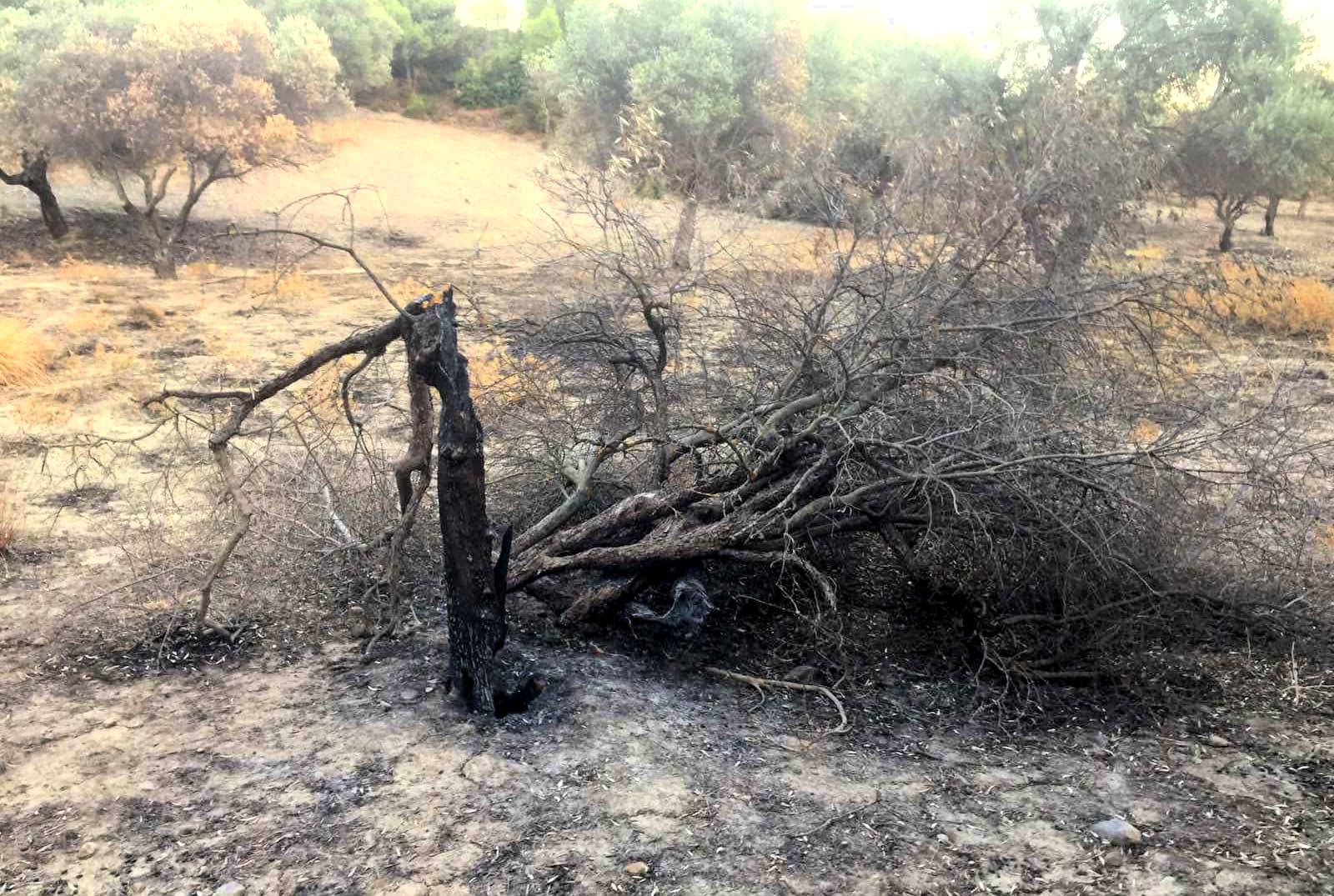
Burned olive tree on Rhodes (Photo: Yiorgos Tsakalios)
Europe’s Copernicus Atmosphere Monitoring Service (CAMS) published video footage depicting the burn scar of the wildfire on Rhodes as seen from space.
Around 20,000 locals and tourists were evacuated from impacted settlements like Kiotari and Asklipio and several tourist resorts in what was described as the largest evacuation operation the country has ever seen.
In the mountainous village of Apollona in the center of the island, mill owner Yiorgos Tsakalios is counting the wounds inflicted on the area’s olive groves by the wildfires.
“Every day, I venture into the groves around the village to assess the damage to the olive trees,” Tsakalios told Olive Oil Times.
“We almost completely rely on our olive trees for a living since there are no other crops here, and this part of Rhodes is not touristy,” he added. “Unfortunately, the fire has dealt a major blow to the area’s local economy. Based on rough estimates, around 15,000 olive trees succumbed to the flames in our area alone.”
Meanwhile, the government announced that the country’s olive farmers impacted by the wildfires are entitled to financial compensation of €160 per damaged olive tree.
Tsakalios, nevertheless, argued that rehabilitation measures for the island’s olive groves would prove more constructive than any financial backing.
“The support the government promised is pointless,” he said. “Just giving money cannot bring back our trees, some of which were centuries old. The state must come up with a comprehensive plan to restore our burned olive groves.”
“What is more, deer roam Rhodes in large numbers, and any young olive trees planted would have no chance of surviving,” Tsakalios added. “Wild plants and grass are not there after the fires, and the deer live on anything they can find now. There must be a hedge of some kind to keep them away.”
In the western Peloponnese, fires broke out in four different locations in the municipalities of Pyrgos and Ancient Olympia. Several settlements were evacuated as the flames consumed large swathes of countryside and crops and came dangerously close to the Olympia archaeological site.
The authorities activated the automated fire extinguishing system installed at the site in case the flames went out of control.
The archaeological site of Olympia, a UNESCO World Heritage Site, was previously threatened by the wildfire of August 2021, which engulfed more than 5,000 hectares of olive trees in the area.
According to Yiorgos Georgopoulos, the mayor of the contemporary town of Ancient Olympia, the water-bombing aircraft already operating in two other fires nearby were the reason the Olympia archaeological site and the contemporary town remained intact.
“Hadn’t it been for the fires in Karoutes and Paliovarvasena, which had planes already in the air, the flames would have reached our settlement and the archaeological site,” the mayor said. “This is what saved us.”
Local award-winning producer Alexis Karabelas of AMG Karabelas, based near the archaeological site of Olympia, said that the company’s establishments narrowly escaped the fire.
“The flames approached us to as close as 2 kilometers, but luckily the firefighters were able to contain them,” Karabelas told Olive Oil Times. “It was a dreadful experience.”
Other producers in the area outlined wildfires’ negative, long-lasting impact on the country’s olive oil industry.
“We managed to steer clear of the July fire, but the fire of 2021 has almost put us out of business,” local producer and mill owner Giannis Gouvas told Olive Oil Times. “The blaze consumed part of my mill and many olive groves in the area, including mine. I lost not only my olive trees but also my customers who were left with no olives to harvest and mill.”
“The state provided some financial help, but it cannot compensate us for the losses we have suffered,” he added. “Any young olive trees planted would take years to grow.”