Innovation and Sustainability Yield Brilliant Results for Apulian Producers
Teamwork, the responsible use of resources and innovation underpin the success of the Apulian Coratina monovarietal.
The ability to bring out the best of the autochthonous Coratina olive variety lies at the heart of GangaLupo‘s success.
The young company was founded in Bari, Puglia, aiming to produce a top-quality monovarietal. Its efforts were again rewarded with a Gold Award at the 2024 NYIOOC World Olive Oil Competition, the company’s sixth consecutive distinction.
There is a greater awareness that a quality product is not just a commodity, but the fruit of a work of care, attention and respect for territory and communities.
“Many of the trees that we care for were planted by my great-grandfather and grandfather,” said founder Vito Girone. “Indeed, our company was recently created, but my family has been dedicated to olive growing for generations.”
“They used to sell the olives to the local mills, and a small part of the fruit was intended for the production of olive oil for domestic consumption,” he added. “The farm management, which also produces vegetables, has then been passed to our parents, who support me and my brother in our quality-oriented project.”
See Also: Producer ProfilesUntil shortly before the company’s creation, the Apulian farmer’s career had taken a different path.
After high school, Girone moved to Turin, in the northern Italian region of Piedmont. There, he graduated and started working in an engineering firm. This lasted for a few years until an inner voice prompted him to move back.
“It was a very good job, but over time, I have realized that I needed a change, especially since my passion for olive oil made itself felt,” he said. “Therefore, I proposed to my brother Luigi, who had graduated in forestry and environmental sciences and already worked in the family business, to launch our own production of extra virgin olive oil.”
“He eagerly accepted, and we began rearranging the company organization,” Girone added. “Since we had just basic knowledge of how to make olive oil, we turned to an external consultant, Alfredo Marasciulo, an expert in quality production. Seeing our strong belief in the project, he agreed to support us, and we started in the 2017/18 crop year.”
Today, the farm covers 25 hectares in Santo Spirito, the northernmost district of the Apulian capital city. There, 5,500 olive trees flourish on flat land less than a kilometer from the Adriatic Sea.
The orchards are located in a hamlet called Ganga di Lupo, from which the company’s name derives. Over half of the trees are centuries old and still retain a traditional planting pattern, with a spacing of at least six by seven meters. Younger trees have been placed in some areas to thicken the orchards.
“In the olive grove, we installed two weather control units that detect air and soil humidity,” Girone said. “We also added leaf sensors that allow us to monitor the growth of the leaves and avoid thermal and water stress in the plants.”
This Agriculture 4.0 system helps to optimize resources and workloads. Girone and his brother plan to install a subsurface irrigation system to save water and energy, replacing the drip system in the orchards.
“Being sustainable is one of our core values, and therefore, we pay strict attention to the efficient use of resources,” Girone said. “Studies say that with drip irrigation, the water lost to evaporation can reach 40 to 50 percent.”
“This does not happen with subsurface irrigation, which lowers water consumption and, consequently, energy consumption since the booster pumps have to pump less water for less time from the well,” he added. “By the next olive harvest, this system should come into operation in some orchards.”
Girone believes that his company and the olive oil sector can no longer afford to continue using unsustainable farming practices.
“To make a quality product, you need water, but climate change has reduced its availability,” he said. “With less rain and declining aquifer levels, farmers must be careful about water consumption and management. Otherwise, there is a risk that this precious resource will no longer be available for agriculture.”
Drought threatened last year’s production. A rainy spring was followed by a prolonged dry spell from June to November, requiring a higher water and energy input.
Nevertheless, the extra efforts paid off, and the olive yield was satisfactory. Coratina is a late-maturing variety, but Girone carries out an early harvest, which usually starts in the first days of November and ends by mid-December.
“To achieve such results, we rely on one of the best mills in the area,” Girone said. “In his facility in Modugno, Donato Conserva, also known as Mimì, provides us with the best technology available today. There is a plan to build our own company mill, perhaps in a couple of years, but we will take one step at a time for now and continue to work with these great professionals.”
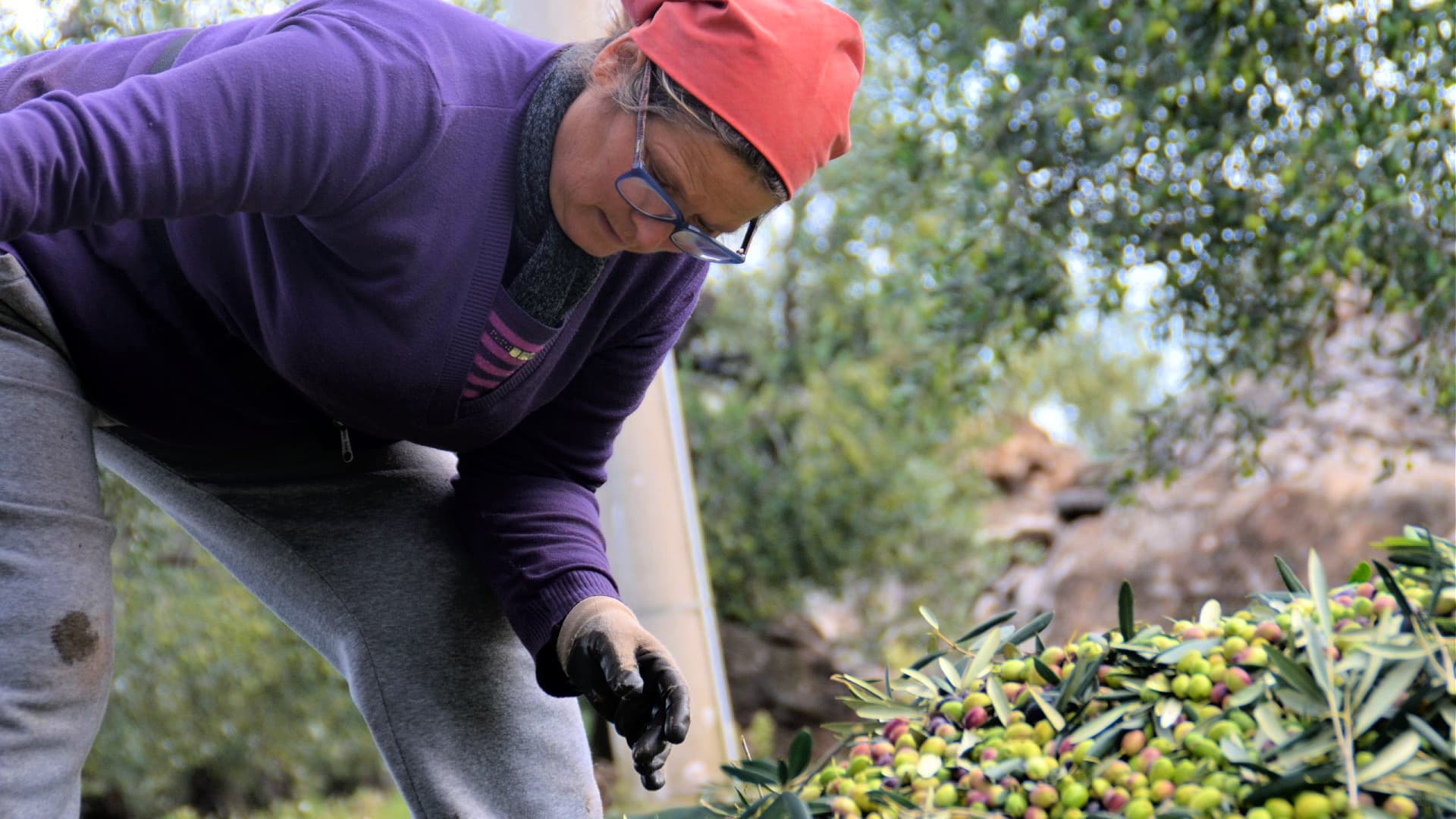
GangaLupo’s strengths arise from the complementary skill sets possessed by each family member and their collaborators. (Photo: GangaLupo)
Girone attributes the company’s success to the complementary skill sets he, his brother and his parents possess.
“In creating our company, I combined all of our expertise, namely my parents’ lifetime experience in the country, my brother’s agricultural knowledge and my engineering skills, especially in implementing a precision farming model, in addition to the abilities of our collaborators,” he said. Working in a team can be a winning choice even for a small company.”
Girone attributed this business strategy to the award-winning results the company has achieved over the years.
“The awards obtained give us the greatest satisfaction,” he said. “They not only indicate that we are doing a good job but also give prestige to our image. And we succeeded in this despite the difficulties that all farmers like us have encountered in recent years, from the ever-more-frequent extreme weather events to the increased production costs.”
Girone revealed that at the beginning of the sales season, he was worried that rising olive oil prices might scare the consumers. However, he realized that a good part of them truly understood the value of premium products and continued to buy and use them despite the cost increases.
“The fact is that the prices of substandard products have also gone up,” he said. “In substance, the difference between the prices of high-quality and poor-quality products has narrowed a lot, and consumers began to understand that, under these conditions, it is worth buying a high-quality extra virgin olive oil.”
Girone noted that the great communication from olive oil professionals also made people aware of what lies behind quality production and its many benefits.
“Ever more consumers know that a high-quality product makes a world of difference both at the table and in terms of the health benefits,” he said. “We see a growing number of people discovering this quality world.”
“There is a greater awareness than in the past that a quality product is not just a commodity, but the fruit of a work of care, attention and respect for territory and communities,” Girone added. “Indeed, this is probably a key moment for the sector, in which we can make a large number of people aware of the differences between a high-quality product and a low-quality one.”
The Apulian farmer said he could not imagine a life different from the one he is living thanks to extra virgin olive oil. He added that he is committed to improving and exploiting today’s innovations to improve quality and sustainability.
“I believe that in our work, there are fundamental points that we must keep in sight, and one of these is respect for the environment,” Girone said. “Certainly, today’s innovations help us reach the highest levels of quality and be more productive, but I believe that we should not overdo it. We must always treat the environment and the territory that gives us this extraordinary product with great care.”
“Through the reduction of emissions and efficient resource use, we can be a sustainable company in every sense and still aim for the highest quality standards,” he concluded.