



Pope Francis: A Legacy of Peace and Environmental Advocacy
Pope Francis, a champion of the poor and marginalized, is remembered for his commitment to peace, climate action, and inter-religious dialogue.
 Zebra48bo, CC BY-SA 4.0, via Wikimedia Commons
Pope Francis, born in Buenos Aires in 1936, served as the head of the Catholic Church until his death in 2025. Known for advocating for the poor, climate action, and peace, his passing was mourned worldwide, with world leaders attending his funeral in the Vatican. Additionally, he was the first Pope to choose the name Francis and promoted peace in the Middle East through symbolic gestures like planting olive trees.
Born Jorge Mario Bergoglio on December 17, 1936, in Buenos Aires to Italian immigrant parents, Pope Francis was the head of the Catholic Church and sovereign of Vatican City from March 13, 2013, until his death due to a stroke on April 21, 2025.
A defender of the poor and marginalized, an advocate for climate action, and a promoter of inter-religious dialogue, hailed by many as a reformer, his passing prompted mourning worldwide.
Pope Francis taught us above all to love. From love comes the courage to denounce injustices and the commitment to build a human, supportive and fraternal world.
On April 26th, numerous world leaders and tens of thousands of people attended his funeral at St. Peter’s Square in the Vatican, followed by the procession to the Basilica of St. Mary Major in Rome, where he was laid to rest.
Among the many records achieved – including being the first born in the Americas – he was the first pope to choose the name Francis, like the Saint from Assisi who embraced the ideals of poverty, humility and peace.
See Also:Buoyed by Awards, the Pope’s Official Olive Oil Producer Looks Ahead to HarvestAn excerpt from the last statement he delivered on April 20th, which was read by Archbishop Diego Ravelli before he imparted the Urbi et Orbi blessing for Easter, encompasses the founding values of his pontificate.
“How much contempt is stirred up at times towards the vulnerable, the marginalized, and migrants,” Pope Francis wrote. “On this day, I would like all of us to hope anew and to revive our trust in others, including those who are different than ourselves, or who come from distant lands, bringing unfamiliar customs, ways of life and ideas. For all of us are children of God. I would like us to renew our hope that peace is possible.”
Francis’s commitment to peace soon became very apparent. On June 9, 2014, the year after his election, he met with Israeli President Shimon Peres and Palestinian President Abu Mazen to plant an olive tree in the gardens of Vatican City and invoke peace in the Holy Land.
The two political leaders were invited during the Pope’s apostolic journey to the Middle East the previous month, when he visited Amman in Jordan, Bethlehem in Palestine and Jerusalem in Israel.
Already on that occasion, after a meeting with priests and worshippers in the Church of All Nations, also known as the Basilica of the Agony, in Jerusalem, Francis planted an olive tree in the Garden of Gethsemane. The olive tree was a cutting taken from one of the eight 1,000-year-old trees in the garden to ensure the continuity of these majestic plants’ genetic heritage.
A few weeks later, the Invocation for Peace in the Holy Land event took place in the Vatican gardens at Francis’s initiative. He welcomed both Peres and President Mazen with a long hug. Then, in front of Pope Francis, the two presidents greeted each other with a hug.
Ecumenical Patriarch Bartholomew of Constantinople was also present at the meeting, which included readings of prayers from Jewish, Catholic, and Islamic traditions. The planting of a young olive tree was the culmination of the event, sending a powerful message of peace.
On June 8, 2024, the pontiff commemorated the historic meeting on its tenth anniversary with a ceremony. In front of that olive tree, which is now grown and thriving, he prayed for peace in Palestine and Israel.
Francis made the last of countless appeals for peace in the Middle East in the aforementioned Easter statement, where he also called for peace, reconciliation, and the restoration of justice across Europe, the Middle East and Africa.
As he considered social justice deeply interconnected with climate justice, Francis was also the first Pope committed to climate action.
His second encyclical letter Laudato si’ (Praise Be to You), named after the Canticle of the Sun, also known as Canticle of the Creatures, composed by Saint Francis in 1224, is the first ever written by a Pope on the subject of the environment.
The pivotal document, subtitled “On care for our common home,” introduces the concept of “integral ecology,” emphasizing “how inseparable the bond is between concern for nature, justice for the poor, commitment to society and inner peace.”
Hence, Francis started the project Borgo Laudato Si’ in his residence at Castel Gandolfo near Rome on February 2, 2023, to promote the principles described in the encyclical.
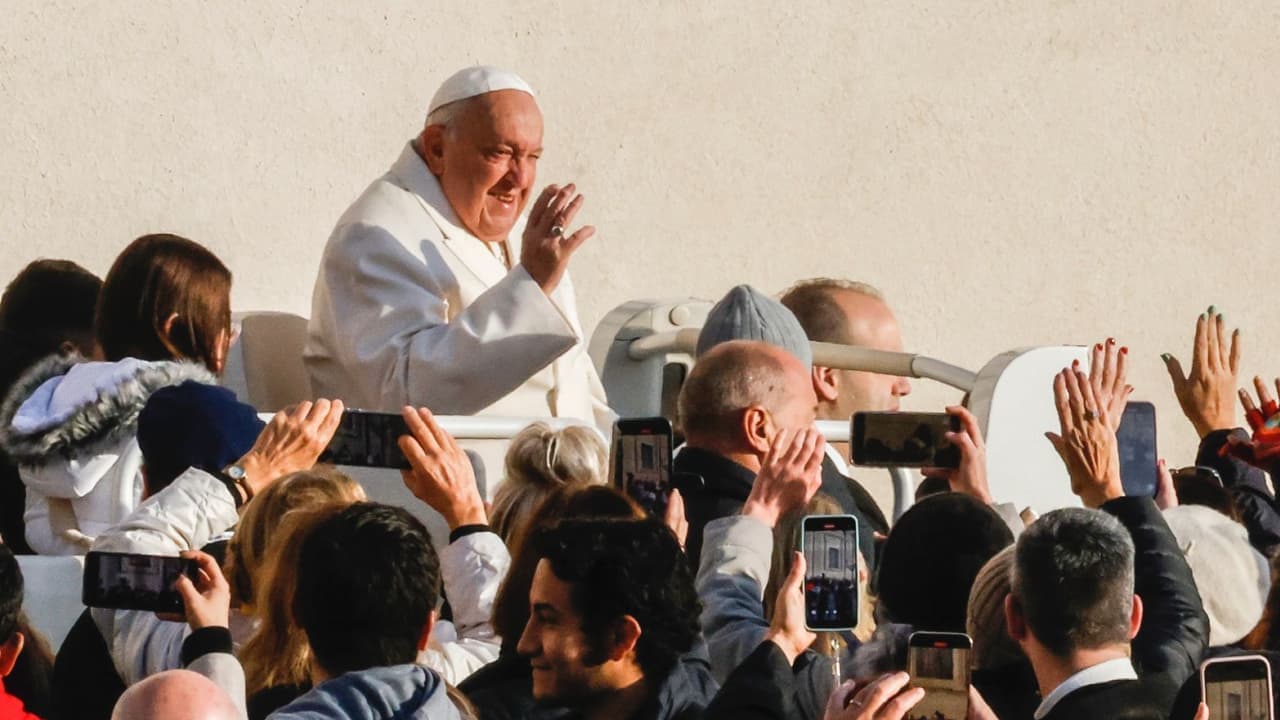
Pope Francis greeted by a crowd of faithful during a recent public appearance on the popemobile. (Photo: Riccardo De Luca)
The Borgo Laudato Si’ estate spans 55 hectares, comprising 35 hectares of gardens and 20 hectares of farmland, greenhouses and service buildings.
Olive trees are one of the seven main tree species chosen as symbols of the project, along with cedar, citron, boxwood, Cypress, holm oak and magnolia.
Based on the three tenets of integral ecology education — a circular and generative economy, and environmental sustainability — Borgo Laudato si’ hosts job training and educational courses, seminars, and cultural events. The estate is also open to visitors.
Its orchards include Pendolino, Frantoio, Rosciola and Vernina trees from which extra virgin olive oil is produced.
Other olive varieties can be found on the estate, including Pigeon Egg, Taggiasca and a tree from the Gethsemane Garden that was donated to Pope Paul VI by King Hussein of Jordan.
In 2021, the daily newspaper of Vatican City, L’Osservatore Romano dedicated an article to the olive branch that, after celebrating Palm Sunday Mass in the St. Peter’s Basilica, Pope Francis brought with him to Casa Santa Marta (the guest house that he chose as his quarters over the more luxurious Apostolic Palace, which is supposed to be the official papal residence).
In that olive branch, there are the expectations and fears of humanity, writes the daily, “but precisely those infinitely small olive leaves, symbols of true peace, in the hands of the successor of Peter are a sign of a hope that does not die. A sign of the resurrection.”
Father Mattia Ferrari, a chaplain aboard the migrant rescue vessel operated by the civil society platform Mediterranea Saving Humans, was very close to the late pope due to his commitment to migrants and refugees.
“Pope Francis taught us above all to love,” Ferrari told Olive Oil Times. “From love comes the courage to denounce injustices and the commitment to build a human, supportive and fraternal world. We must learn from him to love, and with this love we will be able to continue the path he forged to save each other.”
Share this article
Related Articles
Sep. 25, 2025
Italian Olive Oil Producers Optimistic Despite Challenges
Italian farmers and millers are optimistic about the upcoming olive harvest, but challenges from weather and pests remain. Prices are expected to remain high.
Aug. 11, 2025
Italian Olive Oil Sector Demonstrates Resilience in New Report
A report from Ismea showed that exports and organic farming in Italy expanded even as production and consumption continue to decline.
Oct. 9, 2025
Alarm in Gargano as Xylella Reaches New Northern Front
A new Xylella fastidiosa outbreak near Cagnano Varano marks the bacterium’s northernmost spread in Puglia, prompting containment efforts and genetic analysis to trace its origin.
Jun. 28, 2025
Family's Love for Italian Cultivar Shapes Generations of Success
The Carroccia family-run olive farm in central Italy produces a celebrated Itrana monovarietal, rooted in love for the unique cultivar and its connection to the 'village of longevity.'
Mar. 26, 2026
Umbrian Osteria Uses Interactive Olive Oil List to Deepen Guest Engagement
A Michelin-recognized osteria in Montone is using a digital olive oil list and producer-made videos to connect diners with Umbrian extra virgin olive oils and the region behind them.
Sep. 29, 2025
New Initiatives Promote Olive Oil Culture in Northern Italy
New projects are advancing olive oil culture in northern Italy, with the opening of an oleoteca and a collective highlighting top-quality producers.
Mar. 4, 2026
Mandranova Blends Hospitality and Olive Oil Craft in Southern Sicily
The family-run estate near Palma di Montechiaro pairs olive groves and almond orchards with 15 guest rooms and a private villa, offering visitors a closer look at how award-winning extra virgin olive oil is made.
Sep. 29, 2025
Passion for Quality Becomes Legacy at Umbrian Farm
Oro di Giano produces premium extra virgin olive oil in Umbria from native varieties, centered on one of the region’s oldest olive trees. The farm is run by Claudia Pompilj, who built a second career in olive oil with great success.