Lebanon’s Olive Growers Struggle as Conflict and Climate Pressures Deepen
Lebanon’s 2025/2026 olive harvest is unfolding under extreme strain, with drought, soaring costs and persistent military tensions in the south driving yields sharply lower. Farmers describe a season marked by insecurity, water scarcity and rapidly rising prices.
The olive harvest in Lebanon is proving exceptionally difficult for many growers. Weather extremes and ongoing military pressure in the south have turned the 2025/2026 campaign into one of the most challenging in recent years.
The climate crisis is destabilizing everything.
Agriculture Minister Nizar Hani said olive oil yields are running low nationwide. Official estimates forecast a 40 percent drop in production, though late-season rainfall could offer limited relief in some areas.
According to International Olive Council data, Lebanon’s olive oil output has steadily declined. Average production over the past five seasons has fallen to just over 20,000 tons. The minister added that conditions in the south increasingly reflect the accelerating impact of climate change.
“The major issue affecting us, and what other producers and farmers are talking about, is the drought and the rapidly changing climate,” said Karim Arsanios, owner of the award-winning Lebanese producer Solar.
Rising production costs continue to strain growers across the country, with transport and irrigation costs rising sharply, especially as water shortages worsen.
“There is simply no water. Last year it barely rained. This affects not only olive trees but farmers across many crops. The climate crisis is destabilizing everything,” Arsanios said.
“In the north we were lucky enough to harvest the olives. There is some stability here. But people in the south were not as lucky,” he added.
Near-war conditions have persisted in southern Lebanon despite the ceasefire signed a year ago. Olive farmers continue to face insecurity and displacement, as previously reported by Olive Oil Times in coverage of escalating conflict in the south.
Farmers in the south must harvest under the supervision of the Lebanese Army in coordination with UNIFIL. Complex authorizations are required, and Israeli military activities—including drone surveillance and occasional bombings—remain a constant threat.
“Conditions have become so extreme. We did not have bombings, as our groves are in a Christian area untouched by the military operations. Still, every day during harvest you wake up and do not know if you will be able to harvest at all,” said Rose Bechara Perini, founder of the award-winning producer Darmmess.
“From other areas in the south we are hearing it is even more difficult. Farmers need to fill out forms for access, listing details they often cannot predict—such as the exact number of workers and their tasks. It’s really hard,” she added.
Many growers must reach the sensitive Blue Line border area, where a wall is being built following the ceasefire. UNIFIL monitors the zone, which remains a high-risk area. U.N. forces have warned that sections of the Israeli-built wall appear to extend into Lebanese territory.
The conflict has also destroyed more than 40,000 olive trees. “This is not a loss for our country only, but a loss for everyone. These trees have been around for so long,” Arsanios said.
At Solar’s groves in Kour, in northern Lebanon, Arsanios is pursuing regenerative, low-impact farming to strengthen resilience. The team avoids tilling, uses natural compost, terraces land for water retention and plants companion species such as figs and vines to enhance biodiversity. “We want trees to actually help one another,” he said.
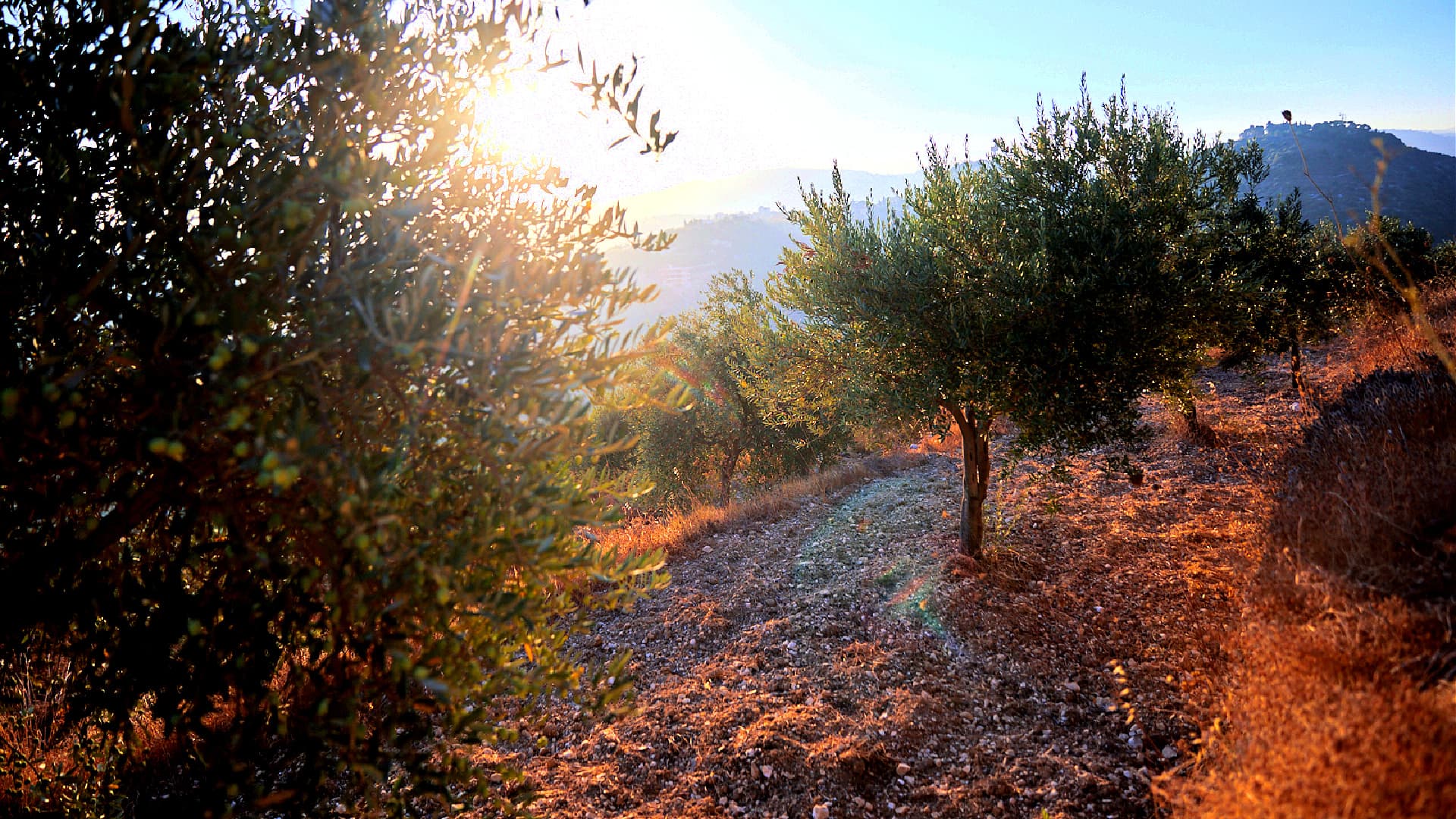
Solar’s groves in Kour, in northern Lebanon (Photo: Solar)
“Climate change has always been something in the back of my mind. I knew we were going to be faced with it, so I wanted to be more proactive and help the land become more resilient,” he added.
In the south, Darmmess workers managed to complete the harvest despite the instability. “We had a small harvest, about 60 percent of what I hoped for,” Bechara Perini said. She is expanding operations through new agreements with nearby growers, aiming to help them produce high-quality oil while Darmmess oversees marketing and sales.
Amid worsening conditions, Lebanese producers and traders recently announced the formation of a new Central Committee for Olives and Olive Oil at the Ministry of Agriculture.
The committee urged authorities to strengthen oversight against adulteration and fraud, increase penalties and uphold strict limitations on those involved in illicit practices. Members also backed a full ban on olive oil imports to protect local producers.
Under current Ministry of Agriculture regulations, all olive oil imports require prior authorization. Combined with reduced production, this policy has driven prices sharply upward. A tin of olive oil now sells for $180–$250, compared with under $100 a year ago.
The committee also urged swift action against Xylella fastidiosa, which is believed to be present in Lebanon but not yet widespread. Members called for a ban on imports of ornamental olive saplings and plant materials from affected countries.
“All that is happening to the southern olive groves breaks my heart,” Arsanios said. “If this were happening to us in the north, I think I would feel completely destroyed. I can only empathize with what they’re facing, but I can’t truly grasp what they’re living through. It’s devastating, and very sad.”
Growers say that if stability returns, several trends could help the sector recover. Expanding solar energy could lower production costs, new partnerships like those at Darmmess may help small growers improve quality and market access, and global demand for high-quality olive oil continues to rise.