Chemists Recognize Australian Lab’s Mailer
Olive oil experts gathered at the annual meeting and expo of the American Oil Chemists’ Society (AOCS) in San Antonio.
The annual meeting and expo of the American Oil Chemists’ Society (AOCS) took place this year in San Antonio, Texas, on 4 – 7 May. Olive oil was the subject of a number of oral presentations and posters as well as an expert committee meeting.
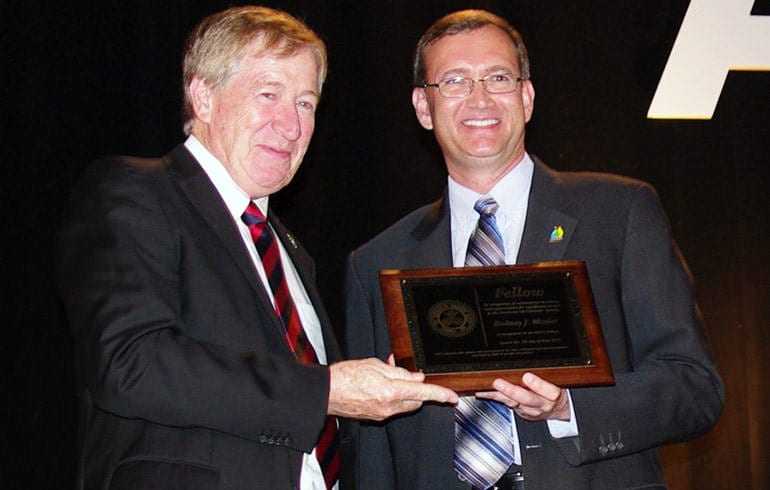
The olive oil-related activities got off to a good start at the annual business meeting and luncheon on Monday when Rod Mailer of Australian Oil Research was made a Fellow of AOCS. The status of AOCS Fellow is granted to veteran members for exceptional achievement in science or unusually important service to the Society or the profession.
Although Dr. Mailer had been involved for many years in canola breeding and quality improvement, in recent years he has worked extensively with olive oil. The Australian Oil Research Laboratory (AORL) at the New South Wales Department of Agriculture in Wagga Wagga became a leading olive oil research and testing center under Mailer’s leadership. An AOCS member since 1983, Mailer belongs to the AOCS Expert Panel on Olive Oil and was one of the founding members of the Australasian Section (AAOCS). He is an Elected Fellow of the Royal Swedish Academy of Agriculture and Forestry and recipient of many other awards and recognitions.
Posters were available for viewing in the afternoons, and detecting adulteration was the dominant topic in olive oil posters, including a calorimetric approach to measure the response of olive oil to temperature changes in order to detect adulteration. A session entitled “Analysis of Vegetable Oil Authentication and Adulteration,” chaired by Pierluigi Delmonte of US FDA and Lars Reimann of Eurofins, USA, contained several presentations on olive oil analysis.
Wenceslao Moreda of Instituto de la Grasa in Seville, Spain made a presentation “Detection of the Addition of Vegetable Oils to Olive Oil by Comparison of Theoretical and Experimental TAG (triacylglycerol).” The International Olive Council (IOC) standard contains 22 parameters for authenticity, designed to detect adulteration with seed oils or refined olive oil. The value of the fatty acid profile as an authenticity measure – that is the amount of various fatty acids such as oleic acid contained in olive oil versus seed oils – has been compromised recently as “high oleic everything” has entered the market.
This presentation looked at the success of the IOC “Global Method” to detect adulterants. The method compares experimental TAG composition with theoretical values obtained from the analysis of fatty acid methyl esters. The global method detected Turkish hazelnut oil in the range of 2 to 20%, but had difficulty when the adulterant was desterolyzed high oleic sunflower oil.
Pierluigi Delmonte of FDA gave a summary of testing results in “Evaluation of the Authenticity of Olive Oil in the US Market Through the Analysis of the Triglyceride Composition.” For this study they purchased 93 samples in the US market in late 2013 – 90 samples labeled as “extra virgin” and 3 labeled as “olive oil” or “other” blends. The samples were analyzed for fatty acid profile and TAG. They also created “spiked” oils to test their method.
They found that fatty acid profile by itself was not useful for detecting adulteration. Using the equivalent carbon number ECN 42 method did not detect the spiking with palm olein, peanut or hazelnut oil. The Global Method was successful in detecting all the adulterant oils except palm olein oil.
A presentation by Zhu of University of California Davis on “Characterization of Volatile Compounds in Virgin Olive Oil Produced in the United States” showed work done on oils produced with the laboratory Abencor system at UC Davis. Olives for the study were gathered from Oregon, Georgia and several locations in California and analyzed for their volatiles content.
Frederica Camin of Fondazione Emund Mach in Trento, Italy described research “Using Stable Isotope Ratio Analysis of Carbon, Oxygen and Hydrogen to Determine the Origin of Extra-Virgin Olive Oil.” The ratio of the C, H and O isotopes in a plant – and in an olive oil – can be analyzed by gas chromatography and mass spectroscopy and linked to geographical origin through the water and CO2 taken up by the plant. The isotope ratios are affected by climate, and latitude, showing clear differences between northern and southern regions, for example. The method has been used since the late 1980’s to detect mislabeled origins for honey, cheese and other products.
The system is of particular value in authenticating products bearing a designated origin certification, such as a PDO. The isotope ratios are not affected by the processing of the olive oil, or by storage conditions, oxidation, aging or refining, but products from very similar climatic and geographic origins can be difficult to distinguish. But better accuracy in distinguishing between oil from Southern Italy and Tunisia, for example, was achieved by using NMR metabolite profiling. Dr. Camin pointed out that an annual updating of the database is important for accuracy and amassing more data is also an objective of the project. The method has been submitted to IOC for approval and the researchers are waiting for an answer.
Kangming Ma of Eurofins laboratory reported on work done on rapid analysis of olive oil using near infra-red and mid infra-red. IR is fast and easily performed analysis, so it is of great interest for commercial analysis. Working with 97 samples from the EU – all pre-analyzed by their lab with wet chemistry – and 20 samples of US and Australian origin, they ran the standard tests and compared results with the wet chemistry. Correlations on some tests such as fatty acid profile, DAGs and K232 were good, but others such as K268 did not correlate as well. Continuing work is needed to build a database and validate the accuracy of the process.
The AOCS Expert Panel on Olive Oil had its 6th meeting to discuss the panel’s program and progress. A general discussion of future programs started with an update by chairman Richard Cantrill on the Horizon 2020 program of the European Union. A 5 million Euro grant under the Sustainable Food Security category has been allocated for work on olive oil authentication and the proposals were due in March. Those initial proposals are being culled, with a small number passing to the final stage.
An update on olive oil standards from Paul Miller of the Australian Olive Association mentioned that the Australian Standard AS 5264-2011 is being used by various entities as a reference point for new standards, as well as by people within the trade who are interested in monitoring quality. Bruce Golino of the California Olive Oil Council said the USDA olive oil standard is currently being used by the USDA Quality Monitoring Program (QMP) but that the program has only one participant to date. The USDA has moved its chemistry lab from Georgia to North Carolina and its sensory panel to Fresno.
For the US Olive Oil Survey report, Dan Flynn of UC Davis Olive Center said they had analyzed another 23 samples this year for a total of 38 over two years. Campesterol exceeded 4.5 (the USDA limit) in 24 percent of the samples, and palmitic acid looks like it can be an issue in Georgia, Texas and the Imperial Valley. Linoleic acid is also outside the standard in some areas. This is consistent with the experience of producers outside the traditional olive growing regions of the Mediterranean: the natural variability of olive oils from various climates can result in chemical analyses that fall out of the current standards which is why a robust database of olive oil composition covering diverse growing conditions is important.
A proposed new method from Agilent for measuring pheophytin and pyropheophytin was described and discussed. Although the cycle time for the test is the same as the standard method, the clean-up time is much less. Four labs agreed to test the method over the next year to see how it works.
Claudia Guillaume of Modern Olives talked about her work testing the use of an ultraviolet test – K225 – as a “bitterness index.” There is a decent correlation between the K225 and a finding of bitter taste by a sensory panel. The value of an objective measure of bitterness would be to serve as a tool for calibrating panels by providing a reference. It was proposed that the method be written up with a temporary AOCS reference number so labs can start to test it.
Richard Cantrill gave the update on laboratory and sensory panel proficiency testing programs in the US. Although there are a number of labs doing proficiency testing for a portion of the tests used in olive oil analysis, only one lab in the US is doing the full suite of tests (and they are a private lab that does not do work for outside clients).
There are 23 panels from around the world currently enrolled in the sensory panel proficiency testing program. There have been six cycles of samples to date, and the results are ready for adjudication. The first round of decisions on panel proficiency are expected soon.