Coming Off a Strong Year, Growers Ready for Harvest in Italy
The season now ending was characterized by an upward trend in terms of volume. Now, Italian farmers are looking at the next harvest and its climatic challenges.
The latest report by the Italian institute ISMEA says Italy’s olive oil production in the 2017/2018 season reached 429,000 tons — a 135 percent increase over the prior year (182,000 tons).
Italy has seen major increases in southern regions, starting with Puglia which exceeded the threshold of 200,000 tons, while Sicily and Calabria returned to normal levels of production. The same goes for Abruzzo, while other areas of central Italy suffered most from the effects of extreme weather conditions. Meanwhile, quality has remained at the highest level, as proven by countless recognitions obtained by the growers across the Boot.
See Also: This Year's Best Olive Oils from Italy
Never able to rest on their laurels, farmers are now looking ahead to the upcoming harvest. They are aware of the natural tendency of olive trees for alternate bearing, combined with the consequences of winter frosts.
They’re looking to limit the onset of pest infestations such as the olive fruit fly and olive moth, and fungal diseases like olive peacock spot and anthracnose, favored by humid climate and dropping temperatures.
“Even so, thanks to a constant monitoring of olive groves we prevented the attack of the fly,” affirmed Angela Fiore, who manages Olio Infiore with her brother Tommaso. “We are now in the final phase of a great season, during which still a proper management of water scarcity-related issues played a key role,” the producer from Puglia revealed.
The condition of their nine hundred plants of Coratina spread over the territories of Terlizzi and Bitonto, on the north side of Bari, provides hope for another good harvest, albeit a more complex one.
A slight decrease in production could be caused by the effects of two years of extreme cold in a sector of the orchard, where the farmers are still working to recover the harmed plants.
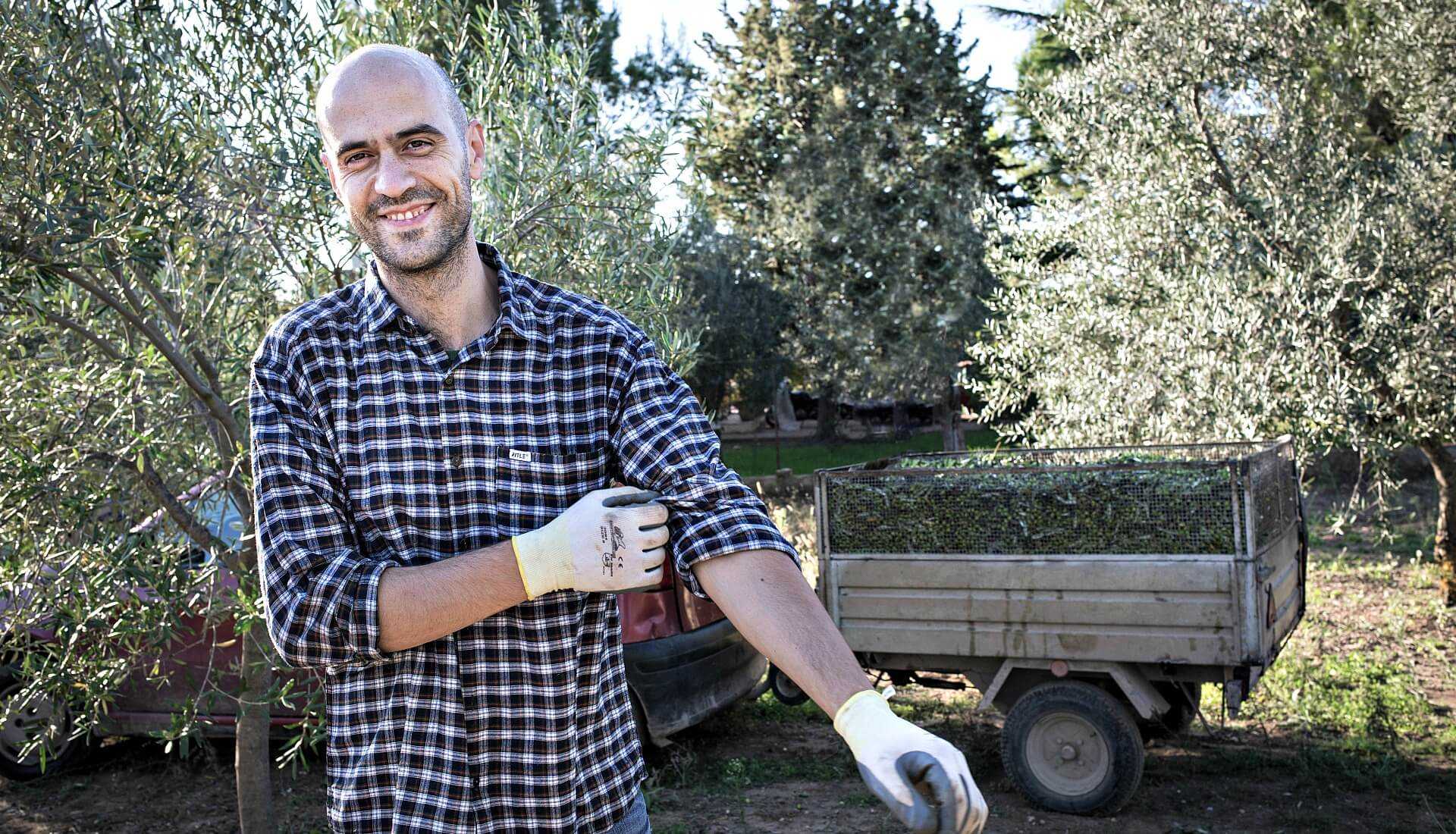
Tommaso Fiore
“Despite this year’s cold snap had a shorter duration than the last, nighttime temperatures affected some olive trees, breaking the wood or burning the top of canopies,” Fiore observed. “In the latter case, however, olive trees got better quickly, and fortunately other plants affected by the bad weather of last season fully recovered.”
“In particular, in the most suffering olive grove, olive trees were so asphyxiated and desiccated, we thought about getting rid of them. But in the end, thanks to a great teamwork, we were able to save the plants which are flourishing and healthy again. When you rescue an olive tree that seemed doomed, you feel an indescribable feeling of joy,” she added.
Fiore allowed herself only a few days of vacation because she has a close relationship with her olive trees. As they are converting to organic farming with timely actions with allowed treatments and traps against the olive fruit fly, they move confidently towards the next harvest.
At Colle Nobile, last season was fair in terms of quantity, and qualitatively excellent, thanks to the constant commitment of Giorgio Tonti, who manages 1,600 trees on the hills of the Marche region. In the lands of Jesi and San Marcello, he produces five monovarietals from the autochthonous cultivars Raggia, Mignola, and Rosciola dei Colli Esini, and the more widespread Frantoio and Leccino.
“Sometimes extreme temperatures helped us, as it was the case with the [the olive fruit fly], whose development last summer was completely blocked by the heat,” Tonti noted. “Basically, the season went well, while this year we might have a small decrease in volumes, as part of our olive trees suffered from the low temperatures registered in February.”

Giorgio Tonti
The Frantoio and Raggia were affected more than the others on Tonti’s farm, and he had to perform a drastic pruning of some plants. “Mignola, which generally has a good frost resistance, also had problems but to a lesser extent, while Rosciola dei Colli Esini responded very well, and this seems to be a high-yield year for this cultivar, which hopefully will give us a great harvest together with Leccino.”
Tonti said researchers have shown an interest in further investigating the varieties considered more resistant to cold temperatures.
As for the olive fruit fly, he already noticed a negligible presence due to weather conditions. “As soon as we find any oviposition or more catches in the traps, we are ready to use appropriate organic products.”
Highlighting the importance of a sustainable approach to high-quality olive growing, the farmer concluded, “our extra virgin olive oil with its unique organoleptic characteristics, is the healthy result of agriculture in balance with nature.”