Values of Hospitality, Sustainability Drive Quality at Misciattelli Bernardini Farm
From its historic headquarters in the old town of Allerona to the sustainably managed groves in the neighboring hills, an Umbrian producer preserves tradition while embracing change.
Perched on a hill overlooking the Paglia River valley, Allerona is an Umbrian gem at the border with Tuscany and Lazio, where Girolamo Misciattelli Bernardini carries on a cherished family tradition with his company, Misciattelli Bernardini Marchesi delle Ripe.
“We have been olive growers and producers for centuries,” he told Olive Oil Times. “Our archive documents report oil supplies to Pope Leo XII, even before his election in 1823, from one of our estates that belonged to the branch of the Misciattelli. Also, the Bernardini have been landowners and farmers since at least 1600, and managed a mill and a winery.”
Today, the ancient family building, in the village’s historic center, houses the company’s headquarters and store. It is also the residence of Misciattelli Bernardini and his life and work partner, Elena Gorelli, who also comes from a family of farmers in Tuscany.
See Also: Producer ProfilesTheir home on the upper floors and the farm shop on the ground floor of the mansion define an all-Italian style of warm hospitality.
“All those who arrive in Allerona are welcome here. We will offer them a glass of wine and a bruschetta drizzled with our extra virgin olive oil, for free,” Misciattelli Bernardini said.
“Within the walls of the old town, we are a few dozen permanent residents, and tourists are present from Easter to early September. We opened this small store here, which, from an economic perspective, doesn’t make much sense. But we just love this way of working and living,” he added.
Customers and visitors are invited to enjoy the charming garden of the residence, which features a summer lounge adorned with frescoes from the late 1800s.
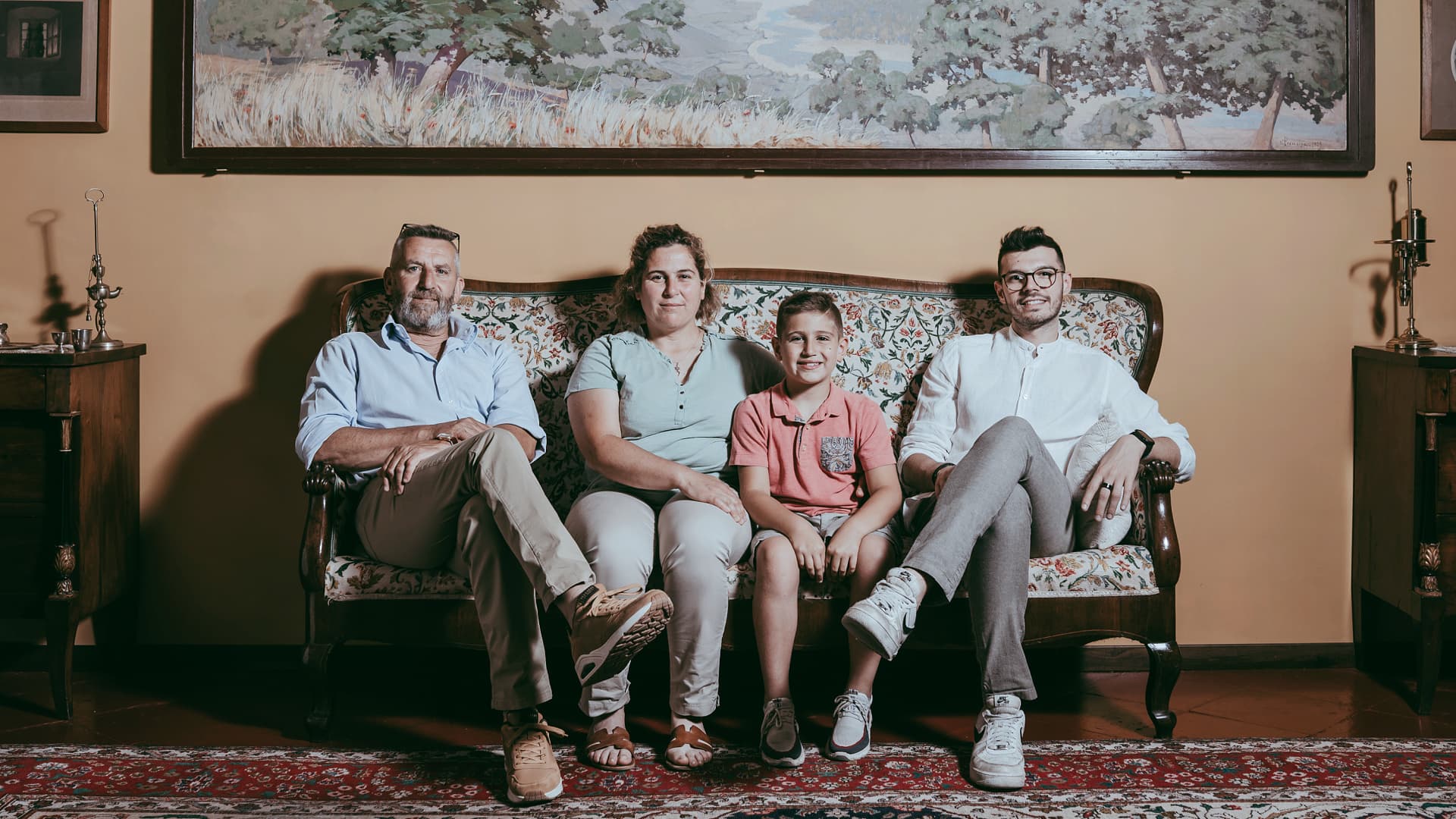
Misciattelli Bernardini, Gorelli, and their sons Vittorio and Gregorio (Photo: Misciattelli Bernardini)
“Elena and I greet not only our customers but all the travelers who visit Allerona, which is in the circuit of Italy’s most beautiful villages, and invite them to sit at our table,” Misciattelli Bernardini said. “We welcome them to our home. Sometimes we spend even hours together talking, during which there is always an enriching human exchange.”
“We are always glad to give them tips to have a pleasant stay, and through the tasting of our products, we introduce ourselves, our company and the territory to them,” he added.
Hospitality is a passion for the couple, who manage two agritouristic structures, including one in the countryside of Montepulciano, Gorelli’s hometown.
Their farmhouse accommodation in Allerona comprises four apartments surrounded by an olive grove, which is part of a 120-hectare estate that also cultivates vines and cereals.
The orchard is made up of 1,000 Leccino, Moraiolo and Frantoio trees. About 300 olive trees were recovered by the company last year, which aims to increase production while preserving the landscape.
“Many olive groves have been abandoned in the last decades, as it happens often in these marginal hilly areas,” Misciattelli Bernardini said. “Initially, we wanted to plant new trees, but then we realized that there was no point in creating new orchards when we already had wonderful trees that just needed to be rejuvenated. So, we started recovering them, also with the intent to restore the land contours.”
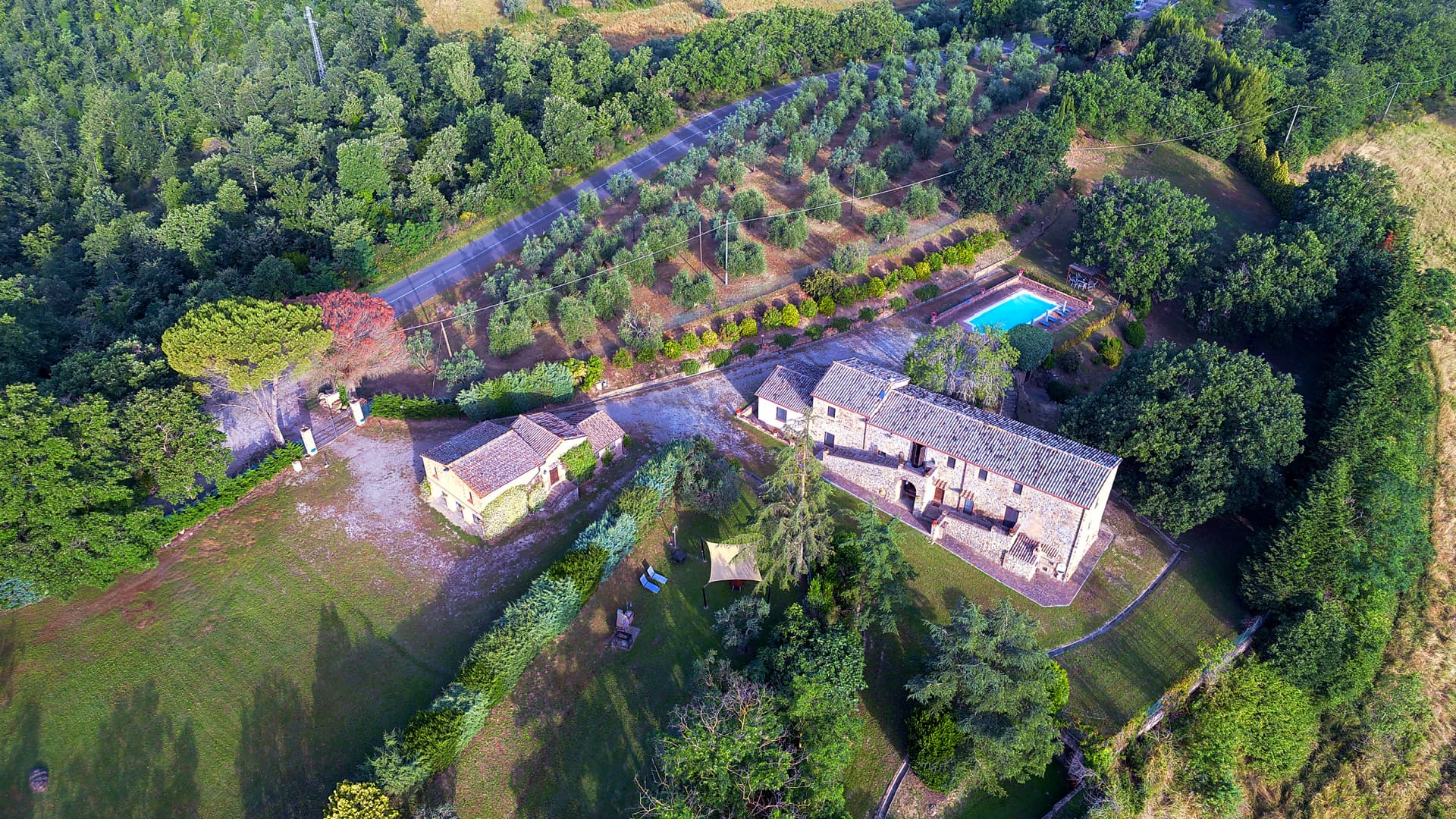
In Allerona, the Misciattelli Berdardini Marchesi delle Ripe company manages the Casale Montemoro farmhouse accomodation. (Photo: Misciattelli Berdardini)
“However, we don’t want to enlarge the production capacities much,” he added. “A bigger company should be managed differently. This is an approach to business that many see as starry-eyed, but working according to our entrepreneurial vision continues to bring us great satisfaction.”
Misciattelli Bernardini worked alongside his father until the late 1980s and then took over the reins of the company, which had previously sold oil in bulk. In 2000, he and Gorelli decided to reorganize the business and created two extra virgin olive oil brands.
“Some years ago, I became friends with a neighbor, who, after retiring from another job in Milan, moved here, where his father had worked as an agronomist and had connections with my family,” Misciattelli Bernardini said.
“We often exchanged advice, as he also started making olive oil,” he added. “This collaboration gave me a new boost, since I saw how much he loved this place as well, despite coming from somewhere else. Together, we decided to apply to get the Protected Designation of Origin for our products, with the intent to highlight the territory.”
Ripalta was then certified as Umbria Colli Orvietani PDO, and a few years later, at its first participation in the 2025 NYIOOC World Olive Oil Competition, this outstanding blend of native varieties received a Gold Award.
“We pick the first olives for this extra virgin olive oil around mid-October, then we collect those for Aristide, named in honor of my great-grandfather Aristide Bernardini,” Misciattelli Bernardini said. “They are both blends, with different characteristics, which allows us to satisfy different tastes.”
“We do not have a company mill and we don’t intend to have one, because there are excellent millers whom we can rely on,” he added. “We are now collaborating with the milling facility managed by Paolo Brizi in Orvieto, which boasts the latest generation Alfa Laval equipment.”
During the year, the company implements eco-friendly farming practices on the estate, aiming to improve soil health and promote local biodiversity.
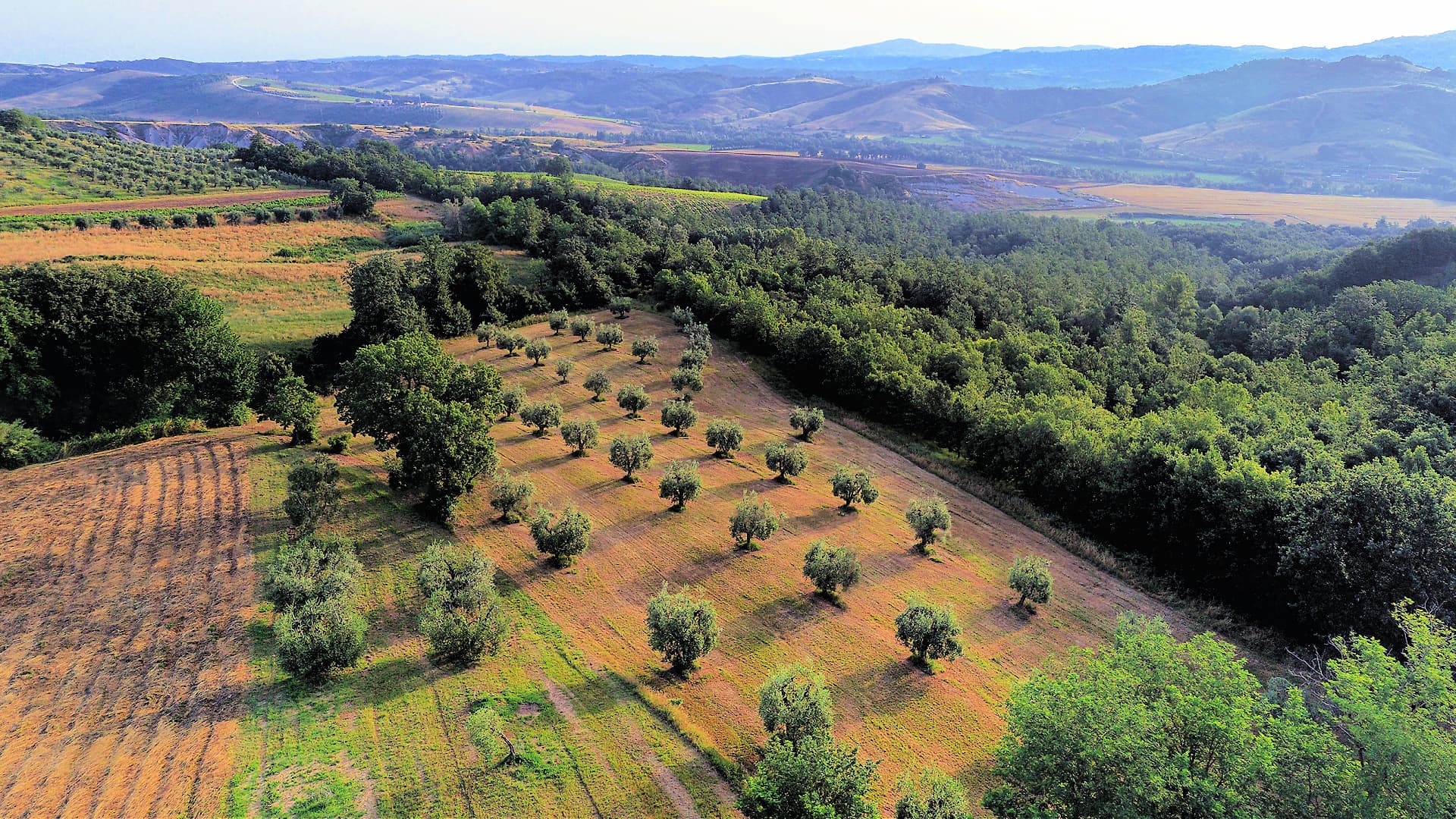
An orchard called The Pope’s olive grove on the Misciattelli Bernardini Marchesi delle Ripes estate. (Photo: Misciattelli Bernardini)
“We manage our orchards sustainably, also considering that we are the first consumers of our products, but primarily to preserve this precious environment,” Misciattelli Bernardini said. “Our company started several years ago to use the no-tillage technique, a now increasingly widespread regenerative farming practice to favor the growth of spontaneous plants under the olive trees and limit soil erosion.”
“Let me say that everything we do is not only for our company, but above all for this land,” he said. “I live and work here because I deeply love this village, which is where I have my roots. This is my heart’s place, and I am committed to respecting it.”
To preserve the traditional olive landscape, the company has maintained the extensive planting patterns of the orchards, which feature a spacing of six meters by six meters or even greater.
“The olive trees in this area were almost all wiped out by the great frost of 1956, then from the still living ancient stumps the new trunks were reborn, which is why they appear as relatively young,” Misciattelli Bernardini said.
“I do believe that we farmers should act as custodians of the territory,” he added. “And I am convinced that places like these, where the beauty of the territory goes hand in hand with the healthiness of the environment thanks to sustainable farming, can be an example for an agriculture that looks at the future of the new generations.”
“Moreover, we have so much history behind us, and all of these elements contribute to the quality of our productions,” Misciattelli Bernardini concluded. “Within a bottle of our extra virgin olive oil, you will find its rich history, its wonderful territory and its healthy environment. It’s precisely here that I, as a quality producer, can make a difference.”