Chiarentana: How One Tuscan Estate Shaped Val d’Orcia
Once a refuge during wartime, Chiarentana today produces award-winning olive oils and welcomes visitors to experience the peaceful heart of Val d’Orcia, a UNESCO World Heritage Site.
A timeless harmony between human presence and the natural landscape earned Tuscany’s Val d’Orcia its place as a UNESCO World Heritage Site. Located in the province of Siena, this one-of-a-kind rural landscape is defined by its signature cypress-lined roads, stone farmhouses, and carefully cultivated fields unfolding across gentle hills.
Spreading olive oil culture and telling our story allow us to celebrate and safeguard Val d’Orcia’s unique heritage.
At the heart of Val d’Orcia lies Chiarentana, an organic estate that Donata Origo has guided since the 1980s with a steadfast commitment to excellence and the well-being of her guests and local community.
Chiarentana and Confini blends, along with the Maurino monovarietal, each received a Gold Award at the 2025 NYIOOC World Olive Oil Competition.
Today, the property produces acclaimed olive oils and offers a refined agritourism immersed in tranquility. Its journey, however, extends far beyond hospitality — revealing deep roots in the making of modern Val d’Orcia.
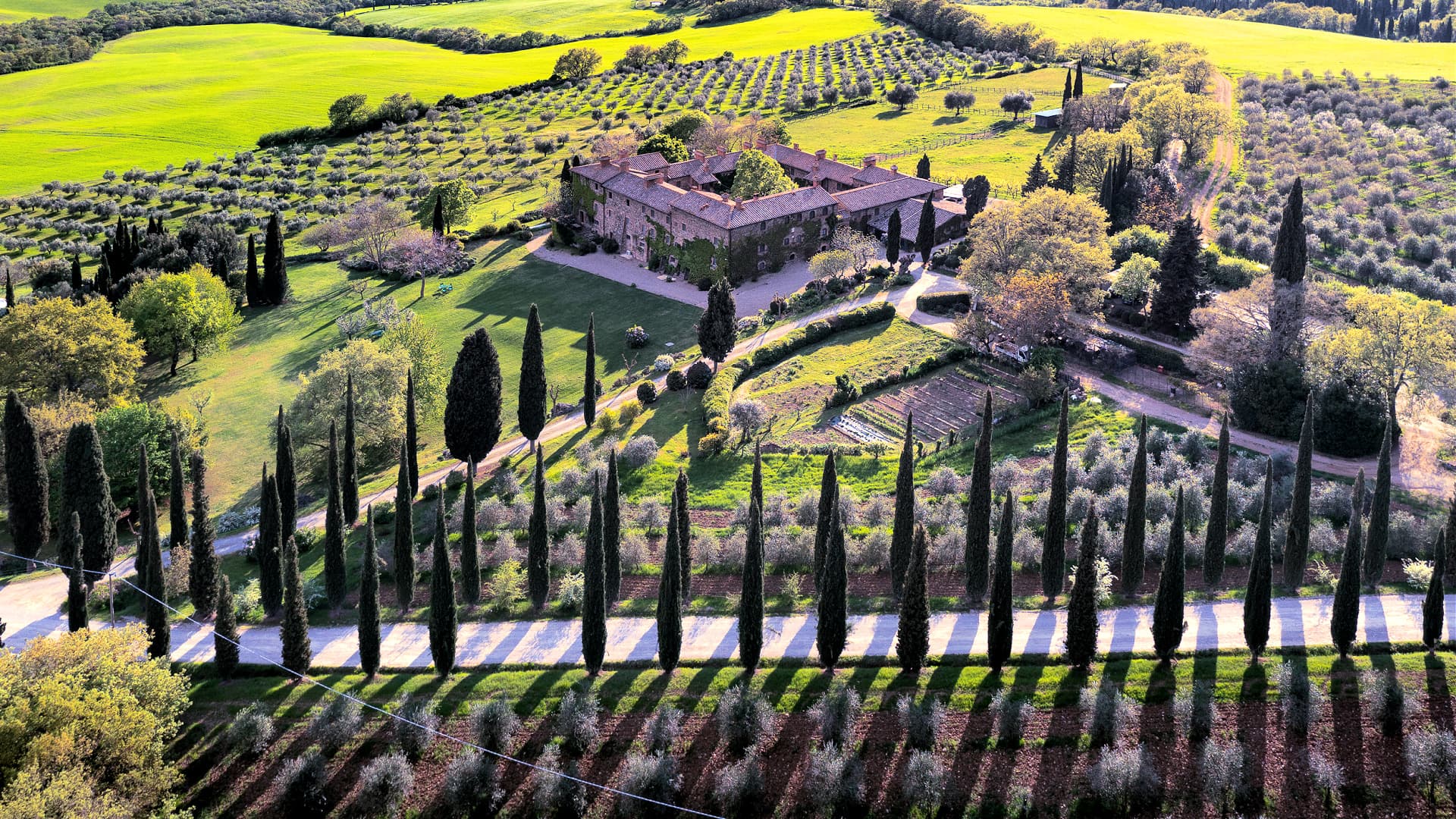
Chiarentana in the heart of Tuscany’s Val d’Orcia
“This estate was part of the vast farm run by my parents, Iris and Antonio, who arrived from Florence in the Valley of the Orcia River in the early 1920s, when this area was still unknown to the world,” Origo told Olive Oil Times.
Born Iris Margaret Cutting, Iris Origo was an Anglo-Irish writer whose literary work earned her a place among the leading chroniclers of 20th-century Italy. After meeting Italian nobleman Antonio Origo in Florence, the couple married in 1924 and soon settled at La Foce, a 3,000-hectare (7,413-acre) estate in a state of neglect near Chianciano Terme.
“Back then, this territory was plagued by aridity and poverty,” Origo said. “My parents undertook a major reclamation project and devoted their lives to improving conditions for the 58 sharecropping families who lived there.”
They built nearly fifty new farmhouses, along with schools, a hospital, a store, and a workers’ recreation center — transforming the once-barren valley into a thriving landscape.
“The interventions they carried out form the foundation of what Val d’Orcia is today,” Origo emphasized.
One of those farmsteads was Chiarentana, recalled in Iris Origo’s memoir War in Val d’Orcia . The book intertwines historical depth and personal witness, recounting how the Origos sheltered dozens of evacuated children and displaced people during 1943–44 — civilians, soldiers, and partisans resisting the Nazi-Fascist regime — all finding refuge on their estate.
In what The New York Times called “a remarkably moving document,” the courage and compassion of the Origos transcend ideology and remain strikingly relevant today.
After their parents’ passing in the late 1970s, Donata and her sister Benedetta inherited the estate. “My sister devoted herself to La Foce, while I took charge of Chiarentana,” Origo said.
“Alongside running the farm, I later became involved in something completely different,” she added. “From 1990 to 2000, I chaired the Arché association in Rome, which provided psychosocial support to HIV-positive children and their families.”
“At that time, hospitals focused on medical treatment, while psychological and social needs were largely overlooked,” she explained. “These children were often marginalized and faced extremely difficult circumstances. Our work was demanding but sustained by the dedication of many volunteers.”
Throughout the 1990s, Origo welcomed families to Chiarentana each summer. “After home care in Rome, I hosted them here so they could rest and enjoy a real vacation,” she recalled. “Once life-saving medicines became available, I chose to continue my work in Africa.”
From 2000 to 2004, she expanded her efforts through a project in Zimbabwe. She later worked as a consultant for the World Health Organization in Ethiopia, Tanzania, and Kenya, training nurses and social workers.
“My mother always cared deeply for children. After losing a son to meningitis at eight years old, that devotion grew even stronger,” Origo added. “During the war, she opened her farm to displaced children, offering safety and protection. That spirit of care is the legacy she passed on to me.”
Over the past two decades, Origo has devoted herself to Chiarentana, managing a 550-hectare (1,360-acre) farm, including 10 hectares of olive groves with 2,800 trees surrounding the farmhouse.
“The olive groves retain a traditional planting layout. In the 1980s, I replanted many trees, focusing on Tuscan varieties such as Frantoio, Leccino, Moraiolo, Pendolino, and Maurino, which we use for our Chiarentana blend,” Origo said. “We also grow some Umbrian varieties for our Confini blend and craft Cavalli, a Moraiolo-dominant blend, along with monovarietals like our Maurino, depending on the harvest.”
Olives are pressed at a state-of-the-art mill in Cetona to ensure the highest quality of extraction.
“In recent years, we have faced growing challenges,” Origo noted. “Climate change has brought extreme weather and increased pests like the olive fruit fly. Yet we remain committed to quality and sustainability, to protect the health and beauty of this landscape.”
Chiarentana offers accommodations in farmhouses and apartments, and its restaurant welcomes guests by request. Visitors can also join guided tastings and pairing lunches.
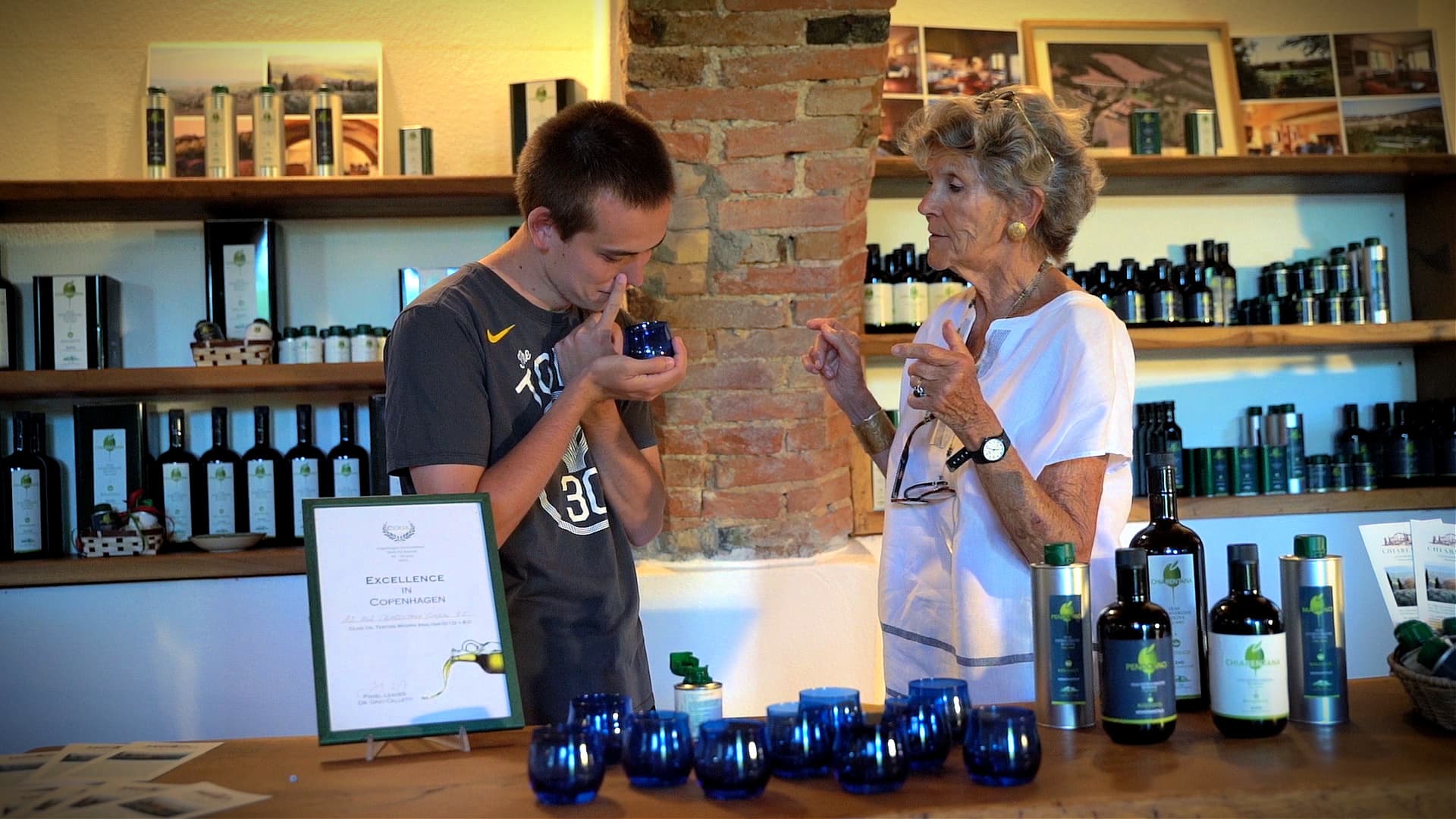
Donata Origo and her grandson Matthew during an olive oil tasting
“When tasting our oils and pairing them with food, guests are truly fascinated,” Origo said. “For many, it’s their first encounter with olive oil, and we’re delighted to guide them through the experience — explaining how to recognize a quality extra virgin olive oil and sharing the story behind our farm.”
“Spreading olive oil culture and telling our story allow us to celebrate and safeguard Val d’Orcia’s unique heritage,” she added. “We uphold the humanitarian spirit that inspired my parents, seeing quality not as an end but as a responsibility — to the land, its people, and the values that endure here.”