Italy Crowns Pruning Champ
Olive tree pruning is an ancient craft, and skilled pruners can have a major effect on a farm’s quality and yield. In Italy, the importance of proper pruning is highlighted at an annual competition.
The 14th national championship of olive tree pruning was held at an experimental farm in Montopoli di Sabina (Latium). Sixty participants, selected through regional competitions competed, with saws and pole pruners, trimmed three plants, each within 30 minutes.
The competition was organized by ASSAM in collaboration with Nova Agricultura, Latium Region and the Regional Agency for Development and Innovation of Agriculture in Latium Arsial.
The jury, chaired by Franco Famiani and composed by Barbara Alfei, Salvatore De Angelis, Luciano Pollastri and Antonio Montinaro, evaluated the performances based on five parameters: the number and shape of the peaks, balance and disposition of primary branches, number and disposition of secondary branches, vegetative-productive balance and conformity to the ideal shape.

Riccardo Macari, Italy’s olive tree pruning champion
The president of the scientific committee, Giorgio Pannelli, led spectators to a better knowledge of the structure of the polyconic vase and the management of the olive grove, through demonstrations in the field.
Riccardo Macari, 30 years old, was the winner. An olive oil taster, agriculturist, professional olive tree pruner, farmer and food and wine guide, Macari started to prune when he was only 13 years old.
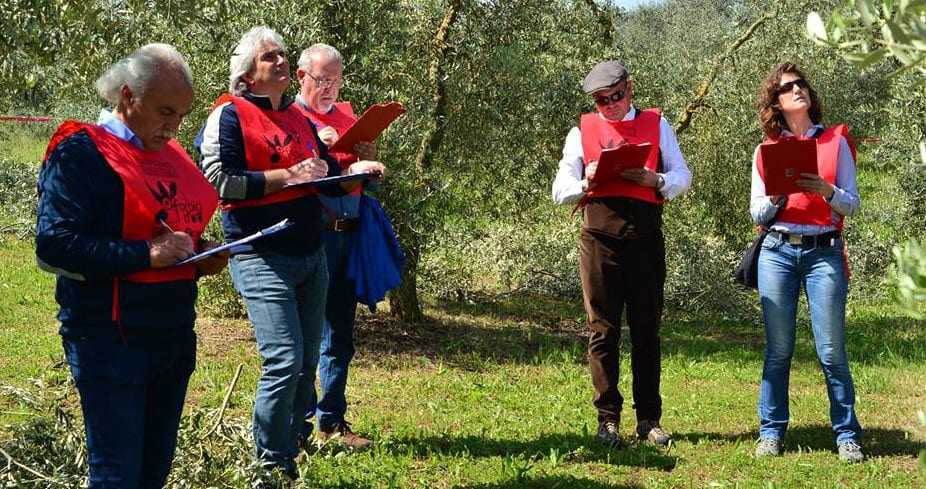
Judges of Italy’s national pruning championship
“This award is a great satisfaction,” he said, adding that he was seeking professional experience abroad to “enrich my knowledge at international level.”
Another young pruner, Gioele Gaspari, 19, won in the competition category dedicated to schools finished sixth overall. Gaspari attends the Technical Agricultural Institute in Pesaro (Marche) and started to prune only last year. “I am so glad of this award and now I want to start a real profession in olive growing and pruning,” said the young champion.
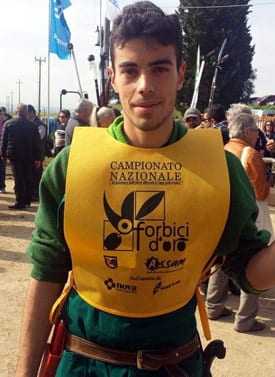
Gioele Gaspari
The outstanding biodiversity that embellishes landscapes of the Italian peninsula has its own yearly showcase in the National Exhibition of Monovarietal Extra Virgin Olive Oils. Organized by the Marche Agri-Food Sector Service Agency ASSAM and the Marche Region the event has become a reference point on the chemical and sensory characteristics of extra virgin olive oils obtained from native varieties.
The president of the scientific committee of the event and panel leader, Barbara Alfei, noted, “540 officially recognized varieties represent a real treasure for Italy and our goal is to exalt and draw attention on the peculiarities of every cultivar. Our objective is going beyond the quality that provides the minimum requirements of extra virginity…and show the identity of the product, which is realized by the inseparable coupling of variety and territory.”
On April 23 and 24 in Ascoli Piceno (Marche), 48 companies from all Italian regions presented EVOOs selected by the regional panel ASSAM. The exhibition included debates and updates for technicians, producers, expert tasters and consumers, along with the 9th edition of a ‘Guess the variety’ competition, seen as an incentive to recognize the different sensory peculiarities.
“Each variety gives a specific extra virgin olive oil with regard to analytical parameters, which means its composition in fatty acids and polyphenols but above all sensory attributes, that provide the consumer a perception of this multifaceted biodiversity,” Alfei explained.
The samples received each year have been used to create a database that currently consists of over 2,600 extra virgin olive oils, to characterize monovarietals and analyze the effects of genotype, territory and seasonal pattern on their analytical and sensory composition. This year, 308 samples were submitted from 18 regions, of which 241 from 94 varieties will be included in the database.