New Method for Identifying Olive Cultivars
The identification olive cultivars according to the appearance of leaves and fruit is expected to serve as the basis for a phone app and contributions to a new international olive tree database.
A new semi-automatic methodology for identifying olive cultivars according to the appearance of leaves and fruit is intended to serve as the basis for a phone app for producers and contributions to a new international olive tree database, according to Konstantinos Blazakis, a researcher working with Panagiotis Kalaitzis in the Department of Horticultural Genetics and Biotechnology at the Mediterranean Agronomic Institute of Chania (MAICh) in Crete, Greece.
Blazakis hopes one application of this new method will be a cell phone app that can identify the cultivar from a photo of an olive fruit, leaf, or endocarp. He expects to start with Greek cultivars within the next year or two and hopes to gain support to add international cultivars to this app as a supplementary project later. He admits that the cell phone app will probably be most helpful in countries with many different olive varieties, as farmers want to be sure they know which cultivar they have.
Another of Blazakis’s goals is to contribute to a new international online database that will catalog information on the appearance and chemical analysis of olive varieties worldwide, among other things. He said fifteen partners from several countries are working together to prepare this user-friendly database for the general public, which will be “based on the genetic, physiological, molecular, and morphological study of each cultivar.” The researchers intend to incorporate previously collected, double-checked data, as well as add new information.
This is part of the wide-ranging, ambitious Bioresources For Oliviculture, or BeFOre, project, which has received funding from the European Union’s Horizon 2020 research and innovation program under the Marie Skłodowska-Curie grant agreement and is also supported by the International Olive Council.
BeFOre is “focused on establishing integrated common protocols to phenotype and characterize plants at molecular, morphological and physiological level, and evaluating the olive oil quality related to varieties,” according to its website, “expecting to improve the potential of the Olive Germplasm collections, repositories and banks as main sources of variability and of evaluation tools to be used to increase sustainability of oliviculture and to face existing and arising problems.”
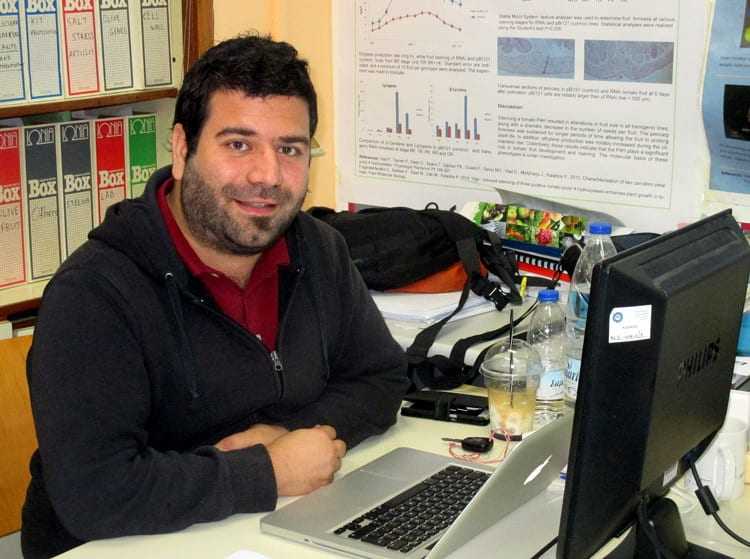
Konstantinos Blazakis (Lisa Radinovsky)
Emphasizing the importance of evaluating and characterizing the diversity of olive species to preserve the rich variety of genetic resources and their distinct health benefits, Blazakis focuses on the form and structure, or morphology, of olives, olive trees, and their leaves.
At the 3rd International Symposium on Horticulture in Europe in Chania, Crete in mid-October, Blazakis presented the work he is doing in collaboration with Luciana Baldoni and Marina Bufacchi from the Italian National Research Council, Abdelmajid Moukhli from INRA Marrakech in Morocco, and Panagiotis Kalaitzis from MAICh (which is part of the International Center for Advanced Mediterranean Agronomic Studies).
In a presentation titled “Advanced Mathematical Algorithms to Characterize Olive Varieties through Morphological Parameters,” Blazakis explained that his “study aims to present a completely new semi-automatic methodology for detecting various morphological parameters” of different olive cultivars. His method involves 5 steps:
- collect samples of leaves and fruit: 25 or 30 from the middle of a tree whose variety has been determined at a nursery
- create imaging data: take photos of them
- segmentation: separate the picture of the leaves, olives, or seeds from the background using scientific software
- apply mathematical algorithms: use MATLAB software to create a set of instructions related to various aspects of the olive’s or leaf’s form and structure, for example (for the fruit) area, perimeter, height, maximum width, position of maximum width, symmetry or lack of symmetry, ellipse shape, curvature, nipple
- translate results: end up with numbers that describe each aspect of the form and structure of each olive cultivar
Blazakis mentioned that it is necessary to run additional tests to ensure that the morphological parameters his team is working with can distinguish among different cultivars, but he believes they will succeed. He added that the automated tool he is developing will provide a faster, less expensive method for determining an olive cultivar than DNA analysis and will offer a valuable option for many farmers seeking information about their trees.