Farmer Producesextra virgin olive oil from Rescued and Newly Discovered Olive Varieties
La Zadruga is a farm on the west bank of Lake Garda which produces high-quality EVOO from rare, rescued and newly discovered varieties.
“Our goal is to protect olive biodiversity and rescue forgotten varieties,” said Sergio Cozzaglio, owner with his wife, Ilaria Galetti, of La Zadruga, a farm located in Toscolano Maderno, on the west bank of Lake Garda. “At some point, I noticed plants with particular traits, which made them different from all the renowned varieties spread in the area and widely reported,” he explained. “Therefore, I focused on a monovarietal approach and I began to test the different varieties.”
Cozzaglio, thanks to his remarkable knowledge of anything that concerns the olive tree (he is also a former winner of the national championship of olive tree pruning), started research work by consulting local elders which had memory of names and use of cultivars that in the last decades have been set aside, and found concrete evidence of the presence of plants that still have not been officially recognized. The consistent presence of ‘Negrel’ in the territory was confirmed by experts at the Interprovincial Association of Olive Producers of Lombardy Aipol, in collaboration with academic specialists.
Negrel is now waiting for DNA mapping and the official classification. “I discovered that it was collected in single variety harvests, with a very high yield, from the 1930s to the 1950s and the etymology of the name is uncertain since documents are missing, but probably it comes from the dark color of the fruits.”
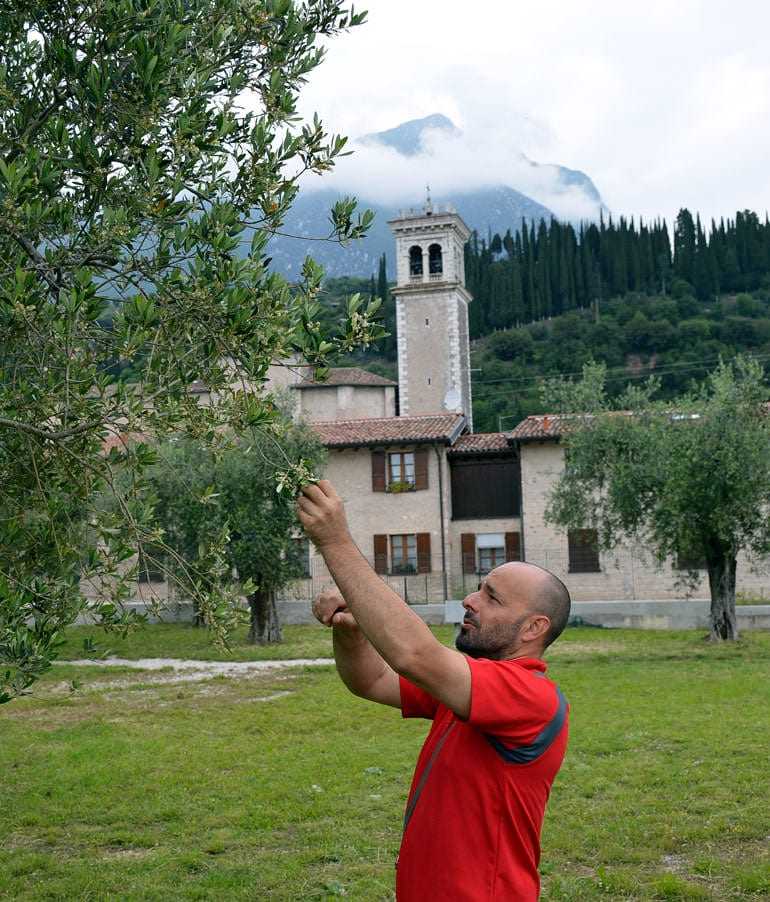
Sergio Cozzaglio at Villa Roman
La Zadruga were the first to produce a monovarietalextra virgin olive oil from another rare variety, Miniol, whose name probably derives from Latin ‘minus,’ due to its small size. Some unofficial sources said it is cultivated only on Lake Garda and in small areas in Argentina. The most likely scenario is that it was probably brought overseas at the end of 19th century by an immigrant farmer.
“Harvest of uncommon varieties can be complex since olive groves register only a small number of these plants among the most common ones, and this forces us to carry out itinerant harvests.” Therefore, a tour of olive groves or an exchange of varieties with other farmers is needed to reach the amount requested by clients. A very well organized harvest is essential to bring olives from different plots to the mill strictly within 10-12 hours.
The archaeological site ‘Roman Villa’ (Villa Romana) is a first-century building belonged to the ancient family of Nonii Arrii. Enriched by exquisite mosaic floors and painted plasters, it is located on a beautiful terrace overlooking the lake and includes an olive grove that has been entrusted by the municipality to local farmers with the aim to exalt the local olive oil production.
From this olive grove, Cozzaglio produces an award-winning blend consisting of Casaliva, Grignan, Leccino, and a brand new variety that he discovered four years ago. “I noticed these plants with an erect growth habit and their own agronomic characteristics,” Cozzaglio revealed. Now, with the experts at Aipol, in collaboration with the University of Milan, he is trying to classify the uncharted variety which, for the moment, is called ‘Villa Romana.’
“While Mother Nature provides us with unique varieties thanks to which we can produce our green gold, our papermakers offer us a special material made with knowledge and experience, according to techniques from the fourteenth century,” said Ilaria Galetti, who takes care of sales and gives her personal touch to the packaging, reaffirming the importance of identity and connection with the territory that has a long tradition in paper production. “It was a great opportunity to combine these two local excellences. Our packaging is enriched by hand-made paper which shows features of each cultivar: the innovation and traditions of ‘Made in Italy’ in one product.”
Our interview finished when it was time to go back to work in the olive grove. “For me taking care of olive trees is not only a work, it is a real passion,” our farmer revealed.