Liguria Region Launches Innovative Olive Farming Project with AI and Smart Sensors
Liguria, Italy funds experimental project using smart sensors, AI, and drones to optimize olive farming and improve quality of Riviera Ligure PDO oil.
The Liguria region in northwestern Italy is financing an 18-month experimental project to optimize olive farming through new technological architecture.
Based on a network of smart sensors that detect real-time soil and plant conditions in olive orchards, the system will use artificial intelligence to interpret the data and provide growers with valuable insights and advice.
Liguria is home to more than 740,000 olive trees and dozens of cultivars. The region’s flagship product is the high-quality Riviera Ligure PDO (Protected Designation of Origin) extra virgin olive oil.
See Also: Leveraging AI to Enhance Olive Oil Quality, Efficiency and Trust“This experiment is the result of a partnership among several local public and private entities involved in developing advanced technologies in engineering, IT and telecommunications,” Federico Tinivella, project leader at the publicly-owned Center for Agricultural Experimentation and Assistance (CeRSAA), told Olive Oil Times.
“They are all experts in sensor technologies and in enabling different sensors to communicate with each other,” he added.
According to the project’s promoters, some of the innovation lies in transferring to olive farming a range of technologies already used to monitor and improve the efficiency of industrial processes.
These include familiar tools such as weather stations for tracking environmental conditions in the field, though others are more advanced.
“One smart thermometer is placed in an elevated position where it can read the infrared radiation of the olive tree canopy and detect leaf temperature,” Tinivella said. “That indirectly indicates the potential water stress the plant is experiencing.”
Other sensors focus on soil conditions, analyzing the percentage of nutrients such as nitrogen, phosphorus and potassium.
“They also measure oxygen levels in the soil, which provide useful information, for example, to monitor the health of the tree’s root system,” Tinivella said.
One sensor detects the amount of water on olive tree leaves. Another sensor being developed for the project focuses on identifying parasites, such as the olive fruit fly, and also serves as a smart trap.
“It will attract the fruit fly and will be able to identify it. Once the AI system has been trained, it will recognize the insect and alert us to its presence,” Tinivella said.
Other smart sensors are designed to track fungi presence and others to deter wild boars from entering the orchards.
Given the mountainous nature of the Ligurian landscape, many olive groves are located on terraces, which are constantly threatened by wild boars that dig up the orchards and damage the terrace walls.
“Essentially, it is a photo trap that detects the animals and emits loud, constantly varying sounds,” Tinivella said. “Since the sounds change every time they blast, the boars are unable to recognize them, making the noise an effective deterrent.”
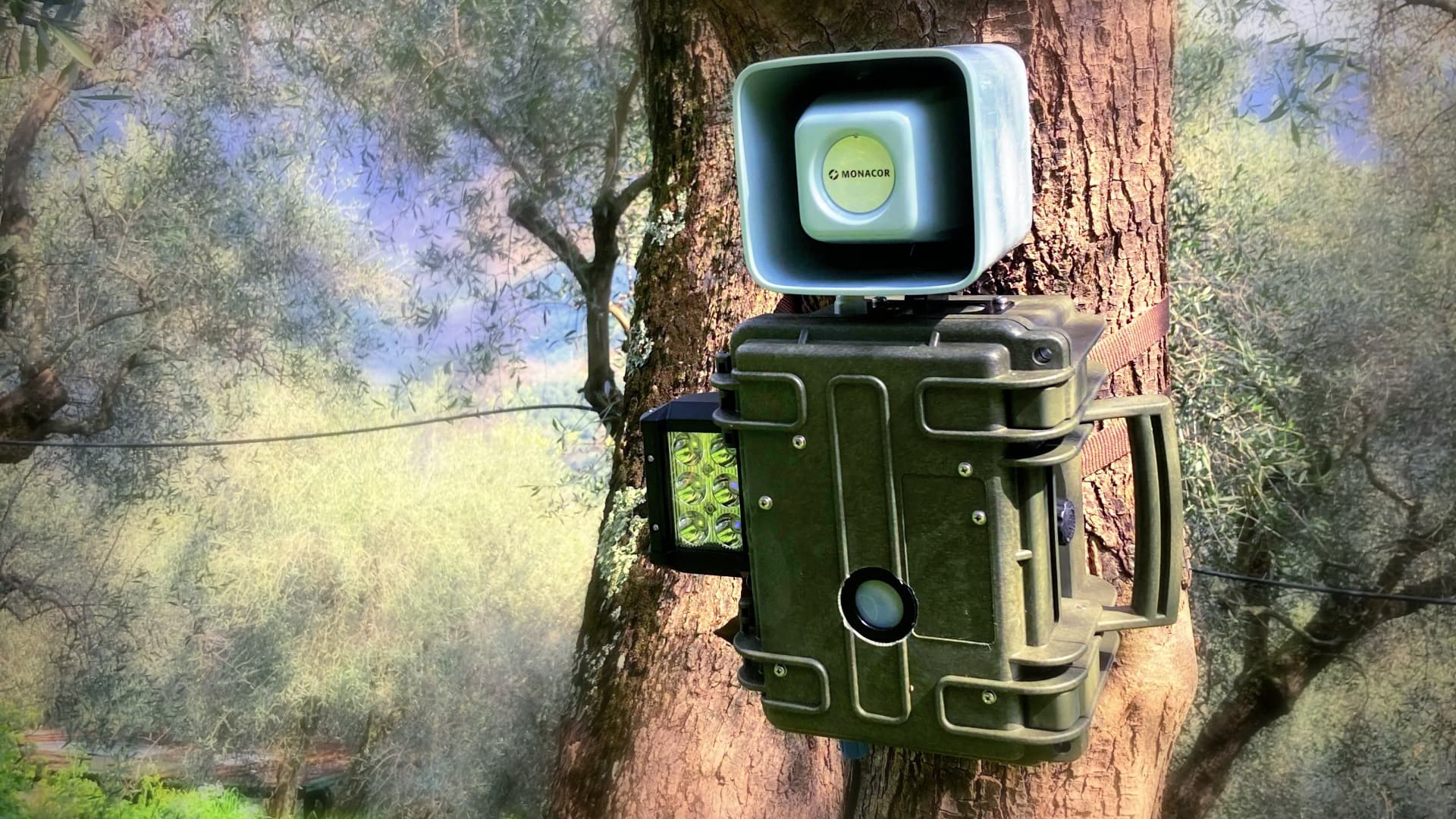
Sensors on the trees help detect water stress and pest activity among other metrics. (Photo: Riviera Ligure PDO Consortium)
Specific sensors also monitor air quality in the field, such as the presence and concentration of carbon dioxide.
Others are being developed to detect and measure specific substances in the soil.
“One example is Katerina, a gamma-ray spectrometer,” Tinivella said. “This instrument uses techniques that detect atomic behavior and analyze specific spectra. The goal is to determine, for instance, how much potassium is in the soil.”
This technology is being installed in an olive orchard associated with Riviera Ligure PDO productions.
The artificial intelligence platform analyzes the data coming from the field and presents it on the grower’s dashboard. This data can become a comprehensive decision support system.
“By training the AI engine, the system will be able to offer useful advice to the grower,” Tinivella said. “The system will alert us when certain conditions occur that may require a decision.”
Examples include irrigating the trees when water stress is detected or applying fertilization treatments tailored to the soil and plant conditions.
“This project can definitely help improve the outlook for Ligurian olive production,” said Giorgio Lazzaretti, consortium director for protecting Riviera Ligure PDO extra virgin olive oil.
“It’s not the only initiative. We’re also experimenting with drones to maintain olive groves, a project we’re conducting in collaboration with Lombardy’s regional institutions,” he added.
The drone project explores the use of large aerial drones to apply targeted treatments to olive trees.
This technology could easily be integrated into the artificial intelligence platform being developed.
“The experiment will continue throughout 2025 and will also focus on combating olive fruit fly infestations,” Lazzaretti said.
“In an initial test, the olive orchard was mapped, and then the drone could automatically move from one tree to another to apply treatments,” he added.
These aerial drones can carry heavy loads and operate more sustainably and quickly than traditional methods, regardless of terrain.
“What we’ve seen is that when a drone treats a plant, its rotors push the substances exactly where they need to go, drastically reducing drift,” Tinivella remarked.
“The biggest issue with deploying this technology is the complex bureaucracy surrounding drone use,” Lazzaretti said. “A large amount of paperwork is already required just to carry out the experiments.”
These smart drones can deliver treatments very quickly.
“We’ve seen from early trials that they can cover hectares of olive groves in just minutes,” he said. “And of course, they can also easily access the more difficult areas of the groves, especially in mountainous regions.”
“We can only hope that our results and the research behind them will encourage Italian and European lawmakers to draft regulations specifically for the use of aerial drones in agriculture,” Lazzaretti added.
According to the project promoters, combining drone technology with artificial intelligence and an expanding network of smart sensors could revolutionize productivity in traditional olive groves.
This would be a crucial development for Italian olive farming, which is deeply rooted in traditional growing methods.